

214
A. Ikehata
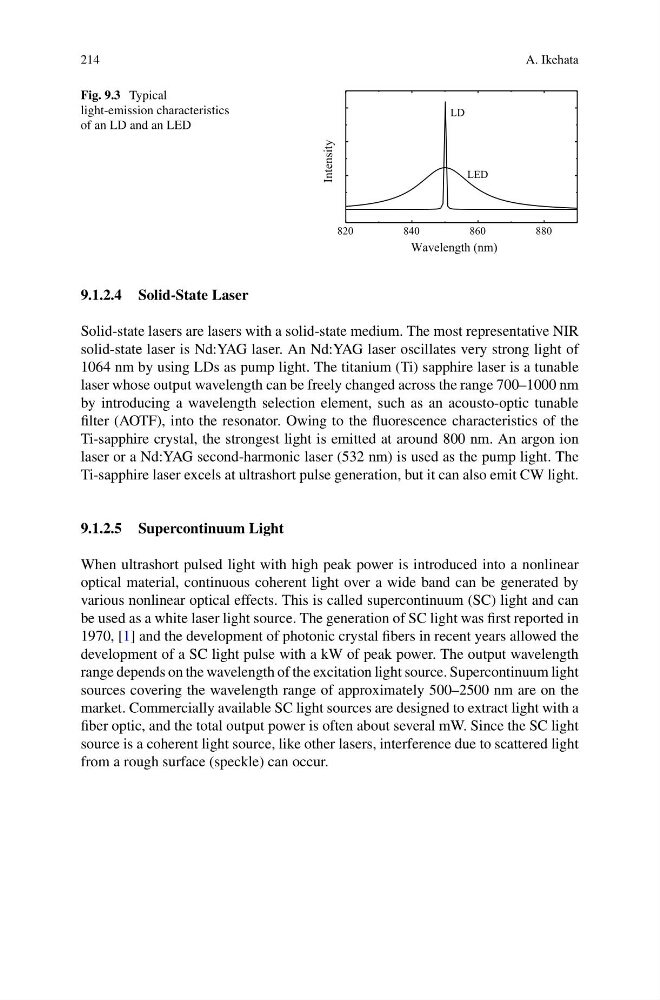
Fig. 9.3 Typical
light-emission characteristics
of an LD and an LED
LD
LED
820
840
860
880
Wavelength (nm)
Intensity
9.1.2.4 Solid-State Laser
Solid-state lasers are lasers with a solid-state medium. The most representative NIR
solid-state laser is Nd:YAG laser. An Nd:YAG laser oscillates very strong light of
1064 nm by using LDs as pump light. The titanium (Ti) sapphire laser is a tunable
laser whose output wavelength can be freely changed across the range 700–1000 nm
by introducing a wavelength selection element, such as an acousto-optic tunable
filter (AOTF), into the resonator. Owing to the fluorescence characteristics of the
Ti-sapphire crystal, the strongest light is emitted at around 800 nm. An argon ion
laser or a Nd:YAG second-harmonic laser (532 nm) is used as the pump light. The
Ti-sapphire laser excels at ultrashort pulse generation, but it can also emit CW light.
9.1.2.5 Supercontinuum Light
When ultrashort pulsed light with high peak power is introduced into a nonlinear
optical material, continuous coherent light over a wide band can be generated by
various nonlinear optical effects. This is called supercontinuum (SC) light and can
be used as a white laser light source. The generation of SC light was first reported in
1970, [1] and the development of photonic crystal fibers in recent years allowed the
development of a SC light pulse with a kW of peak power. The output wavelength
range depends on the wavelength of the excitation light source. Supercontinuum light
sources covering the wavelength range of approximately 500–2500 nm are on the
market. Commercially available SC light sources are designed to extract light with a
fiber optic, and the total output power is often about several mW. Since the SC light
source is a coherent light source, like other lasers, interference due to scattered light
from a rough surface (speckle) can occur.
A. Ikehata
Fig. 9.3 Typical
light-emission characteristics
of an LD and an LED
LD
LED
820
840
860
880
Wavelength (nm)
Intensity
9.1.2.4 Solid-State Laser
Solid-state lasers are lasers with a solid-state medium. The most representative NIR
solid-state laser is Nd:YAG laser. An Nd:YAG laser oscillates very strong light of
1064 nm by using LDs as pump light. The titanium (Ti) sapphire laser is a tunable
laser whose output wavelength can be freely changed across the range 700–1000 nm
by introducing a wavelength selection element, such as an acousto-optic tunable
filter (AOTF), into the resonator. Owing to the fluorescence characteristics of the
Ti-sapphire crystal, the strongest light is emitted at around 800 nm. An argon ion
laser or a Nd:YAG second-harmonic laser (532 nm) is used as the pump light. The
Ti-sapphire laser excels at ultrashort pulse generation, but it can also emit CW light.
9.1.2.5 Supercontinuum Light
When ultrashort pulsed light with high peak power is introduced into a nonlinear
optical material, continuous coherent light over a wide band can be generated by
various nonlinear optical effects. This is called supercontinuum (SC) light and can
be used as a white laser light source. The generation of SC light was first reported in
1970, [1] and the development of photonic crystal fibers in recent years allowed the
development of a SC light pulse with a kW of peak power. The output wavelength
range depends on the wavelength of the excitation light source. Supercontinuum light
sources covering the wavelength range of approximately 500–2500 nm are on the
market. Commercially available SC light sources are designed to extract light with a
fiber optic, and the total output power is often about several mW. Since the SC light
source is a coherent light source, like other lasers, interference due to scattered light
from a rough surface (speckle) can occur.