

9 NIR Optics and Measurement Methods
213
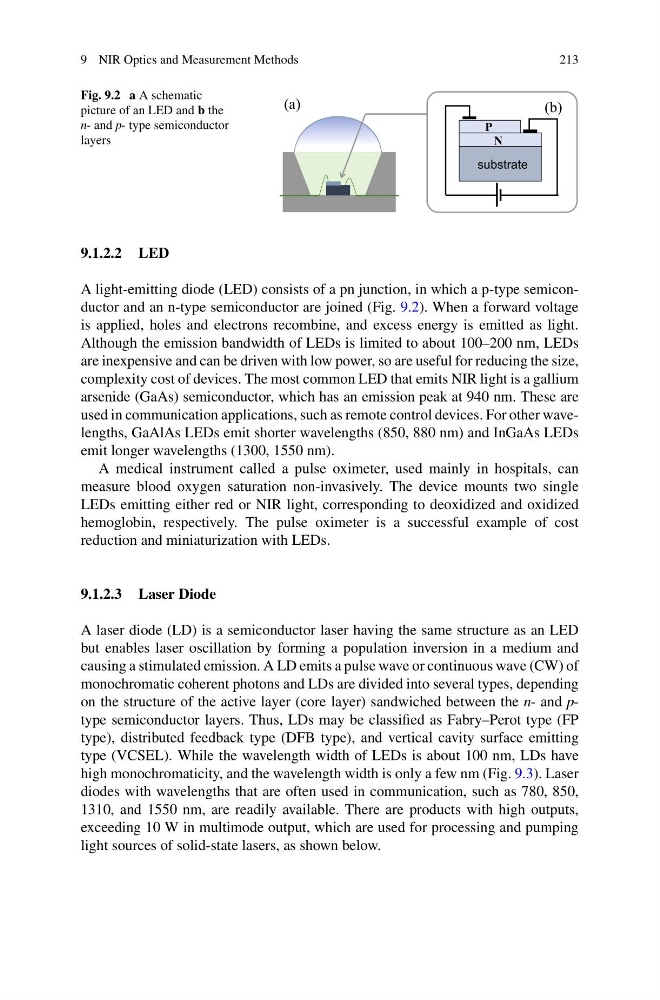
Fig. 9.2 a A schematic
picture of an LED and b the
n- and p- type semiconductor
layers
P
N
substrate
(a)
(b)
9.1.2.2 LED
A light-emitting diode (LED) consists of a pn junction, in which a p-type semiconductor and an n-type semiconductor are joined (Fig. 9.2). When a forward voltage
is applied, holes and electrons recombine, and excess energy is emitted as light.
Although the emission bandwidth of LEDs is limited to about 100–200 nm, LEDs
are inexpensive and can be driven with low power, so are useful for reducing the size,
complexity cost of devices. The most common LED that emits NIR light is a gallium
arsenide (GaAs) semiconductor, which has an emission peak at 940 nm. These are
used in communication applications, such as remote control devices. For other wavelengths, GaAlAs LEDs emit shorter wavelengths (850, 880 nm) and InGaAs LEDs
emit longer wavelengths (1300, 1550 nm).
A medical instrument called a pulse oximeter, used mainly in hospitals, can
measure blood oxygen saturation non-invasively. The device mounts two single
LEDs emitting either red or NIR light, corresponding to deoxidized and oxidized
hemoglobin, respectively. The pulse oximeter is a successful example of cost
reduction and miniaturization with LEDs.
9.1.2.3 Laser Diode
A laser diode (LD) is a semiconductor laser having the same structure as an LED
but enables laser oscillation by forming a population inversion in a medium and
causing a stimulated emission. A LD emits a pulse wave or continuous wave (CW) of
monochromatic coherent photons and LDs are divided into several types, depending
on the structure of the active layer (core layer) sandwiched between the n- and ptype semiconductor layers. Thus, LDs may be classified as Fabry–Perot type (FP
type), distributed feedback type (DFB type), and vertical cavity surface emitting
type (VCSEL). While the wavelength width of LEDs is about 100 nm, LDs have
high monochromaticity, and the wavelength width is only a few nm (Fig. 9.3). Laser
diodes with wavelengths that are often used in communication, such as 780, 850,
1310, and 1550 nm, are readily available. There are products with high outputs,
exceeding 10 W in multimode output, which are used for processing and pumping
light sources of solid-state lasers, as shown below.
213
Fig. 9.2 a A schematic
picture of an LED and b the
n- and p- type semiconductor
layers
P
N
substrate
(a)
(b)
9.1.2.2 LED
A light-emitting diode (LED) consists of a pn junction, in which a p-type semiconductor and an n-type semiconductor are joined (Fig. 9.2). When a forward voltage
is applied, holes and electrons recombine, and excess energy is emitted as light.
Although the emission bandwidth of LEDs is limited to about 100–200 nm, LEDs
are inexpensive and can be driven with low power, so are useful for reducing the size,
complexity cost of devices. The most common LED that emits NIR light is a gallium
arsenide (GaAs) semiconductor, which has an emission peak at 940 nm. These are
used in communication applications, such as remote control devices. For other wavelengths, GaAlAs LEDs emit shorter wavelengths (850, 880 nm) and InGaAs LEDs
emit longer wavelengths (1300, 1550 nm).
A medical instrument called a pulse oximeter, used mainly in hospitals, can
measure blood oxygen saturation non-invasively. The device mounts two single
LEDs emitting either red or NIR light, corresponding to deoxidized and oxidized
hemoglobin, respectively. The pulse oximeter is a successful example of cost
reduction and miniaturization with LEDs.
9.1.2.3 Laser Diode
A laser diode (LD) is a semiconductor laser having the same structure as an LED
but enables laser oscillation by forming a population inversion in a medium and
causing a stimulated emission. A LD emits a pulse wave or continuous wave (CW) of
monochromatic coherent photons and LDs are divided into several types, depending
on the structure of the active layer (core layer) sandwiched between the n- and ptype semiconductor layers. Thus, LDs may be classified as Fabry–Perot type (FP
type), distributed feedback type (DFB type), and vertical cavity surface emitting
type (VCSEL). While the wavelength width of LEDs is about 100 nm, LDs have
high monochromaticity, and the wavelength width is only a few nm (Fig. 9.3). Laser
diodes with wavelengths that are often used in communication, such as 780, 850,
1310, and 1550 nm, are readily available. There are products with high outputs,
exceeding 10 W in multimode output, which are used for processing and pumping
light sources of solid-state lasers, as shown below.