

9 NIR Optics and Measurement Methods
215
9.1.3 Spectroscopic Elements
9.1.3.1 Prism
A prism is a classic feature of spectroscopes and is still sometimes used today.
Because the refractive index of the prism differs depending on the wavelength (this
is called “wavelength dispersion” or simply “dispersion”), incident light is emitted in
different angles. Many optical materials highly disperse NIR light, so that good wavelength resolution is possible. However, the internal transmittance itself is inadequate.
Consequently, most dispersion-type NIR spectrometers currently on the market use
diffraction gratings to replace prisms, as described below.
9.1.3.2 Diffraction Grating
A diffraction grating is a dispersive element that diffracts white light into constituent
wavelengths. The prototype was made by Fraunhofer in 1814, [2] and it has been
widely commercially available since 1945 [3]. The spectral characteristics of a
prism depend on its physical properties (refractive index), while the characteristics
of a diffraction grating are determined only by the geometric structure. In general, a
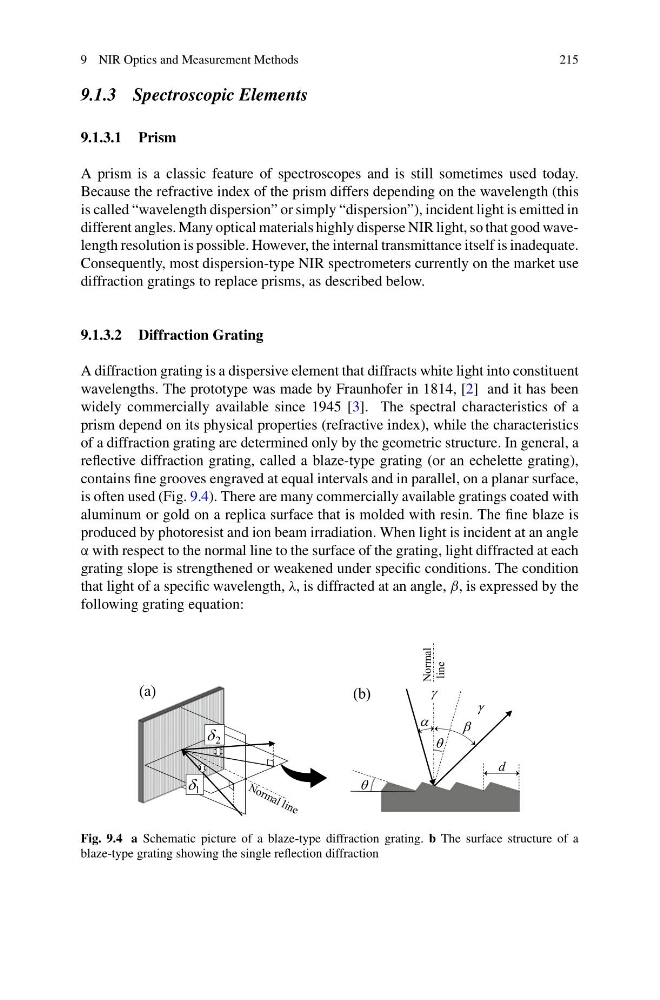
reflective diffraction grating, called a blaze-type grating (or an echelette grating),
contains fine grooves engraved at equal intervals and in parallel, on a planar surface,
is often used (Fig. 9.4). There are many commercially available gratings coated with
aluminum or gold on a replica surface that is molded with resin. The fine blaze is
produced by photoresist and ion beam irradiation. When light is incident at an angle
α with respect to the normal line to the surface of the grating, light diffracted at each
grating slope is strengthened or weakened under specific conditions. The condition
that light of a specific wavelength, λ, is diffracted at an angle, β, is expressed by the
following grating equation:
Fig. 9.4 a Schematic picture of a blaze-type diffraction grating. b The surface structure of a
blaze-type grating showing the single reflection diffraction
215
9.1.3 Spectroscopic Elements
9.1.3.1 Prism
A prism is a classic feature of spectroscopes and is still sometimes used today.
Because the refractive index of the prism differs depending on the wavelength (this
is called “wavelength dispersion” or simply “dispersion”), incident light is emitted in
different angles. Many optical materials highly disperse NIR light, so that good wavelength resolution is possible. However, the internal transmittance itself is inadequate.
Consequently, most dispersion-type NIR spectrometers currently on the market use
diffraction gratings to replace prisms, as described below.
9.1.3.2 Diffraction Grating
A diffraction grating is a dispersive element that diffracts white light into constituent
wavelengths. The prototype was made by Fraunhofer in 1814, [2] and it has been
widely commercially available since 1945 [3]. The spectral characteristics of a
prism depend on its physical properties (refractive index), while the characteristics
of a diffraction grating are determined only by the geometric structure. In general, a
reflective diffraction grating, called a blaze-type grating (or an echelette grating),
contains fine grooves engraved at equal intervals and in parallel, on a planar surface,
is often used (Fig. 9.4). There are many commercially available gratings coated with
aluminum or gold on a replica surface that is molded with resin. The fine blaze is
produced by photoresist and ion beam irradiation. When light is incident at an angle
α with respect to the normal line to the surface of the grating, light diffracted at each
grating slope is strengthened or weakened under specific conditions. The condition
that light of a specific wavelength, λ, is diffracted at an angle, β, is expressed by the
following grating equation:
Fig. 9.4 a Schematic picture of a blaze-type diffraction grating. b The surface structure of a
blaze-type grating showing the single reflection diffraction