

196
C. W. Huck
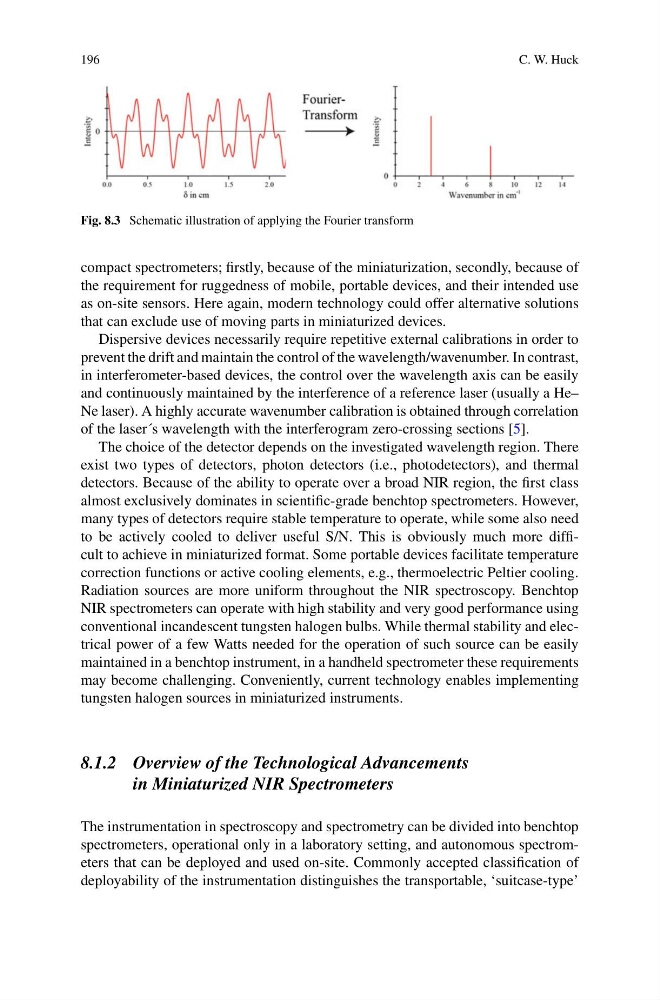
Fig. 8.3 Schematic illustration of applying the Fourier transform
compact spectrometers; firstly, because of the miniaturization, secondly, because of
the requirement for ruggedness of mobile, portable devices, and their intended use
as on-site sensors. Here again, modern technology could offer alternative solutions
that can exclude use of moving parts in miniaturized devices.
Dispersive devices necessarily require repetitive external calibrations in order to
prevent the drift and maintain the control of the wavelength/wavenumber. In contrast,
in interferometer-based devices, the control over the wavelength axis can be easily
and continuously maintained by the interference of a reference laser (usually a He–
Ne laser). A highly accurate wavenumber calibration is obtained through correlation
of the laser´s wavelength with the interferogram zero-crossing sections [5].
The choice of the detector depends on the investigated wavelength region. There
exist two types of detectors, photon detectors (i.e., photodetectors), and thermal
detectors. Because of the ability to operate over a broad NIR region, the first class
almost exclusively dominates in scientific-grade benchtop spectrometers. However,
many types of detectors require stable temperature to operate, while some also need
to be actively cooled to deliver useful S/N. This is obviously much more difficult to achieve in miniaturized format. Some portable devices facilitate temperature
correction functions or active cooling elements, e.g., thermoelectric Peltier cooling.
Radiation sources are more uniform throughout the NIR spectroscopy. Benchtop
NIR spectrometers can operate with high stability and very good performance using
conventional incandescent tungsten halogen bulbs. While thermal stability and electrical power of a few Watts needed for the operation of such source can be easily
maintained in a benchtop instrument, in a handheld spectrometer these requirements
may become challenging. Conveniently, current technology enables implementing
tungsten halogen sources in miniaturized instruments.
8.1.2 Overview of the Technological Advancements
in Miniaturized NIR Spectrometers
The instrumentation in spectroscopy and spectrometry can be divided into benchtop
spectrometers, operational only in a laboratory setting, and autonomous spectrometers that can be deployed and used on-site. Commonly accepted classification of
deployability of the instrumentation distinguishes the transportable, ‘suitcase-type’
C. W. Huck
Fig. 8.3 Schematic illustration of applying the Fourier transform
compact spectrometers; firstly, because of the miniaturization, secondly, because of
the requirement for ruggedness of mobile, portable devices, and their intended use
as on-site sensors. Here again, modern technology could offer alternative solutions
that can exclude use of moving parts in miniaturized devices.
Dispersive devices necessarily require repetitive external calibrations in order to
prevent the drift and maintain the control of the wavelength/wavenumber. In contrast,
in interferometer-based devices, the control over the wavelength axis can be easily
and continuously maintained by the interference of a reference laser (usually a He–
Ne laser). A highly accurate wavenumber calibration is obtained through correlation
of the laser´s wavelength with the interferogram zero-crossing sections [5].
The choice of the detector depends on the investigated wavelength region. There
exist two types of detectors, photon detectors (i.e., photodetectors), and thermal
detectors. Because of the ability to operate over a broad NIR region, the first class
almost exclusively dominates in scientific-grade benchtop spectrometers. However,
many types of detectors require stable temperature to operate, while some also need
to be actively cooled to deliver useful S/N. This is obviously much more difficult to achieve in miniaturized format. Some portable devices facilitate temperature
correction functions or active cooling elements, e.g., thermoelectric Peltier cooling.
Radiation sources are more uniform throughout the NIR spectroscopy. Benchtop
NIR spectrometers can operate with high stability and very good performance using
conventional incandescent tungsten halogen bulbs. While thermal stability and electrical power of a few Watts needed for the operation of such source can be easily
maintained in a benchtop instrument, in a handheld spectrometer these requirements
may become challenging. Conveniently, current technology enables implementing
tungsten halogen sources in miniaturized instruments.
8.1.2 Overview of the Technological Advancements
in Miniaturized NIR Spectrometers
The instrumentation in spectroscopy and spectrometry can be divided into benchtop
spectrometers, operational only in a laboratory setting, and autonomous spectrometers that can be deployed and used on-site. Commonly accepted classification of
deployability of the instrumentation distinguishes the transportable, ‘suitcase-type’