

8 New Trend in Instrumentation of NIR Spectroscopy …
197
and handheld spectrometers [6]. The criterion is based on the equipment weight, and
the first class groups autonomous instruments weighting over 20 kg, which means
they are deployable on field while mounted in a car. Next, an intermediate ‘suitcase’
format corresponds to equipment with weight of several kg. The handheld spectrometers are designed to be carried and operates by hand, and typically weigh under 1 kg
[6]. Such classification should be understood broadly, as fieldable instrumentation
in mass spectrometry (MS), nuclear magnetic resonance (NMR, relaxometry), or
elemental (atomic) spectroscopy such as X-ray fluorescence (XRF) or laser-induced
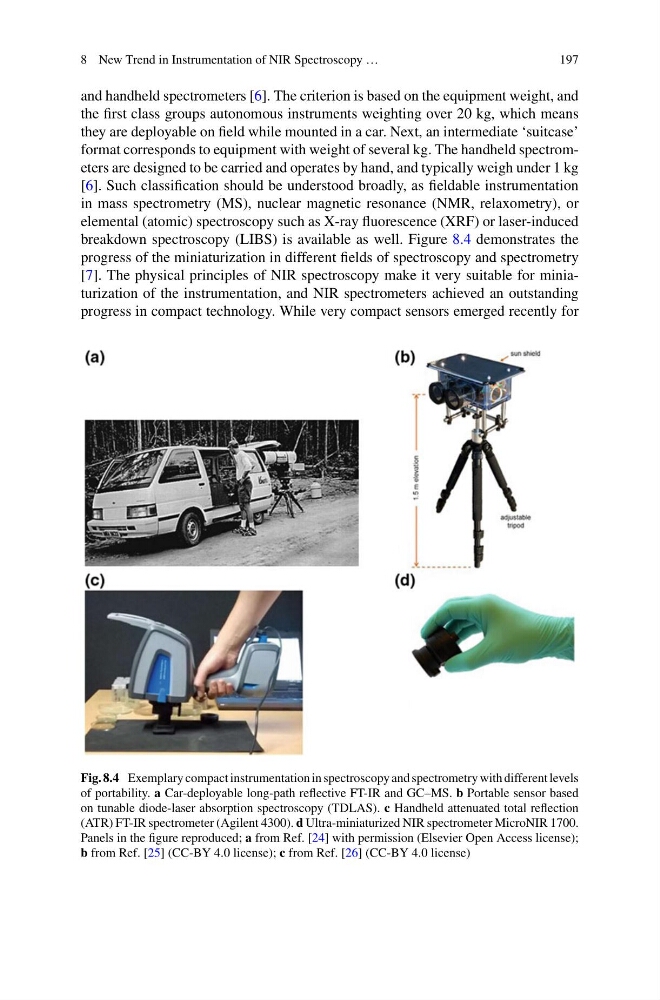
breakdown spectroscopy (LIBS) is available as well. Figure 8.4 demonstrates the
progress of the miniaturization in different fields of spectroscopy and spectrometry
[7]. The physical principles of NIR spectroscopy make it very suitable for miniaturization of the instrumentation, and NIR spectrometers achieved an outstanding
progress in compact technology. While very compact sensors emerged recently for
Fig. 8.4 Exemplary compact instrumentation in spectroscopy and spectrometry with different levels
of portability. a Car-deployable long-path reflective FT-IR and GC–MS. b Portable sensor based
on tunable diode-laser absorption spectroscopy (TDLAS). c Handheld attenuated total reflection
(ATR) FT-IR spectrometer (Agilent 4300). d Ultra-miniaturized NIR spectrometer MicroNIR 1700.
Panels in the figure reproduced; a from Ref. [24] with permission (Elsevier Open Access license);
b from Ref. [25] (CC-BY 4.0 license); c from Ref. [26] (CC-BY 4.0 license)
197
and handheld spectrometers [6]. The criterion is based on the equipment weight, and
the first class groups autonomous instruments weighting over 20 kg, which means
they are deployable on field while mounted in a car. Next, an intermediate ‘suitcase’
format corresponds to equipment with weight of several kg. The handheld spectrometers are designed to be carried and operates by hand, and typically weigh under 1 kg
[6]. Such classification should be understood broadly, as fieldable instrumentation
in mass spectrometry (MS), nuclear magnetic resonance (NMR, relaxometry), or
elemental (atomic) spectroscopy such as X-ray fluorescence (XRF) or laser-induced
breakdown spectroscopy (LIBS) is available as well. Figure 8.4 demonstrates the
progress of the miniaturization in different fields of spectroscopy and spectrometry
[7]. The physical principles of NIR spectroscopy make it very suitable for miniaturization of the instrumentation, and NIR spectrometers achieved an outstanding
progress in compact technology. While very compact sensors emerged recently for
Fig. 8.4 Exemplary compact instrumentation in spectroscopy and spectrometry with different levels
of portability. a Car-deployable long-path reflective FT-IR and GC–MS. b Portable sensor based
on tunable diode-laser absorption spectroscopy (TDLAS). c Handheld attenuated total reflection
(ATR) FT-IR spectrometer (Agilent 4300). d Ultra-miniaturized NIR spectrometer MicroNIR 1700.
Panels in the figure reproduced; a from Ref. [24] with permission (Elsevier Open Access license);
b from Ref. [25] (CC-BY 4.0 license); c from Ref. [26] (CC-BY 4.0 license)