

5 Introduction to Quantum Vibrational Spectroscopy
103
is proposed, leading to the vibrational coupled-cluster (VCC) scheme. VCI/VCC
wavefunctions provide very good approximations to the exact vibrational wavefunction, and at the level of theory are not limited to any particular systems (such as
those with weakly coupled modes). These approaches are capable of yielding very
accurate results; however, they are extremely costly in their application to multimodal systems, and thus not suitable for spectroscopic studies of even moderate
sized chemical systems.
On the other hand, vibrational perturbation theory (VPTn) adopts the Møller–
Plesset formalism of n-th order (e.g., second-order perturbation leading to VPT2)
to re-introduce the anharmonic terms in Eq. 5.1 as a perturbation to the (harmonic)
vibrational Hamiltonian. The VPT ansatz separates the anharmonic contributions in
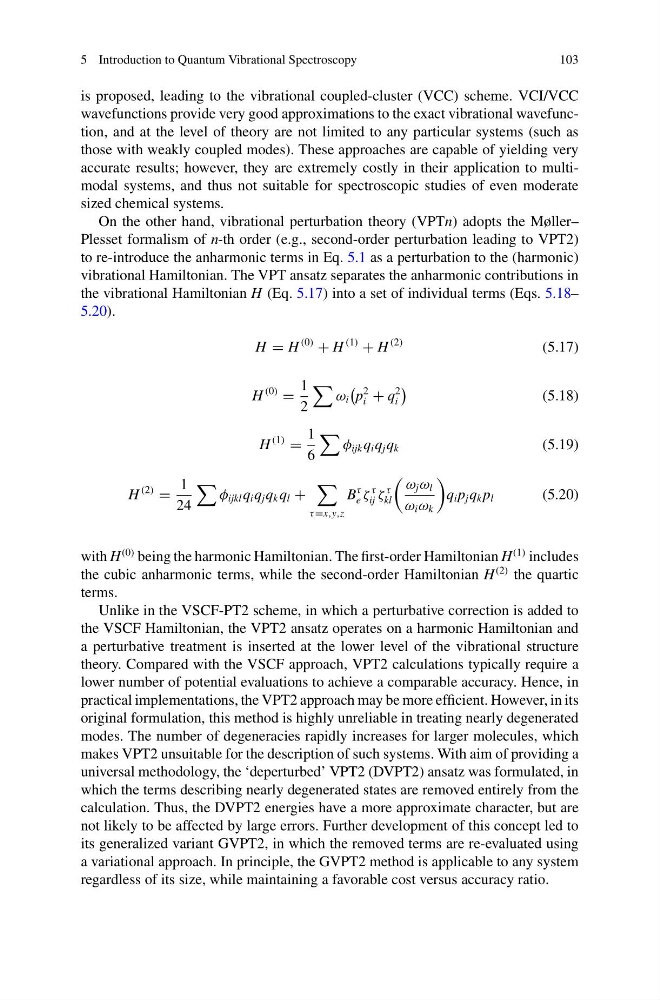
the vibrational Hamiltonian H (Eq. 5.17) into a set of individual terms (Eqs. 5.18–
5.20).
H = H
(0)
+ H
(1)
+ H
(2)
(5.17)
H
(0)
=
1
2
ω i
p
2
i + q
2
i
(5.18)
H
(1)
=
1
6
φ ijk q i q j q k
(5.19)
H
(2)
=
1
24
φ ijkl q i q j q k q l +
τ =x,y,z
B
τ
e ζ
τ
ij ζ
τ
kl
ω j ω l
ω i ω k
q i p j q k p l
(5.20)
with H
(0) being the harmonic Hamiltonian. The first-order Hamiltonian H
(1) includes
the cubic anharmonic terms, while the second-order Hamiltonian H
(2) the quartic
terms.
Unlike in the VSCF-PT2 scheme, in which a perturbative correction is added to
the VSCF Hamiltonian, the VPT2 ansatz operates on a harmonic Hamiltonian and
a perturbative treatment is inserted at the lower level of the vibrational structure
theory. Compared with the VSCF approach, VPT2 calculations typically require a
lower number of potential evaluations to achieve a comparable accuracy. Hence, in
practical implementations, the VPT2 approach may be more efficient. However, in its
original formulation, this method is highly unreliable in treating nearly degenerated
modes. The number of degeneracies rapidly increases for larger molecules, which
makes VPT2 unsuitable for the description of such systems. With aim of providing a
universal methodology, the ‘deperturbed’ VPT2 (DVPT2) ansatz was formulated, in
which the terms describing nearly degenerated states are removed entirely from the
calculation. Thus, the DVPT2 energies have a more approximate character, but are
not likely to be affected by large errors. Further development of this concept led to
its generalized variant GVPT2, in which the removed terms are re-evaluated using
a variational approach. In principle, the GVPT2 method is applicable to any system
regardless of its size, while maintaining a favorable cost versus accuracy ratio.
103
is proposed, leading to the vibrational coupled-cluster (VCC) scheme. VCI/VCC
wavefunctions provide very good approximations to the exact vibrational wavefunction, and at the level of theory are not limited to any particular systems (such as
those with weakly coupled modes). These approaches are capable of yielding very
accurate results; however, they are extremely costly in their application to multimodal systems, and thus not suitable for spectroscopic studies of even moderate
sized chemical systems.
On the other hand, vibrational perturbation theory (VPTn) adopts the Møller–
Plesset formalism of n-th order (e.g., second-order perturbation leading to VPT2)
to re-introduce the anharmonic terms in Eq. 5.1 as a perturbation to the (harmonic)
vibrational Hamiltonian. The VPT ansatz separates the anharmonic contributions in
the vibrational Hamiltonian H (Eq. 5.17) into a set of individual terms (Eqs. 5.18–
5.20).
H = H
(0)
+ H
(1)
+ H
(2)
(5.17)
H
(0)
=
1
2
ω i
p
2
i + q
2
i
(5.18)
H
(1)
=
1
6
φ ijk q i q j q k
(5.19)
H
(2)
=
1
24
φ ijkl q i q j q k q l +
τ =x,y,z
B
τ
e ζ
τ
ij ζ
τ
kl
ω j ω l
ω i ω k
q i p j q k p l
(5.20)
with H
(0) being the harmonic Hamiltonian. The first-order Hamiltonian H
(1) includes
the cubic anharmonic terms, while the second-order Hamiltonian H
(2) the quartic
terms.
Unlike in the VSCF-PT2 scheme, in which a perturbative correction is added to
the VSCF Hamiltonian, the VPT2 ansatz operates on a harmonic Hamiltonian and
a perturbative treatment is inserted at the lower level of the vibrational structure
theory. Compared with the VSCF approach, VPT2 calculations typically require a
lower number of potential evaluations to achieve a comparable accuracy. Hence, in
practical implementations, the VPT2 approach may be more efficient. However, in its
original formulation, this method is highly unreliable in treating nearly degenerated
modes. The number of degeneracies rapidly increases for larger molecules, which
makes VPT2 unsuitable for the description of such systems. With aim of providing a
universal methodology, the ‘deperturbed’ VPT2 (DVPT2) ansatz was formulated, in
which the terms describing nearly degenerated states are removed entirely from the
calculation. Thus, the DVPT2 energies have a more approximate character, but are
not likely to be affected by large errors. Further development of this concept led to
its generalized variant GVPT2, in which the removed terms are re-evaluated using
a variational approach. In principle, the GVPT2 method is applicable to any system
regardless of its size, while maintaining a favorable cost versus accuracy ratio.