

102
K. B. Be´ c et al.
the VSCF concept. In other words, the potential for each normal mode is averaged
over all other normal modes. Interestingly, the accuracy of the basic VSCF method
increases relatively with the system size, as the average treatment of mode couplings
applies better to extensively multidimensional (i.e., multimodal) systems.
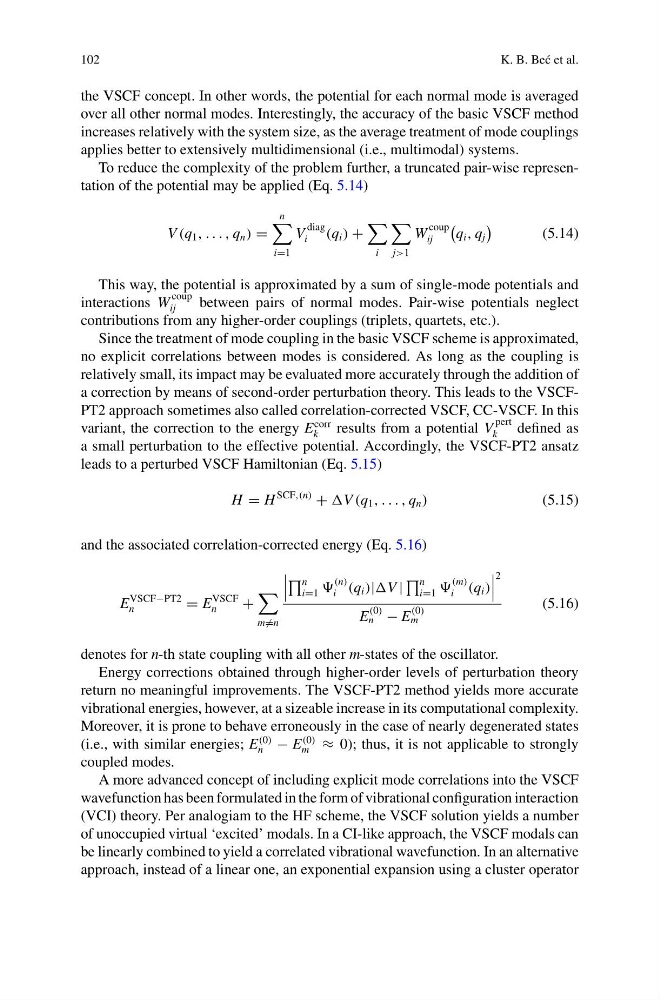
To reduce the complexity of the problem further, a truncated pair-wise representation of the potential may be applied (Eq. 5.14)
V (q 1 , . . . , q n ) =
n
i=1
V
diag
i
(q i ) +
i
j>1
W
coup
ij
q i , q j
(5.14)
This way, the potential is approximated by a sum of single-mode potentials and
interactions W
coup
ij
between pairs of normal modes. Pair-wise potentials neglect
contributions from any higher-order couplings (triplets, quartets, etc.).
Since the treatment of mode coupling in the basic VSCF scheme is approximated,
no explicit correlations between modes is considered. As long as the coupling is
relatively small, its impact may be evaluated more accurately through the addition of
a correction by means of second-order perturbation theory. This leads to the VSCFPT2 approach sometimes also called correlation-corrected VSCF, CC-VSCF. In this
variant, the correction to the energy E
corr
k
results from a potential V
pert
k
defined as
a small perturbation to the effective potential. Accordingly, the VSCF-PT2 ansatz
leads to a perturbed VSCF Hamiltonian (Eq. 5.15)
H = H
SCF,(n)
+ V (q 1 , . . . , q n )
(5.15)
and the associated correlation-corrected energy (Eq. 5.16)
E
VSCF−PT2
n
= E
VSCF
n
+
m =n
n
i=1
(n)
i (q i )|V |
n
i=1
(m)
i (q i )
2
E
(0)
n − E
(0)
m
(5.16)
denotes for n-th state coupling with all other m-states of the oscillator.
Energy corrections obtained through higher-order levels of perturbation theory
return no meaningful improvements. The VSCF-PT2 method yields more accurate
vibrational energies, however, at a sizeable increase in its computational complexity.
Moreover, it is prone to behave erroneously in the case of nearly degenerated states
(i.e., with similar energies; E
(0)
n − E
(0)
m ≈ 0); thus, it is not applicable to strongly
coupled modes.
A more advanced concept of including explicit mode correlations into the VSCF
wavefunction has been formulated in the form of vibrational configuration interaction
(VCI) theory. Per analogiam to the HF scheme, the VSCF solution yields a number
of unoccupied virtual ‘excited’ modals. In a CI-like approach, the VSCF modals can
be linearly combined to yield a correlated vibrational wavefunction. In an alternative
approach, instead of a linear one, an exponential expansion using a cluster operator
K. B. Be´ c et al.
the VSCF concept. In other words, the potential for each normal mode is averaged
over all other normal modes. Interestingly, the accuracy of the basic VSCF method
increases relatively with the system size, as the average treatment of mode couplings
applies better to extensively multidimensional (i.e., multimodal) systems.
To reduce the complexity of the problem further, a truncated pair-wise representation of the potential may be applied (Eq. 5.14)
V (q 1 , . . . , q n ) =
n
i=1
V
diag
i
(q i ) +
i
j>1
W
coup
ij
q i , q j
(5.14)
This way, the potential is approximated by a sum of single-mode potentials and
interactions W
coup
ij
between pairs of normal modes. Pair-wise potentials neglect
contributions from any higher-order couplings (triplets, quartets, etc.).
Since the treatment of mode coupling in the basic VSCF scheme is approximated,
no explicit correlations between modes is considered. As long as the coupling is
relatively small, its impact may be evaluated more accurately through the addition of
a correction by means of second-order perturbation theory. This leads to the VSCFPT2 approach sometimes also called correlation-corrected VSCF, CC-VSCF. In this
variant, the correction to the energy E
corr
k
results from a potential V
pert
k
defined as
a small perturbation to the effective potential. Accordingly, the VSCF-PT2 ansatz
leads to a perturbed VSCF Hamiltonian (Eq. 5.15)
H = H
SCF,(n)
+ V (q 1 , . . . , q n )
(5.15)
and the associated correlation-corrected energy (Eq. 5.16)
E
VSCF−PT2
n
= E
VSCF
n
+
m =n
n
i=1
(n)
i (q i )|V |
n
i=1
(m)
i (q i )
2
E
(0)
n − E
(0)
m
(5.16)
denotes for n-th state coupling with all other m-states of the oscillator.
Energy corrections obtained through higher-order levels of perturbation theory
return no meaningful improvements. The VSCF-PT2 method yields more accurate
vibrational energies, however, at a sizeable increase in its computational complexity.
Moreover, it is prone to behave erroneously in the case of nearly degenerated states
(i.e., with similar energies; E
(0)
n − E
(0)
m ≈ 0); thus, it is not applicable to strongly
coupled modes.
A more advanced concept of including explicit mode correlations into the VSCF
wavefunction has been formulated in the form of vibrational configuration interaction
(VCI) theory. Per analogiam to the HF scheme, the VSCF solution yields a number
of unoccupied virtual ‘excited’ modals. In a CI-like approach, the VSCF modals can
be linearly combined to yield a correlated vibrational wavefunction. In an alternative
approach, instead of a linear one, an exponential expansion using a cluster operator