

5 Introduction to Quantum Vibrational Spectroscopy
101
normal modes provides an effective route to enable approximate computational IR
and Raman spectroscopy. However, in the majority of cases, this approach is too error
prone to provide a reasonable prediction of overtones. In addition, the fundamental
point of the harmonic approximation, the additive nature of the harmonic potential,
does not take the coupling between individual modes into account, as reflected by
the assumed zero cross-derivatives, or anharmonic force constants in Eq. 5.1. This
fact leads to a critical limitation of the harmonic approximation, being its inability
to describe combination transitions, rendering it inapplicable to NIR spectroscopy.
5.5 Beyond the Harmonic Approximation
5.5.1 Anharmonic Approaches Formulated on the Basis
of the Harmonic Approximation
For the reasons explained above, the harmonic approximation is unsuitable for the
calculation of NIR transitions. The inclusion of anharmonic effects to vibrational
structure theory may be treated in an analogous way as electron correlation is included
into the theory of the electronic structure. Accordingly, vibrational self-consistent
field (VSCF) is the most straightforward anharmonic approach and an analogy to
HF theory. The VSCF method is based on the concept that for each vibrational state
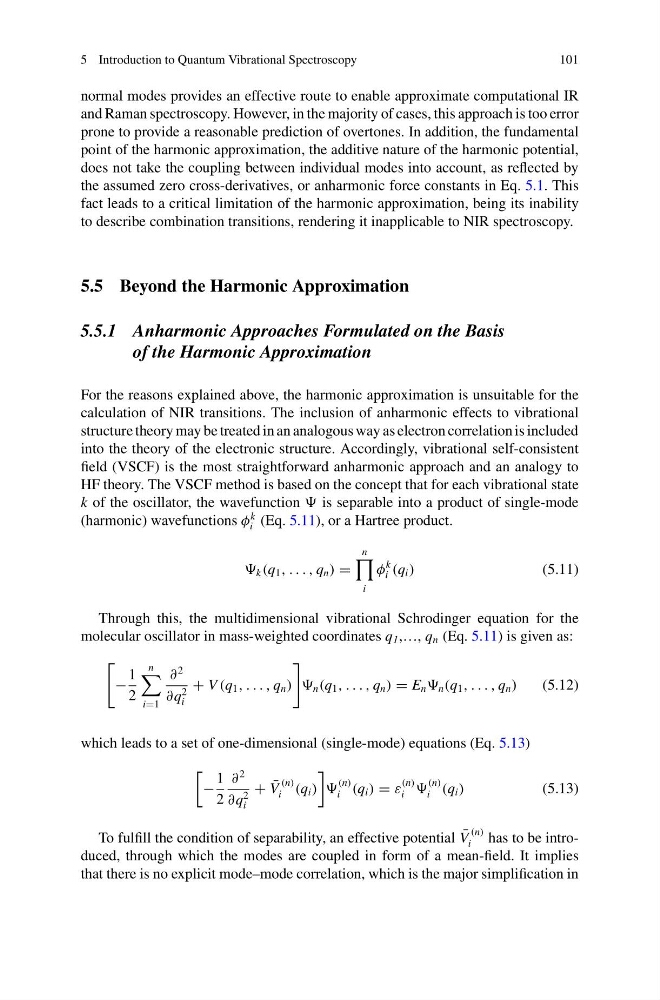
k of the oscillator, the wavefunction is separable into a product of single-mode
(harmonic) wavefunctions φ
k
i (Eq. 5.11), or a Hartree product.
k (q 1 , . . . , q n ) =
n
i
φ
k
i (q i )
(5.11)
Through this, the multidimensional vibrational Schrodinger equation for the
molecular oscillator in mass-weighted coordinates q 1 ,…, q n (Eq. 5.11) is given as:
−
1
2
n
i=1
∂
2
∂q
2
i
+ V (q 1 , . . . , q n )
n (q 1 , . . . , q n ) = E n n (q 1 , . . . , q n )
(5.12)
which leads to a set of one-dimensional (single-mode) equations (Eq. 5.13)
−
1
2
∂
2
∂q
2
i
+ ¯
V
(n)
i (q i )
(n)
i (q i ) = ε
(n)
i
(n)
i (q i )
(5.13)
To fulfill the condition of separability, an effective potential ¯
V
(n)
i
has to be introduced, through which the modes are coupled in form of a mean-field. It implies
that there is no explicit mode–mode correlation, which is the major simplification in
101
normal modes provides an effective route to enable approximate computational IR
and Raman spectroscopy. However, in the majority of cases, this approach is too error
prone to provide a reasonable prediction of overtones. In addition, the fundamental
point of the harmonic approximation, the additive nature of the harmonic potential,
does not take the coupling between individual modes into account, as reflected by
the assumed zero cross-derivatives, or anharmonic force constants in Eq. 5.1. This
fact leads to a critical limitation of the harmonic approximation, being its inability
to describe combination transitions, rendering it inapplicable to NIR spectroscopy.
5.5 Beyond the Harmonic Approximation
5.5.1 Anharmonic Approaches Formulated on the Basis
of the Harmonic Approximation
For the reasons explained above, the harmonic approximation is unsuitable for the
calculation of NIR transitions. The inclusion of anharmonic effects to vibrational
structure theory may be treated in an analogous way as electron correlation is included
into the theory of the electronic structure. Accordingly, vibrational self-consistent
field (VSCF) is the most straightforward anharmonic approach and an analogy to
HF theory. The VSCF method is based on the concept that for each vibrational state
k of the oscillator, the wavefunction is separable into a product of single-mode
(harmonic) wavefunctions φ
k
i (Eq. 5.11), or a Hartree product.
k (q 1 , . . . , q n ) =
n
i
φ
k
i (q i )
(5.11)
Through this, the multidimensional vibrational Schrodinger equation for the
molecular oscillator in mass-weighted coordinates q 1 ,…, q n (Eq. 5.11) is given as:
−
1
2
n
i=1
∂
2
∂q
2
i
+ V (q 1 , . . . , q n )
n (q 1 , . . . , q n ) = E n n (q 1 , . . . , q n )
(5.12)
which leads to a set of one-dimensional (single-mode) equations (Eq. 5.13)
−
1
2
∂
2
∂q
2
i
+ ¯
V
(n)
i (q i )
(n)
i (q i ) = ε
(n)
i
(n)
i (q i )
(5.13)
To fulfill the condition of separability, an effective potential ¯
V
(n)
i
has to be introduced, through which the modes are coupled in form of a mean-field. It implies
that there is no explicit mode–mode correlation, which is the major simplification in