

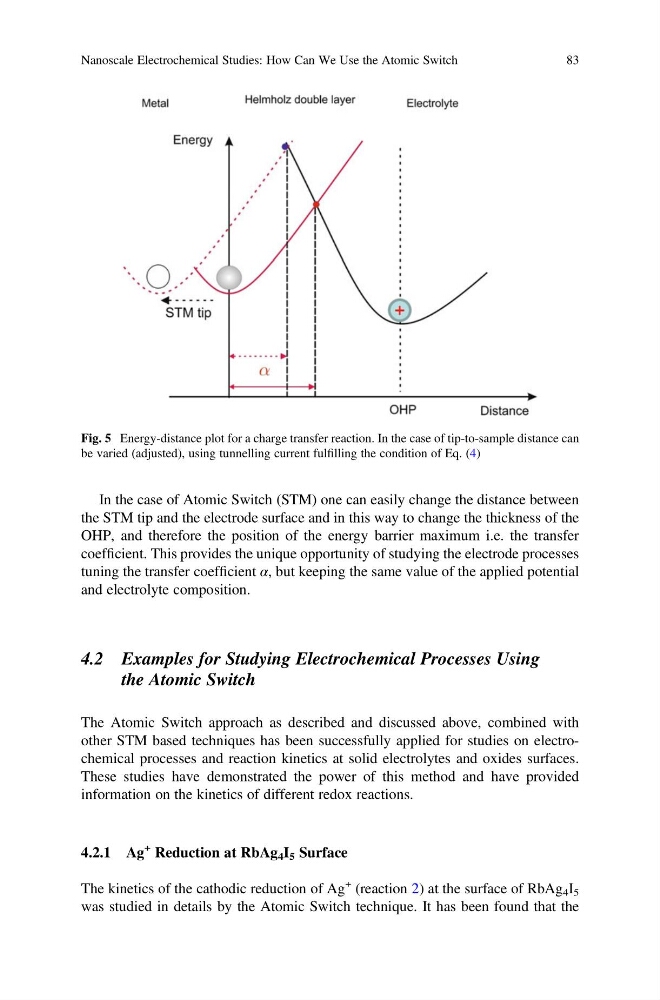
In the case of Atomic Switch (STM) one can easily change the distance between
the STM tip and the electrode surface and in this way to change the thickness of the
OHP, and therefore the position of the energy barrier maximum i.e. the transfer
coefficient. This provides the unique opportunity of studying the electrode processes
tuning the transfer coefficient α, but keeping the same value of the applied potential
and electrolyte composition.
4.2 Examples for Studying Electrochemical Processes Using
the Atomic Switch
The Atomic Switch approach as described and discussed above, combined with
other STM based techniques has been successfully applied for studies on electrochemical processes and reaction kinetics at solid electrolytes and oxides surfaces.
These studies have demonstrated the power of this method and have provided
information on the kinetics of different redox reactions.
4.2.1 Ag
+ Reduction at RbAg 4 I 5 Surface
The kinetics of the cathodic reduction of Ag
+ (reaction 2) at the surface of RbAg 4 I 5
was studied in details by the Atomic Switch technique. It has been found that the
Fig. 5 Energy-distance plot for a charge transfer reaction. In the case of tip-to-sample distance can
be varied (adjusted), using tunnelling current fulfilling the condition of Eq. (4)
Nanoscale Electrochemical Studies: How Can We Use the Atomic Switch
83
the STM tip and the electrode surface and in this way to change the thickness of the
OHP, and therefore the position of the energy barrier maximum i.e. the transfer
coefficient. This provides the unique opportunity of studying the electrode processes
tuning the transfer coefficient α, but keeping the same value of the applied potential
and electrolyte composition.
4.2 Examples for Studying Electrochemical Processes Using
the Atomic Switch
The Atomic Switch approach as described and discussed above, combined with
other STM based techniques has been successfully applied for studies on electrochemical processes and reaction kinetics at solid electrolytes and oxides surfaces.
These studies have demonstrated the power of this method and have provided
information on the kinetics of different redox reactions.
4.2.1 Ag
+ Reduction at RbAg 4 I 5 Surface
The kinetics of the cathodic reduction of Ag
+ (reaction 2) at the surface of RbAg 4 I 5
was studied in details by the Atomic Switch technique. It has been found that the
Fig. 5 Energy-distance plot for a charge transfer reaction. In the case of tip-to-sample distance can
be varied (adjusted), using tunnelling current fulfilling the condition of Eq. (4)
Nanoscale Electrochemical Studies: How Can We Use the Atomic Switch
83