

so we account for, that more atoms will be deposited within the switching time filling
pyramidal or conical shape with a height of h ¼ 1 nm. Taking into account the lateral
distribution of the electric filed at the surface and the tunnelling electrons, the length
of the base side-edge (or the radius) of this geometric form should be ~1 nm. This
volume can be filled by 15–20 Ag atoms. Thus, the charge Q is given by the product
of the number of atoms, the number of exchanged electrons per atom, and the
electron charge. Now knowing Q we can substitute Eq. (6) into Eq. (5) and become
the time-derived Butler-Volmer equation, which for the cathodic (reduction) process
will be:
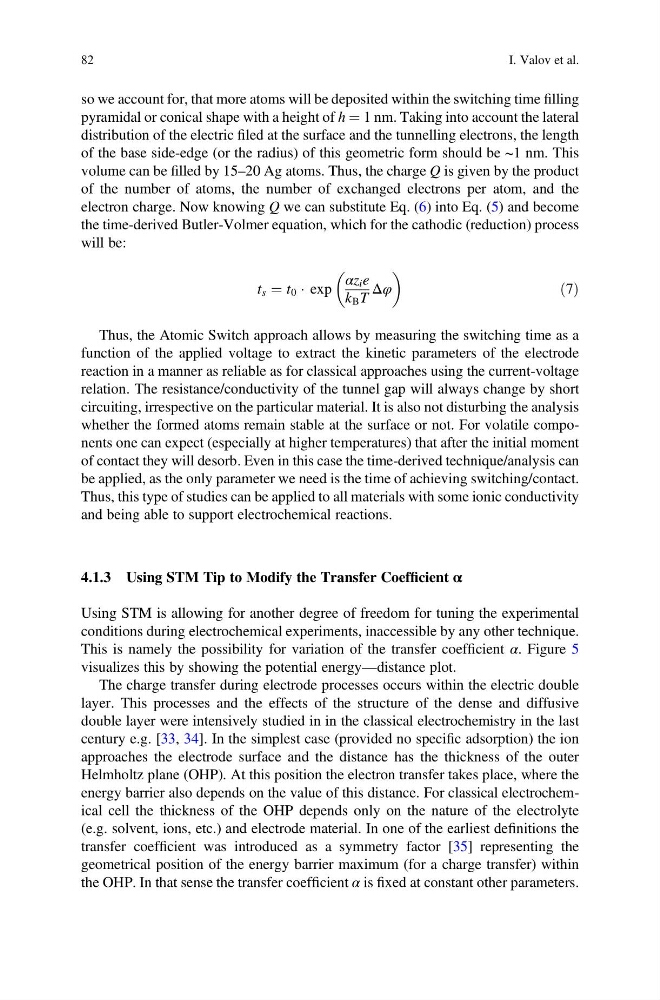
t s ¼ t 0 Á exp
αz i e
k B T
Δφ
ð7Þ
Thus, the Atomic Switch approach allows by measuring the switching time as a
function of the applied voltage to extract the kinetic parameters of the electrode
reaction in a manner as reliable as for classical approaches using the current-voltage
relation. The resistance/conductivity of the tunnel gap will always change by short
circuiting, irrespective on the particular material. It is also not disturbing the analysis
whether the formed atoms remain stable at the surface or not. For volatile components one can expect (especially at higher temperatures) that after the initial moment
of contact they will desorb. Even in this case the time-derived technique/analysis can
be applied, as the only parameter we need is the time of achieving switching/contact.
Thus, this type of studies can be applied to all materials with some ionic conductivity
and being able to support electrochemical reactions.
4.1.3 Using STM Tip to Modify the Transfer Coefficient α
Using STM is allowing for another degree of freedom for tuning the experimental
conditions during electrochemical experiments, inaccessible by any other technique.
This is namely the possibility for variation of the transfer coefficient α. Figure 5
visualizes this by showing the potential energy—distance plot.
The charge transfer during electrode processes occurs within the electric double
layer. This processes and the effects of the structure of the dense and diffusive
double layer were intensively studied in in the classical electrochemistry in the last
century e.g. [33, 34]. In the simplest case (provided no specific adsorption) the ion
approaches the electrode surface and the distance has the thickness of the outer
Helmholtz plane (OHP). At this position the electron transfer takes place, where the
energy barrier also depends on the value of this distance. For classical electrochemical cell the thickness of the OHP depends only on the nature of the electrolyte
(e.g. solvent, ions, etc.) and electrode material. In one of the earliest definitions the
transfer coefficient was introduced as a symmetry factor [35] representing the
geometrical position of the energy barrier maximum (for a charge transfer) within
the OHP. In that sense the transfer coefficient α is fixed at constant other parameters.
82
I. Valov et al.
pyramidal or conical shape with a height of h ¼ 1 nm. Taking into account the lateral
distribution of the electric filed at the surface and the tunnelling electrons, the length
of the base side-edge (or the radius) of this geometric form should be ~1 nm. This
volume can be filled by 15–20 Ag atoms. Thus, the charge Q is given by the product
of the number of atoms, the number of exchanged electrons per atom, and the
electron charge. Now knowing Q we can substitute Eq. (6) into Eq. (5) and become
the time-derived Butler-Volmer equation, which for the cathodic (reduction) process
will be:
t s ¼ t 0 Á exp
αz i e
k B T
Δφ
ð7Þ
Thus, the Atomic Switch approach allows by measuring the switching time as a
function of the applied voltage to extract the kinetic parameters of the electrode
reaction in a manner as reliable as for classical approaches using the current-voltage
relation. The resistance/conductivity of the tunnel gap will always change by short
circuiting, irrespective on the particular material. It is also not disturbing the analysis
whether the formed atoms remain stable at the surface or not. For volatile components one can expect (especially at higher temperatures) that after the initial moment
of contact they will desorb. Even in this case the time-derived technique/analysis can
be applied, as the only parameter we need is the time of achieving switching/contact.
Thus, this type of studies can be applied to all materials with some ionic conductivity
and being able to support electrochemical reactions.
4.1.3 Using STM Tip to Modify the Transfer Coefficient α
Using STM is allowing for another degree of freedom for tuning the experimental
conditions during electrochemical experiments, inaccessible by any other technique.
This is namely the possibility for variation of the transfer coefficient α. Figure 5
visualizes this by showing the potential energy—distance plot.
The charge transfer during electrode processes occurs within the electric double
layer. This processes and the effects of the structure of the dense and diffusive
double layer were intensively studied in in the classical electrochemistry in the last
century e.g. [33, 34]. In the simplest case (provided no specific adsorption) the ion
approaches the electrode surface and the distance has the thickness of the outer
Helmholtz plane (OHP). At this position the electron transfer takes place, where the
energy barrier also depends on the value of this distance. For classical electrochemical cell the thickness of the OHP depends only on the nature of the electrolyte
(e.g. solvent, ions, etc.) and electrode material. In one of the earliest definitions the
transfer coefficient was introduced as a symmetry factor [35] representing the
geometrical position of the energy barrier maximum (for a charge transfer) within
the OHP. In that sense the transfer coefficient α is fixed at constant other parameters.
82
I. Valov et al.