

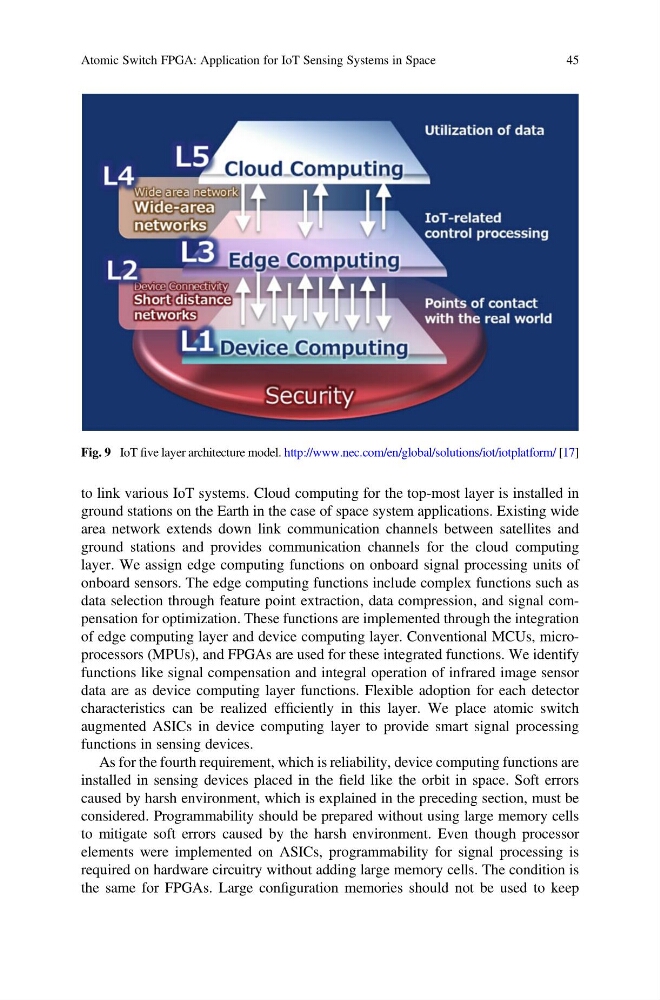
to link various IoT systems. Cloud computing for the top-most layer is installed in
ground stations on the Earth in the case of space system applications. Existing wide
area network extends down link communication channels between satellites and
ground stations and provides communication channels for the cloud computing
layer. We assign edge computing functions on onboard signal processing units of
onboard sensors. The edge computing functions include complex functions such as
data selection through feature point extraction, data compression, and signal compensation for optimization. These functions are implemented through the integration
of edge computing layer and device computing layer. Conventional MCUs, microprocessors (MPUs), and FPGAs are used for these integrated functions. We identify
functions like signal compensation and integral operation of infrared image sensor
data are as device computing layer functions. Flexible adoption for each detector
characteristics can be realized efficiently in this layer. We place atomic switch
augmented ASICs in device computing layer to provide smart signal processing
functions in sensing devices.
As for the fourth requirement, which is reliability, device computing functions are
installed in sensing devices placed in the field like the orbit in space. Soft errors
caused by harsh environment, which is explained in the preceding section, must be
considered. Programmability should be prepared without using large memory cells
to mitigate soft errors caused by the harsh environment. Even though processor
elements were implemented on ASICs, programmability for signal processing is
required on hardware circuitry without adding large memory cells. The condition is
the same for FPGAs. Large configuration memories should not be used to keep
Fig. 9 IoT five layer architecture model. http://www.nec.com/en/global/solutions/iot/iotplatform/ [17]
Atomic Switch FPGA: Application for IoT Sensing Systems in Space
45
ground stations on the Earth in the case of space system applications. Existing wide
area network extends down link communication channels between satellites and
ground stations and provides communication channels for the cloud computing
layer. We assign edge computing functions on onboard signal processing units of
onboard sensors. The edge computing functions include complex functions such as
data selection through feature point extraction, data compression, and signal compensation for optimization. These functions are implemented through the integration
of edge computing layer and device computing layer. Conventional MCUs, microprocessors (MPUs), and FPGAs are used for these integrated functions. We identify
functions like signal compensation and integral operation of infrared image sensor
data are as device computing layer functions. Flexible adoption for each detector
characteristics can be realized efficiently in this layer. We place atomic switch
augmented ASICs in device computing layer to provide smart signal processing
functions in sensing devices.
As for the fourth requirement, which is reliability, device computing functions are
installed in sensing devices placed in the field like the orbit in space. Soft errors
caused by harsh environment, which is explained in the preceding section, must be
considered. Programmability should be prepared without using large memory cells
to mitigate soft errors caused by the harsh environment. Even though processor
elements were implemented on ASICs, programmability for signal processing is
required on hardware circuitry without adding large memory cells. The condition is
the same for FPGAs. Large configuration memories should not be used to keep
Fig. 9 IoT five layer architecture model. http://www.nec.com/en/global/solutions/iot/iotplatform/ [17]
Atomic Switch FPGA: Application for IoT Sensing Systems in Space
45