

5 Operation in Harsh Environment
The operation of atomic-switch based FPGA in harsh environments is discussed.
Here the high temperature or low temperature ambient is considered. As shown in
Fig. 10, temperature effect both on the on resistance and the off current of atomicswitch is smaller than those of nMOSFET [20]. Small variations in the on or off
conductance of atomic-switch contributes to prevent from degrading an operation
margin of FPGA. Moreover, at the high temperatures, the increase in the leakage
current is suppressed, which is the one of the issues of SRAM-based FPGA. We
have also confirmed that atomic-switch based FPGA operates at the temperatures
ranging from À55 to 150
C.
The SRAM has a chance to suffer from soft errors due to the radiation from space.
Especially, the satellites in the space are suffering from the high energy particles.
While SRAM used in the satellites are required to be extremely reliable, they are
susceptible to circuitry failures (that is SEE). Even on the ground, the neutron
generated in the atmosphere by primary cosmic rays is the main source of SEE.
The occurrence of failures due to radiation should be considered for highly reliable
system like a commutation apparatus and automobile. SEE of atomic switch has
50
100
150
0.6
0.7
0.8
0.9
1
1.1
1.2
50
100
150
0.6
0.7
0.8
0.9
1
1.1
1.2
Clock Period (ns)
FAIL
Clock Period (ns)
VDD (V)
VDD (V)
FAIL
PASS
PASS
(a)
(b)
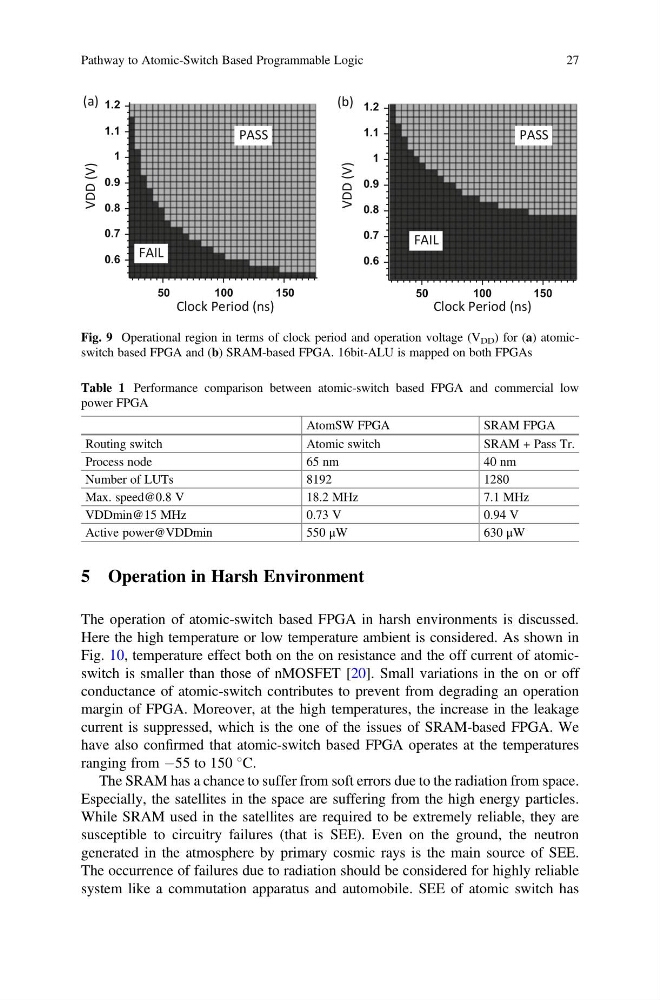
Fig. 9 Operational region in terms of clock period and operation voltage (V DD ) for (a) atomicswitch based FPGA and (b) SRAM-based FPGA. 16bit-ALU is mapped on both FPGAs
Table 1 Performance comparison between atomic-switch based FPGA and commercial low
power FPGA
AtomSW FPGA
SRAM FPGA
Routing switch
Atomic switch
SRAM + Pass Tr.
Process node
65 nm
40 nm
Number of LUTs
8192
1280
Max. speed@0.8 V
18.2 MHz
7.1 MHz
VDDmin@15 MHz
0.73 V
0.94 V
Active power@VDDmin
550 μW
630 μW
Pathway to Atomic-Switch Based Programmable Logic
27
The operation of atomic-switch based FPGA in harsh environments is discussed.
Here the high temperature or low temperature ambient is considered. As shown in
Fig. 10, temperature effect both on the on resistance and the off current of atomicswitch is smaller than those of nMOSFET [20]. Small variations in the on or off
conductance of atomic-switch contributes to prevent from degrading an operation
margin of FPGA. Moreover, at the high temperatures, the increase in the leakage
current is suppressed, which is the one of the issues of SRAM-based FPGA. We
have also confirmed that atomic-switch based FPGA operates at the temperatures
ranging from À55 to 150
C.
The SRAM has a chance to suffer from soft errors due to the radiation from space.
Especially, the satellites in the space are suffering from the high energy particles.
While SRAM used in the satellites are required to be extremely reliable, they are
susceptible to circuitry failures (that is SEE). Even on the ground, the neutron
generated in the atmosphere by primary cosmic rays is the main source of SEE.
The occurrence of failures due to radiation should be considered for highly reliable
system like a commutation apparatus and automobile. SEE of atomic switch has
50
100
150
0.6
0.7
0.8
0.9
1
1.1
1.2
50
100
150
0.6
0.7
0.8
0.9
1
1.1
1.2
Clock Period (ns)
FAIL
Clock Period (ns)
VDD (V)
VDD (V)
FAIL
PASS
PASS
(a)
(b)
Fig. 9 Operational region in terms of clock period and operation voltage (V DD ) for (a) atomicswitch based FPGA and (b) SRAM-based FPGA. 16bit-ALU is mapped on both FPGAs
Table 1 Performance comparison between atomic-switch based FPGA and commercial low
power FPGA
AtomSW FPGA
SRAM FPGA
Routing switch
Atomic switch
SRAM + Pass Tr.
Process node
65 nm
40 nm
Number of LUTs
8192
1280
Max. speed@0.8 V
18.2 MHz
7.1 MHz
VDDmin@15 MHz
0.73 V
0.94 V
Active power@VDDmin
550 μW
630 μW
Pathway to Atomic-Switch Based Programmable Logic
27