

In the absence of recurrent structures within the network, conductivity would
increase monotonically under constant DC bias, as in the case of a single atomic
switch. However, bidirectional fluctuations in the current response persisted for
several days under constant applied voltage, demonstrating that the complex network connectivity inherently resists localized positive feedback that would lead to
the serial formation of a single, dominant high conductivity pathway between
electrodes. Previously unreported current fluctuations of this kind are ascribed to
recurrent loops in the network that create complex couplings between switches,
resulting in network dynamics that do not converge to a steady state even under
constant bias. A single switch turning ON does not simply lead to an increased
potential drop across the next junction in a serial chain, but redistributes voltage
across many recurrent connections that can ultimately produce a net decrease in
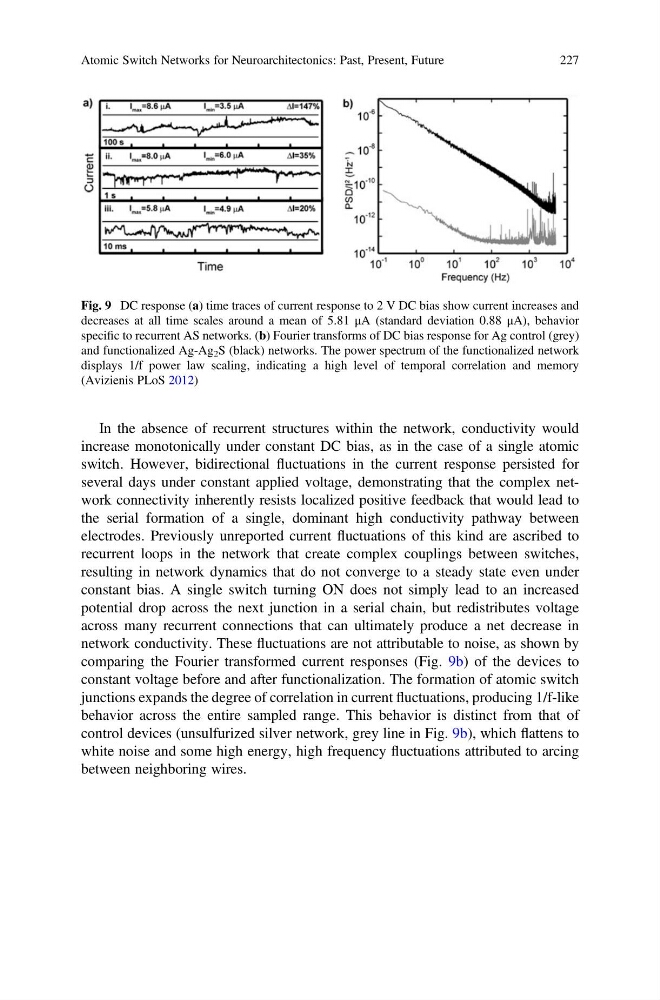
network conductivity. These fluctuations are not attributable to noise, as shown by
comparing the Fourier transformed current responses (Fig. 9b) of the devices to
constant voltage before and after functionalization. The formation of atomic switch
junctions expands the degree of correlation in current fluctuations, producing 1/f-like
behavior across the entire sampled range. This behavior is distinct from that of
control devices (unsulfurized silver network, grey line in Fig. 9b), which flattens to
white noise and some high energy, high frequency fluctuations attributed to arcing
between neighboring wires.
Fig. 9 DC response (a) time traces of current response to 2 V DC bias show current increases and
decreases at all time scales around a mean of 5.81 μA (standard deviation 0.88 μA), behavior
specific to recurrent AS networks. (b) Fourier transforms of DC bias response for Ag control (grey)
and functionalized Ag-Ag 2 S (black) networks. The power spectrum of the functionalized network
displays 1/f power law scaling, indicating a high level of temporal correlation and memory
(Avizienis PLoS 2012)
Atomic Switch Networks for Neuroarchitectonics: Past, Present, Future
227
increase monotonically under constant DC bias, as in the case of a single atomic
switch. However, bidirectional fluctuations in the current response persisted for
several days under constant applied voltage, demonstrating that the complex network connectivity inherently resists localized positive feedback that would lead to
the serial formation of a single, dominant high conductivity pathway between
electrodes. Previously unreported current fluctuations of this kind are ascribed to
recurrent loops in the network that create complex couplings between switches,
resulting in network dynamics that do not converge to a steady state even under
constant bias. A single switch turning ON does not simply lead to an increased
potential drop across the next junction in a serial chain, but redistributes voltage
across many recurrent connections that can ultimately produce a net decrease in
network conductivity. These fluctuations are not attributable to noise, as shown by
comparing the Fourier transformed current responses (Fig. 9b) of the devices to
constant voltage before and after functionalization. The formation of atomic switch
junctions expands the degree of correlation in current fluctuations, producing 1/f-like
behavior across the entire sampled range. This behavior is distinct from that of
control devices (unsulfurized silver network, grey line in Fig. 9b), which flattens to
white noise and some high energy, high frequency fluctuations attributed to arcing
between neighboring wires.
Fig. 9 DC response (a) time traces of current response to 2 V DC bias show current increases and
decreases at all time scales around a mean of 5.81 μA (standard deviation 0.88 μA), behavior
specific to recurrent AS networks. (b) Fourier transforms of DC bias response for Ag control (grey)
and functionalized Ag-Ag 2 S (black) networks. The power spectrum of the functionalized network
displays 1/f power law scaling, indicating a high level of temporal correlation and memory
(Avizienis PLoS 2012)
Atomic Switch Networks for Neuroarchitectonics: Past, Present, Future
227