

5.6 Distributed Switching/Correlations
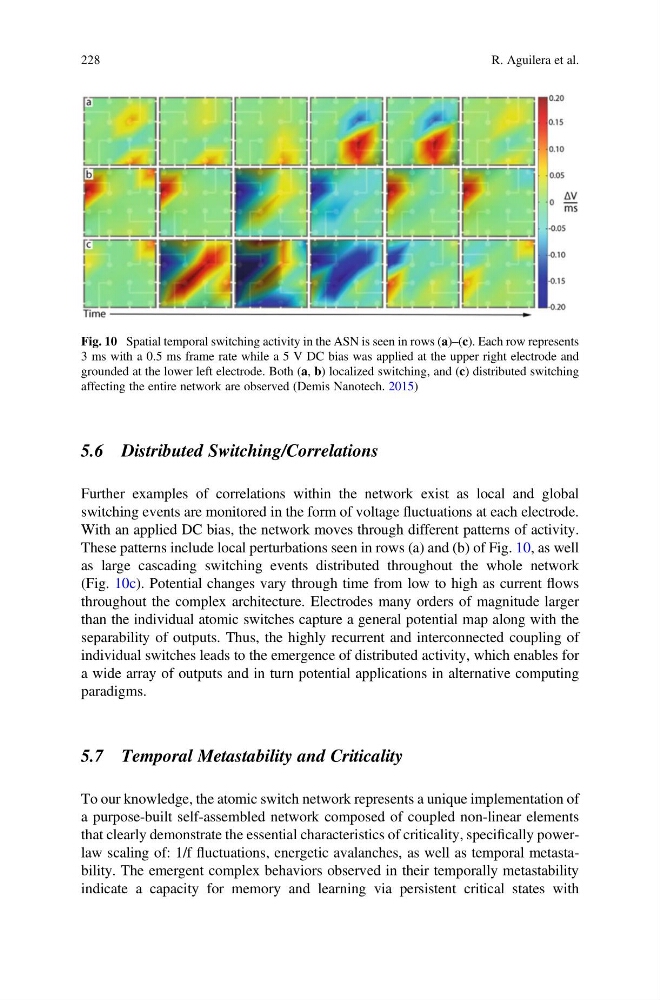
Further examples of correlations within the network exist as local and global
switching events are monitored in the form of voltage fluctuations at each electrode.
With an applied DC bias, the network moves through different patterns of activity.
These patterns include local perturbations seen in rows (a) and (b) of Fig. 10, as well
as large cascading switching events distributed throughout the whole network
(Fig. 10c). Potential changes vary through time from low to high as current flows
throughout the complex architecture. Electrodes many orders of magnitude larger
than the individual atomic switches capture a general potential map along with the
separability of outputs. Thus, the highly recurrent and interconnected coupling of
individual switches leads to the emergence of distributed activity, which enables for
a wide array of outputs and in turn potential applications in alternative computing
paradigms.
5.7 Temporal Metastability and Criticality
To our knowledge, the atomic switch network represents a unique implementation of
a purpose-built self-assembled network composed of coupled non-linear elements
that clearly demonstrate the essential characteristics of criticality, specifically powerlaw scaling of: 1/f fluctuations, energetic avalanches, as well as temporal metastability. The emergent complex behaviors observed in their temporally metastability
indicate a capacity for memory and learning via persistent critical states with
Fig. 10 Spatial temporal switching activity in the ASN is seen in rows (a)–(c). Each row represents
3 ms with a 0.5 ms frame rate while a 5 V DC bias was applied at the upper right electrode and
grounded at the lower left electrode. Both (a, b) localized switching, and (c) distributed switching
affecting the entire network are observed (Demis Nanotech. 2015)
228
R. Aguilera et al.
Further examples of correlations within the network exist as local and global
switching events are monitored in the form of voltage fluctuations at each electrode.
With an applied DC bias, the network moves through different patterns of activity.
These patterns include local perturbations seen in rows (a) and (b) of Fig. 10, as well
as large cascading switching events distributed throughout the whole network
(Fig. 10c). Potential changes vary through time from low to high as current flows
throughout the complex architecture. Electrodes many orders of magnitude larger
than the individual atomic switches capture a general potential map along with the
separability of outputs. Thus, the highly recurrent and interconnected coupling of
individual switches leads to the emergence of distributed activity, which enables for
a wide array of outputs and in turn potential applications in alternative computing
paradigms.
5.7 Temporal Metastability and Criticality
To our knowledge, the atomic switch network represents a unique implementation of
a purpose-built self-assembled network composed of coupled non-linear elements
that clearly demonstrate the essential characteristics of criticality, specifically powerlaw scaling of: 1/f fluctuations, energetic avalanches, as well as temporal metastability. The emergent complex behaviors observed in their temporally metastability
indicate a capacity for memory and learning via persistent critical states with
Fig. 10 Spatial temporal switching activity in the ASN is seen in rows (a)–(c). Each row represents
3 ms with a 0.5 ms frame rate while a 5 V DC bias was applied at the upper right electrode and
grounded at the lower left electrode. Both (a, b) localized switching, and (c) distributed switching
affecting the entire network are observed (Demis Nanotech. 2015)
228
R. Aguilera et al.