

externally controlled input/output contact electrodes allowing for data processing. In
the current device configuration, ASNs can only be electrically probed using the
macroscopic interface electrodes. It was therefore essential to confirm that these
electrodes could be effectively coupled to local ensembles of atomic switches within
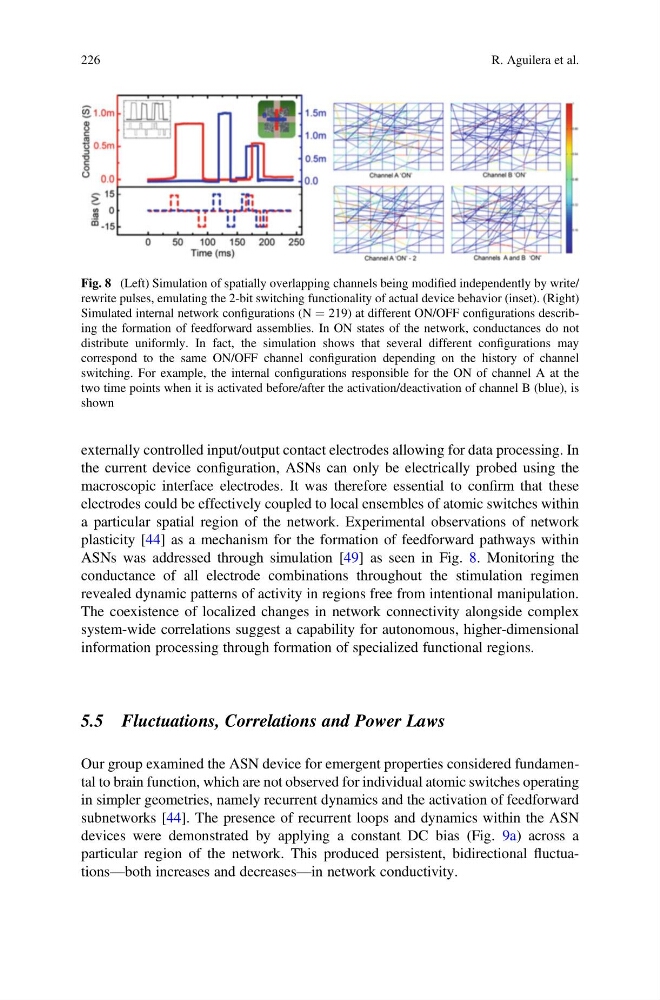
a particular spatial region of the network. Experimental observations of network
plasticity [44] as a mechanism for the formation of feedforward pathways within
ASNs was addressed through simulation [49] as seen in Fig. 8. Monitoring the
conductance of all electrode combinations throughout the stimulation regimen
revealed dynamic patterns of activity in regions free from intentional manipulation.
The coexistence of localized changes in network connectivity alongside complex
system-wide correlations suggest a capability for autonomous, higher-dimensional
information processing through formation of specialized functional regions.
5.5 Fluctuations, Correlations and Power Laws
Our group examined the ASN device for emergent properties considered fundamental to brain function, which are not observed for individual atomic switches operating
in simpler geometries, namely recurrent dynamics and the activation of feedforward
subnetworks [44]. The presence of recurrent loops and dynamics within the ASN
devices were demonstrated by applying a constant DC bias (Fig. 9a) across a
particular region of the network. This produced persistent, bidirectional fluctuations—both increases and decreases—in network conductivity.
Fig. 8 (Left) Simulation of spatially overlapping channels being modified independently by write/
rewrite pulses, emulating the 2-bit switching functionality of actual device behavior (inset). (Right)
Simulated internal network configurations (N ¼ 219) at different ON/OFF configurations describing the formation of feedforward assemblies. In ON states of the network, conductances do not
distribute uniformly. In fact, the simulation shows that several different configurations may
correspond to the same ON/OFF channel configuration depending on the history of channel
switching. For example, the internal configurations responsible for the ON of channel A at the
two time points when it is activated before/after the activation/deactivation of channel B (blue), is
shown
226
R. Aguilera et al.
the current device configuration, ASNs can only be electrically probed using the
macroscopic interface electrodes. It was therefore essential to confirm that these
electrodes could be effectively coupled to local ensembles of atomic switches within
a particular spatial region of the network. Experimental observations of network
plasticity [44] as a mechanism for the formation of feedforward pathways within
ASNs was addressed through simulation [49] as seen in Fig. 8. Monitoring the
conductance of all electrode combinations throughout the stimulation regimen
revealed dynamic patterns of activity in regions free from intentional manipulation.
The coexistence of localized changes in network connectivity alongside complex
system-wide correlations suggest a capability for autonomous, higher-dimensional
information processing through formation of specialized functional regions.
5.5 Fluctuations, Correlations and Power Laws
Our group examined the ASN device for emergent properties considered fundamental to brain function, which are not observed for individual atomic switches operating
in simpler geometries, namely recurrent dynamics and the activation of feedforward
subnetworks [44]. The presence of recurrent loops and dynamics within the ASN
devices were demonstrated by applying a constant DC bias (Fig. 9a) across a
particular region of the network. This produced persistent, bidirectional fluctuations—both increases and decreases—in network conductivity.
Fig. 8 (Left) Simulation of spatially overlapping channels being modified independently by write/
rewrite pulses, emulating the 2-bit switching functionality of actual device behavior (inset). (Right)
Simulated internal network configurations (N ¼ 219) at different ON/OFF configurations describing the formation of feedforward assemblies. In ON states of the network, conductances do not
distribute uniformly. In fact, the simulation shows that several different configurations may
correspond to the same ON/OFF channel configuration depending on the history of channel
switching. For example, the internal configurations responsible for the ON of channel A at the
two time points when it is activated before/after the activation/deactivation of channel B (blue), is
shown
226
R. Aguilera et al.