

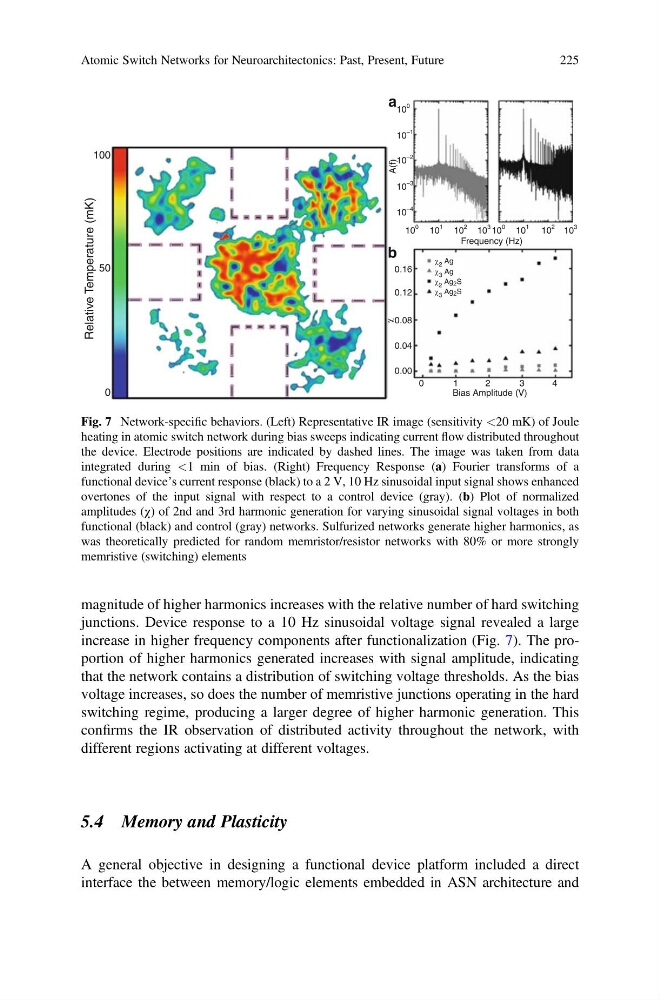
magnitude of higher harmonics increases with the relative number of hard switching
junctions. Device response to a 10 Hz sinusoidal voltage signal revealed a large
increase in higher frequency components after functionalization (Fig. 7). The proportion of higher harmonics generated increases with signal amplitude, indicating
that the network contains a distribution of switching voltage thresholds. As the bias
voltage increases, so does the number of memristive junctions operating in the hard
switching regime, producing a larger degree of higher harmonic generation. This
confirms the IR observation of distributed activity throughout the network, with
different regions activating at different voltages.
5.4 Memory and Plasticity
A general objective in designing a functional device platform included a direct
interface the between memory/logic elements embedded in ASN architecture and
100
10
0
10
–1
10
–2
10
–3
10
–4
10
0
0.16
0.12
0.08
0.04
0.00
0
2 Ag
3 Ag
2 Ag2S
3 Ag2S
1
2
3
4
10
1
10
2
Frequency (Hz)
Bias Amplitude (V)
A(f)
Relative Temperature (mK)
10
3 10
0
10
1
10
2
10
3
50
0
a
b
Fig. 7 Network-specific behaviors. (Left) Representative IR image (sensitivity <20 mK) of Joule
heating in atomic switch network during bias sweeps indicating current flow distributed throughout
the device. Electrode positions are indicated by dashed lines. The image was taken from data
integrated during <1 min of bias. (Right) Frequency Response (a) Fourier transforms of a
functional device’s current response (black) to a 2 V, 10 Hz sinusoidal input signal shows enhanced
overtones of the input signal with respect to a control device (gray). (b) Plot of normalized
amplitudes (χ) of 2nd and 3rd harmonic generation for varying sinusoidal signal voltages in both
functional (black) and control (gray) networks. Sulfurized networks generate higher harmonics, as
was theoretically predicted for random memristor/resistor networks with 80% or more strongly
memristive (switching) elements
Atomic Switch Networks for Neuroarchitectonics: Past, Present, Future
225
junctions. Device response to a 10 Hz sinusoidal voltage signal revealed a large
increase in higher frequency components after functionalization (Fig. 7). The proportion of higher harmonics generated increases with signal amplitude, indicating
that the network contains a distribution of switching voltage thresholds. As the bias
voltage increases, so does the number of memristive junctions operating in the hard
switching regime, producing a larger degree of higher harmonic generation. This
confirms the IR observation of distributed activity throughout the network, with
different regions activating at different voltages.
5.4 Memory and Plasticity
A general objective in designing a functional device platform included a direct
interface the between memory/logic elements embedded in ASN architecture and
100
10
0
10
–1
10
–2
10
–3
10
–4
10
0
0.16
0.12
0.08
0.04
0.00
0
2 Ag
3 Ag
2 Ag2S
3 Ag2S
1
2
3
4
10
1
10
2
Frequency (Hz)
Bias Amplitude (V)
A(f)
Relative Temperature (mK)
10
3 10
0
10
1
10
2
10
3
50
0
a
b
Fig. 7 Network-specific behaviors. (Left) Representative IR image (sensitivity <20 mK) of Joule
heating in atomic switch network during bias sweeps indicating current flow distributed throughout
the device. Electrode positions are indicated by dashed lines. The image was taken from data
integrated during <1 min of bias. (Right) Frequency Response (a) Fourier transforms of a
functional device’s current response (black) to a 2 V, 10 Hz sinusoidal input signal shows enhanced
overtones of the input signal with respect to a control device (gray). (b) Plot of normalized
amplitudes (χ) of 2nd and 3rd harmonic generation for varying sinusoidal signal voltages in both
functional (black) and control (gray) networks. Sulfurized networks generate higher harmonics, as
was theoretically predicted for random memristor/resistor networks with 80% or more strongly
memristive (switching) elements
Atomic Switch Networks for Neuroarchitectonics: Past, Present, Future
225