

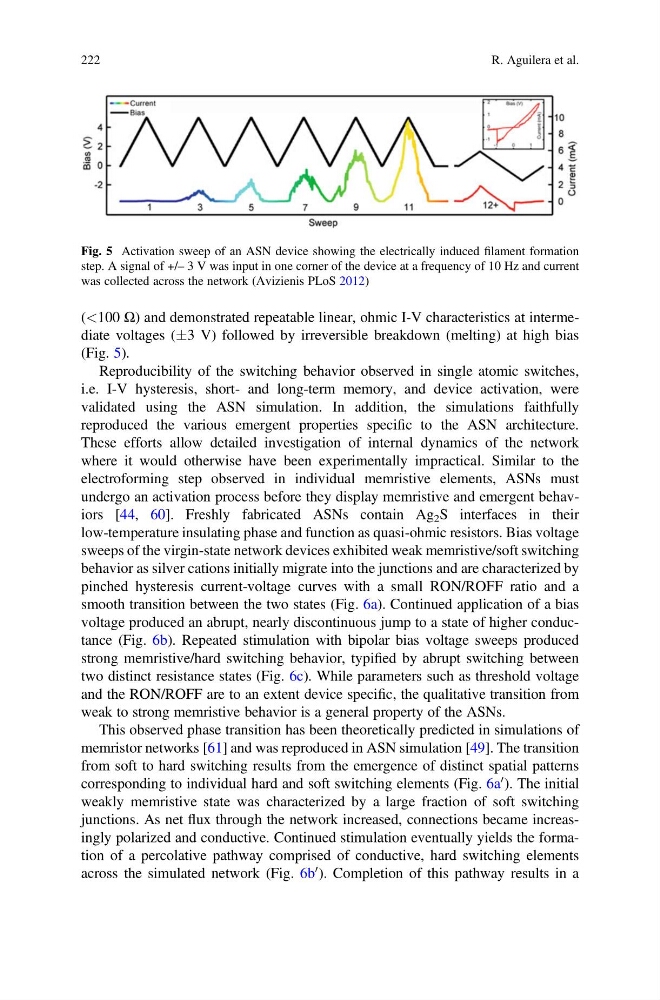
(<100 Ω) and demonstrated repeatable linear, ohmic I-V characteristics at intermediate voltages (Æ3 V) followed by irreversible breakdown (melting) at high bias
(Fig. 5).
Reproducibility of the switching behavior observed in single atomic switches,
i.e. I-V hysteresis, short- and long-term memory, and device activation, were
validated using the ASN simulation. In addition, the simulations faithfully
reproduced the various emergent properties specific to the ASN architecture.
These efforts allow detailed investigation of internal dynamics of the network
where it would otherwise have been experimentally impractical. Similar to the
electroforming step observed in individual memristive elements, ASNs must
undergo an activation process before they display memristive and emergent behaviors [44, 60]. Freshly fabricated ASNs contain Ag 2 S interfaces in their
low-temperature insulating phase and function as quasi-ohmic resistors. Bias voltage
sweeps of the virgin-state network devices exhibited weak memristive/soft switching
behavior as silver cations initially migrate into the junctions and are characterized by
pinched hysteresis current-voltage curves with a small RON/ROFF ratio and a
smooth transition between the two states (Fig. 6a). Continued application of a bias
voltage produced an abrupt, nearly discontinuous jump to a state of higher conductance (Fig. 6b). Repeated stimulation with bipolar bias voltage sweeps produced
strong memristive/hard switching behavior, typified by abrupt switching between
two distinct resistance states (Fig. 6c). While parameters such as threshold voltage
and the RON/ROFF are to an extent device specific, the qualitative transition from
weak to strong memristive behavior is a general property of the ASNs.
This observed phase transition has been theoretically predicted in simulations of
memristor networks [61] and was reproduced in ASN simulation [49]. The transition
from soft to hard switching results from the emergence of distinct spatial patterns
corresponding to individual hard and soft switching elements (Fig. 6a
0 ). The initial
weakly memristive state was characterized by a large fraction of soft switching
junctions. As net flux through the network increased, connections became increasingly polarized and conductive. Continued stimulation eventually yields the formation of a percolative pathway comprised of conductive, hard switching elements
across the simulated network (Fig. 6b
0 ). Completion of this pathway results in a
Fig. 5 Activation sweep of an ASN device showing the electrically induced filament formation
step. A signal of +/– 3 V was input in one corner of the device at a frequency of 10 Hz and current
was collected across the network (Avizienis PLoS 2012)
222
R. Aguilera et al.
(Fig. 5).
Reproducibility of the switching behavior observed in single atomic switches,
i.e. I-V hysteresis, short- and long-term memory, and device activation, were
validated using the ASN simulation. In addition, the simulations faithfully
reproduced the various emergent properties specific to the ASN architecture.
These efforts allow detailed investigation of internal dynamics of the network
where it would otherwise have been experimentally impractical. Similar to the
electroforming step observed in individual memristive elements, ASNs must
undergo an activation process before they display memristive and emergent behaviors [44, 60]. Freshly fabricated ASNs contain Ag 2 S interfaces in their
low-temperature insulating phase and function as quasi-ohmic resistors. Bias voltage
sweeps of the virgin-state network devices exhibited weak memristive/soft switching
behavior as silver cations initially migrate into the junctions and are characterized by
pinched hysteresis current-voltage curves with a small RON/ROFF ratio and a
smooth transition between the two states (Fig. 6a). Continued application of a bias
voltage produced an abrupt, nearly discontinuous jump to a state of higher conductance (Fig. 6b). Repeated stimulation with bipolar bias voltage sweeps produced
strong memristive/hard switching behavior, typified by abrupt switching between
two distinct resistance states (Fig. 6c). While parameters such as threshold voltage
and the RON/ROFF are to an extent device specific, the qualitative transition from
weak to strong memristive behavior is a general property of the ASNs.
This observed phase transition has been theoretically predicted in simulations of
memristor networks [61] and was reproduced in ASN simulation [49]. The transition
from soft to hard switching results from the emergence of distinct spatial patterns
corresponding to individual hard and soft switching elements (Fig. 6a
0 ). The initial
weakly memristive state was characterized by a large fraction of soft switching
junctions. As net flux through the network increased, connections became increasingly polarized and conductive. Continued stimulation eventually yields the formation of a percolative pathway comprised of conductive, hard switching elements
across the simulated network (Fig. 6b
0 ). Completion of this pathway results in a
Fig. 5 Activation sweep of an ASN device showing the electrically induced filament formation
step. A signal of +/– 3 V was input in one corner of the device at a frequency of 10 Hz and current
was collected across the network (Avizienis PLoS 2012)
222
R. Aguilera et al.