

3
10
9
8
7
6
5
4
3
2
1
1 2 3 4 5 6 7 8 9 10
Node #
1 2 3 4 5 6 7 8 9 10
Node #
40
8
6
4
2
0
–2
–4
–6
–8
–2
–1
0
1
2
30
20
10
0
–10
2
1
0
–1
–2
–3
–4
–2
0
2
Bias (V)
Current (uA)
Node #
10
9
8
7
6
5
4
3
2
1
Node #
1 2 3 4 5 6 7 8 9 10
1
0
Node #
10
9
8
7
6
5
4
3
2
1
Node #
Current (uA)
Current (uA)
4
–2
–1
0
1
Bias (V)
Bias (V)
2
Weak/Soft Switching
a
a’
b
b’
c
c’
Activation
Strong / Hard Switching
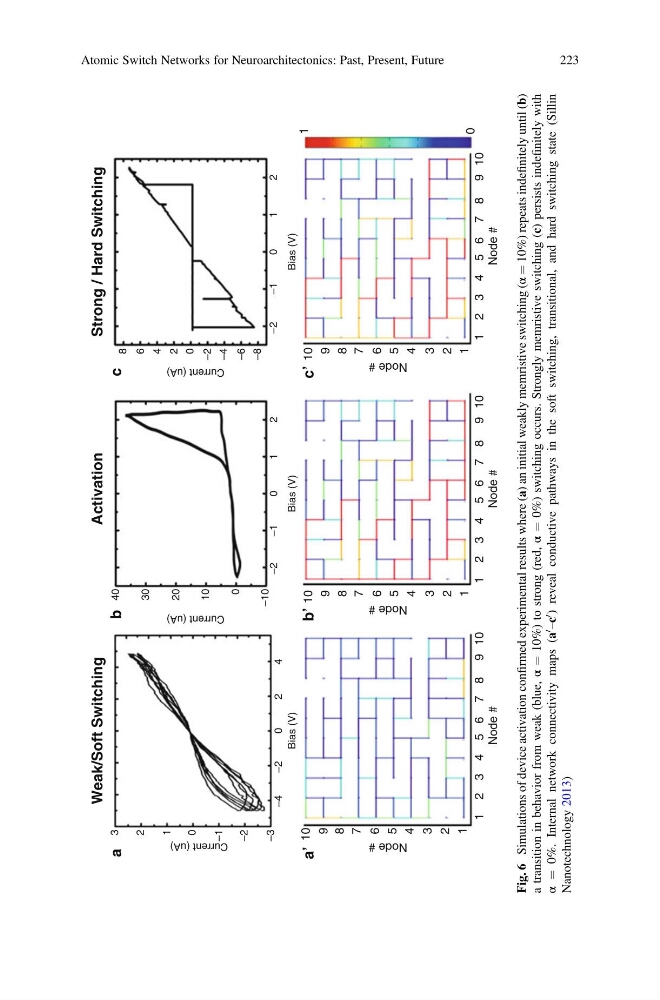
Fig. 6
Simulations of device activation confirmed experimental results where (a) an initial weakly memristive switching (α
¼ 10%) repeats indefinitely until (b)
a transition in behavior from weak (blue,
α ¼ 10%) to strong (red,
α ¼ 0%) switching occurs. Strongly memristive switching (c) persists indefinitely with
α ¼ 0%. Internal network connectivity maps (a
0
–c
0
) reveal conductive pathways in the soft switching, transitional, and hard switching state (Sillin
Nanotechnology 2013)
Atomic Switch Networks for Neuroarchitectonics: Past, Present, Future
223
10
9
8
7
6
5
4
3
2
1
1 2 3 4 5 6 7 8 9 10
Node #
1 2 3 4 5 6 7 8 9 10
Node #
40
8
6
4
2
0
–2
–4
–6
–8
–2
–1
0
1
2
30
20
10
0
–10
2
1
0
–1
–2
–3
–4
–2
0
2
Bias (V)
Current (uA)
Node #
10
9
8
7
6
5
4
3
2
1
Node #
1 2 3 4 5 6 7 8 9 10
1
0
Node #
10
9
8
7
6
5
4
3
2
1
Node #
Current (uA)
Current (uA)
4
–2
–1
0
1
Bias (V)
Bias (V)
2
Weak/Soft Switching
a
a’
b
b’
c
c’
Activation
Strong / Hard Switching
Fig. 6
Simulations of device activation confirmed experimental results where (a) an initial weakly memristive switching (α
¼ 10%) repeats indefinitely until (b)
a transition in behavior from weak (blue,
α ¼ 10%) to strong (red,
α ¼ 0%) switching occurs. Strongly memristive switching (c) persists indefinitely with
α ¼ 0%. Internal network connectivity maps (a
0
–c
0
) reveal conductive pathways in the soft switching, transitional, and hard switching state (Sillin
Nanotechnology 2013)
Atomic Switch Networks for Neuroarchitectonics: Past, Present, Future
223