

5.2 Device Activation and Switching
The ionic resistive atomic switch has been shown to exhibit fascinating electrical
properties analogous to short- and long-term plasticity at single synaptic junctions
while operating as a two-terminal device controlled through formation/annihilation
of a metal filament within a Metal-Insulator-Metal (MIM) interface. However, the
behavior of a collection of atomic switches directly coupled both spatially and
electrically is as of yet unknown. In common with the current understanding of
switching mechanisms in devices based on Ag 2 S, TiO 2 , and Ta 2 O 5 , our network
required an initial forming step to create a short-lived high conductivity ‘ON’ state.
As measured by current-voltage (I-V) spectroscopy, ASN devices demonstrated
non-linear I-V characteristics comprised of a sequential decrease in network resistance with consecutive bias sweeps followed by an abrupt transition to the activated
‘ON’ state. This cascade-type activation required a higher switching voltage (~7 V);
however, they exhibit similar time constants (μs) to single atom switches. The
switching behavior in the fractal network is attributed to an increased spreading
resistance of many individual switching interfaces. In contrast, un-sulfurized control
devices comprised of a purely metallic network have substantially lower resistance
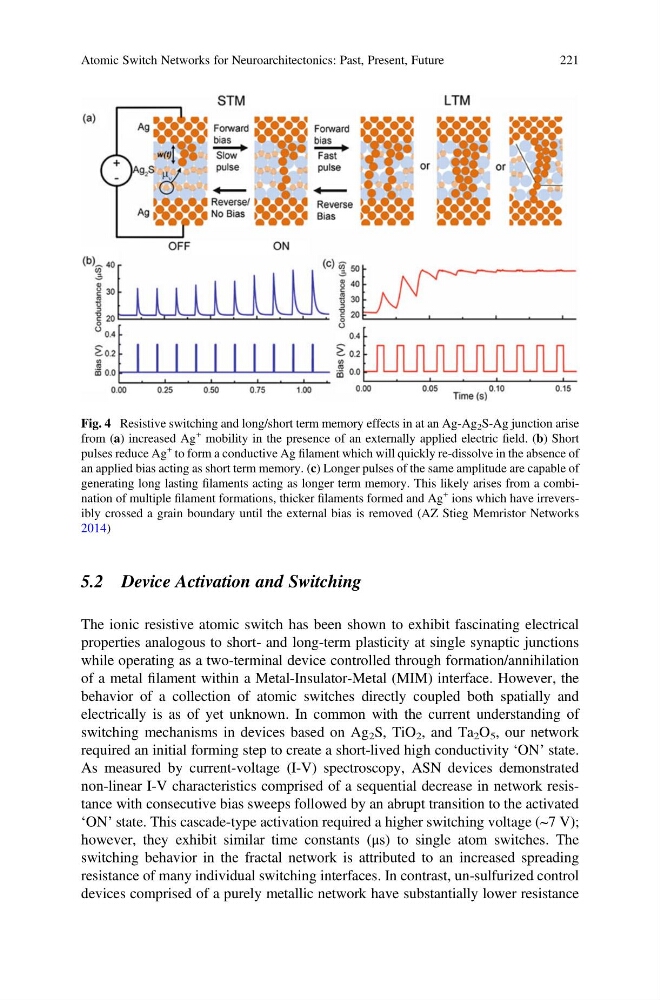
Fig. 4 Resistive switching and long/short term memory effects in at an Ag-Ag 2 S-Ag junction arise
from (a) increased Ag
+ mobility in the presence of an externally applied electric field. (b) Short
pulses reduce Ag
+ to form a conductive Ag filament which will quickly re-dissolve in the absence of
an applied bias acting as short term memory. (c) Longer pulses of the same amplitude are capable of
generating long lasting filaments acting as longer term memory. This likely arises from a combination of multiple filament formations, thicker filaments formed and Ag
+ ions which have irreversibly crossed a grain boundary until the external bias is removed (AZ Stieg Memristor Networks
2014)
Atomic Switch Networks for Neuroarchitectonics: Past, Present, Future
221
The ionic resistive atomic switch has been shown to exhibit fascinating electrical
properties analogous to short- and long-term plasticity at single synaptic junctions
while operating as a two-terminal device controlled through formation/annihilation
of a metal filament within a Metal-Insulator-Metal (MIM) interface. However, the
behavior of a collection of atomic switches directly coupled both spatially and
electrically is as of yet unknown. In common with the current understanding of
switching mechanisms in devices based on Ag 2 S, TiO 2 , and Ta 2 O 5 , our network
required an initial forming step to create a short-lived high conductivity ‘ON’ state.
As measured by current-voltage (I-V) spectroscopy, ASN devices demonstrated
non-linear I-V characteristics comprised of a sequential decrease in network resistance with consecutive bias sweeps followed by an abrupt transition to the activated
‘ON’ state. This cascade-type activation required a higher switching voltage (~7 V);
however, they exhibit similar time constants (μs) to single atom switches. The
switching behavior in the fractal network is attributed to an increased spreading
resistance of many individual switching interfaces. In contrast, un-sulfurized control
devices comprised of a purely metallic network have substantially lower resistance
Fig. 4 Resistive switching and long/short term memory effects in at an Ag-Ag 2 S-Ag junction arise
from (a) increased Ag
+ mobility in the presence of an externally applied electric field. (b) Short
pulses reduce Ag
+ to form a conductive Ag filament which will quickly re-dissolve in the absence of
an applied bias acting as short term memory. (c) Longer pulses of the same amplitude are capable of
generating long lasting filaments acting as longer term memory. This likely arises from a combination of multiple filament formations, thicker filaments formed and Ag
+ ions which have irreversibly crossed a grain boundary until the external bias is removed (AZ Stieg Memristor Networks
2014)
Atomic Switch Networks for Neuroarchitectonics: Past, Present, Future
221