

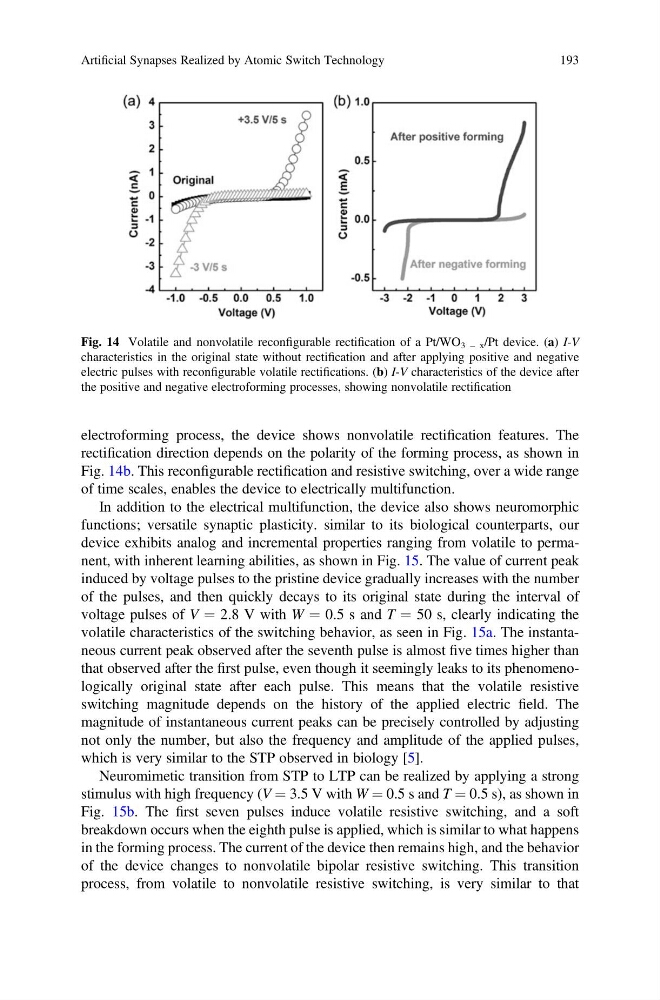
electroforming process, the device shows nonvolatile rectification features. The
rectification direction depends on the polarity of the forming process, as shown in
Fig. 14b. This reconfigurable rectification and resistive switching, over a wide range
of time scales, enables the device to electrically multifunction.
In addition to the electrical multifunction, the device also shows neuromorphic
functions; versatile synaptic plasticity. similar to its biological counterparts, our
device exhibits analog and incremental properties ranging from volatile to permanent, with inherent learning abilities, as shown in Fig. 15. The value of current peak
induced by voltage pulses to the pristine device gradually increases with the number
of the pulses, and then quickly decays to its original state during the interval of
voltage pulses of V ¼ 2.8 V with W ¼ 0.5 s and T ¼ 50 s, clearly indicating the
volatile characteristics of the switching behavior, as seen in Fig. 15a. The instantaneous current peak observed after the seventh pulse is almost five times higher than
that observed after the first pulse, even though it seemingly leaks to its phenomenologically original state after each pulse. This means that the volatile resistive
switching magnitude depends on the history of the applied electric field. The
magnitude of instantaneous current peaks can be precisely controlled by adjusting
not only the number, but also the frequency and amplitude of the applied pulses,
which is very similar to the STP observed in biology [5].
Neuromimetic transition from STP to LTP can be realized by applying a strong
stimulus with high frequency (V ¼ 3.5 V with W ¼ 0.5 s and T ¼ 0.5 s), as shown in
Fig. 15b. The first seven pulses induce volatile resistive switching, and a soft
breakdown occurs when the eighth pulse is applied, which is similar to what happens
in the forming process. The current of the device then remains high, and the behavior
of the device changes to nonvolatile bipolar resistive switching. This transition
process, from volatile to nonvolatile resistive switching, is very similar to that
Fig. 14 Volatile and nonvolatile reconfigurable rectification of a Pt/WO 3 – x /Pt device. (a) I-V
characteristics in the original state without rectification and after applying positive and negative
electric pulses with reconfigurable volatile rectifications. (b) I-V characteristics of the device after
the positive and negative electroforming processes, showing nonvolatile rectification
Artificial Synapses Realized by Atomic Switch Technology
193
rectification direction depends on the polarity of the forming process, as shown in
Fig. 14b. This reconfigurable rectification and resistive switching, over a wide range
of time scales, enables the device to electrically multifunction.
In addition to the electrical multifunction, the device also shows neuromorphic
functions; versatile synaptic plasticity. similar to its biological counterparts, our
device exhibits analog and incremental properties ranging from volatile to permanent, with inherent learning abilities, as shown in Fig. 15. The value of current peak
induced by voltage pulses to the pristine device gradually increases with the number
of the pulses, and then quickly decays to its original state during the interval of
voltage pulses of V ¼ 2.8 V with W ¼ 0.5 s and T ¼ 50 s, clearly indicating the
volatile characteristics of the switching behavior, as seen in Fig. 15a. The instantaneous current peak observed after the seventh pulse is almost five times higher than
that observed after the first pulse, even though it seemingly leaks to its phenomenologically original state after each pulse. This means that the volatile resistive
switching magnitude depends on the history of the applied electric field. The
magnitude of instantaneous current peaks can be precisely controlled by adjusting
not only the number, but also the frequency and amplitude of the applied pulses,
which is very similar to the STP observed in biology [5].
Neuromimetic transition from STP to LTP can be realized by applying a strong
stimulus with high frequency (V ¼ 3.5 V with W ¼ 0.5 s and T ¼ 0.5 s), as shown in
Fig. 15b. The first seven pulses induce volatile resistive switching, and a soft
breakdown occurs when the eighth pulse is applied, which is similar to what happens
in the forming process. The current of the device then remains high, and the behavior
of the device changes to nonvolatile bipolar resistive switching. This transition
process, from volatile to nonvolatile resistive switching, is very similar to that
Fig. 14 Volatile and nonvolatile reconfigurable rectification of a Pt/WO 3 – x /Pt device. (a) I-V
characteristics in the original state without rectification and after applying positive and negative
electric pulses with reconfigurable volatile rectifications. (b) I-V characteristics of the device after
the positive and negative electroforming processes, showing nonvolatile rectification
Artificial Synapses Realized by Atomic Switch Technology
193