

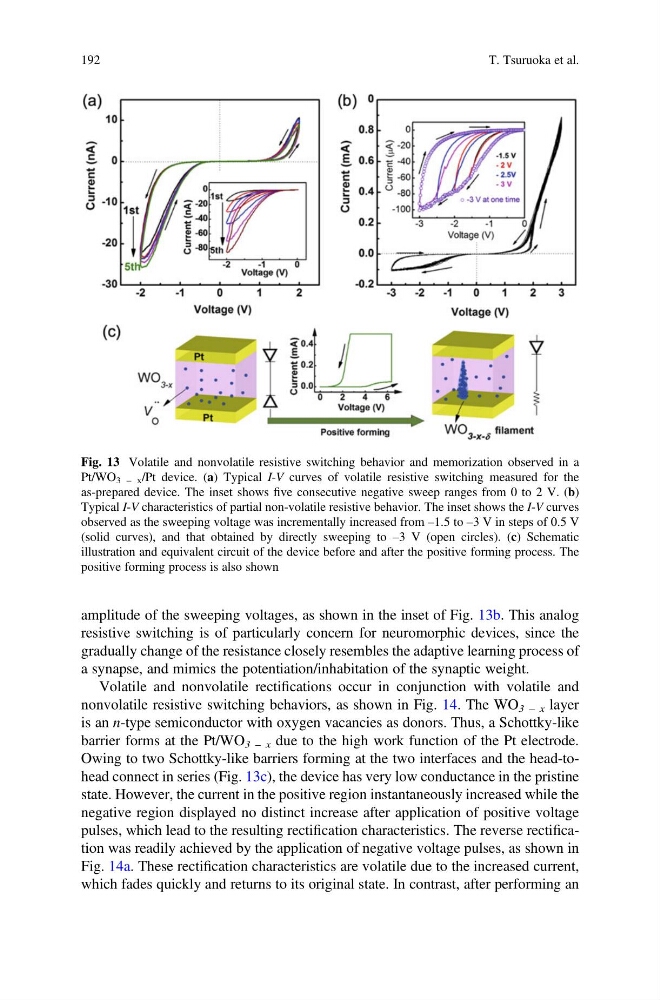
amplitude of the sweeping voltages, as shown in the inset of Fig. 13b. This analog
resistive switching is of particularly concern for neuromorphic devices, since the
gradually change of the resistance closely resembles the adaptive learning process of
a synapse, and mimics the potentiation/inhabitation of the synaptic weight.
Volatile and nonvolatile rectifications occur in conjunction with volatile and
nonvolatile resistive switching behaviors, as shown in Fig. 14. The WO 3 – x layer
is an n-type semiconductor with oxygen vacancies as donors. Thus, a Schottky-like
barrier forms at the Pt/WO 3 – x due to the high work function of the Pt electrode.
Owing to two Schottky-like barriers forming at the two interfaces and the head-tohead connect in series (Fig. 13c), the device has very low conductance in the pristine
state. However, the current in the positive region instantaneously increased while the
negative region displayed no distinct increase after application of positive voltage
pulses, which lead to the resulting rectification characteristics. The reverse rectification was readily achieved by the application of negative voltage pulses, as shown in
Fig. 14a. These rectification characteristics are volatile due to the increased current,
which fades quickly and returns to its original state. In contrast, after performing an
Fig. 13 Volatile and nonvolatile resistive switching behavior and memorization observed in a
Pt/WO 3 – x /Pt device. (a) Typical I-V curves of volatile resistive switching measured for the
as-prepared device. The inset shows five consecutive negative sweep ranges from 0 to 2 V. (b)
Typical I-V characteristics of partial non-volatile resistive behavior. The inset shows the I-V curves
observed as the sweeping voltage was incrementally increased from –1.5 to –3 V in steps of 0.5 V
(solid curves), and that obtained by directly sweeping to –3 V (open circles). (c) Schematic
illustration and equivalent circuit of the device before and after the positive forming process. The
positive forming process is also shown
192
T. Tsuruoka et al.
resistive switching is of particularly concern for neuromorphic devices, since the
gradually change of the resistance closely resembles the adaptive learning process of
a synapse, and mimics the potentiation/inhabitation of the synaptic weight.
Volatile and nonvolatile rectifications occur in conjunction with volatile and
nonvolatile resistive switching behaviors, as shown in Fig. 14. The WO 3 – x layer
is an n-type semiconductor with oxygen vacancies as donors. Thus, a Schottky-like
barrier forms at the Pt/WO 3 – x due to the high work function of the Pt electrode.
Owing to two Schottky-like barriers forming at the two interfaces and the head-tohead connect in series (Fig. 13c), the device has very low conductance in the pristine
state. However, the current in the positive region instantaneously increased while the
negative region displayed no distinct increase after application of positive voltage
pulses, which lead to the resulting rectification characteristics. The reverse rectification was readily achieved by the application of negative voltage pulses, as shown in
Fig. 14a. These rectification characteristics are volatile due to the increased current,
which fades quickly and returns to its original state. In contrast, after performing an
Fig. 13 Volatile and nonvolatile resistive switching behavior and memorization observed in a
Pt/WO 3 – x /Pt device. (a) Typical I-V curves of volatile resistive switching measured for the
as-prepared device. The inset shows five consecutive negative sweep ranges from 0 to 2 V. (b)
Typical I-V characteristics of partial non-volatile resistive behavior. The inset shows the I-V curves
observed as the sweeping voltage was incrementally increased from –1.5 to –3 V in steps of 0.5 V
(solid curves), and that obtained by directly sweeping to –3 V (open circles). (c) Schematic
illustration and equivalent circuit of the device before and after the positive forming process. The
positive forming process is also shown
192
T. Tsuruoka et al.