

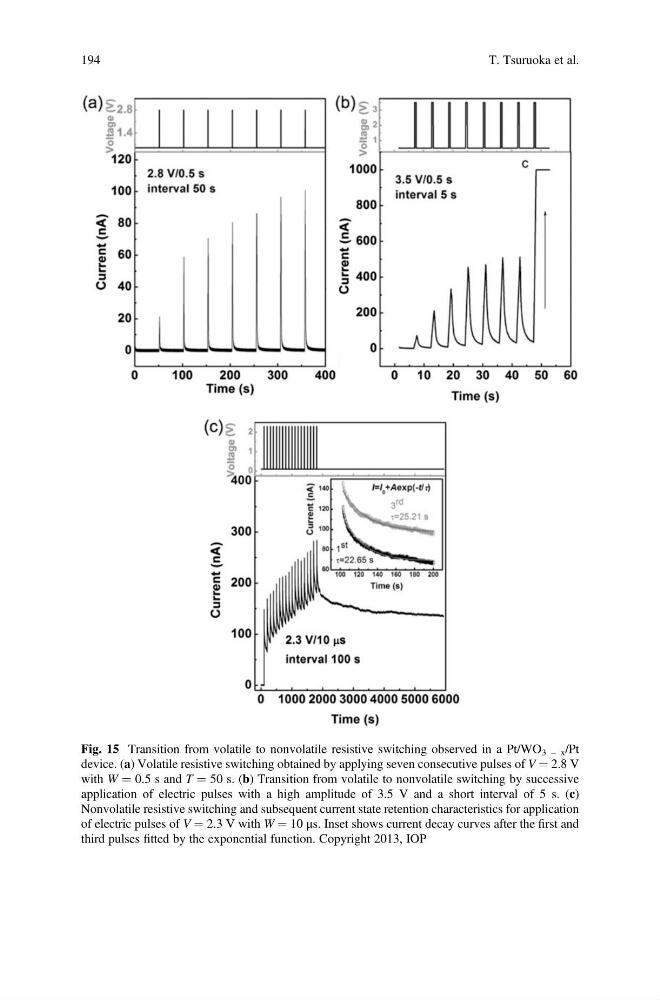
Fig. 15 Transition from volatile to nonvolatile resistive switching observed in a Pt/WO 3 – x /Pt
device. (a) Volatile resistive switching obtained by applying seven consecutive pulses of V ¼ 2.8 V
with W ¼ 0.5 s and T ¼ 50 s. (b) Transition from volatile to nonvolatile switching by successive
application of electric pulses with a high amplitude of 3.5 V and a short interval of 5 s. (c)
Nonvolatile resistive switching and subsequent current state retention characteristics for application
of electric pulses of V ¼ 2.3 V with W ¼ 10 μs. Inset shows current decay curves after the first and
third pulses fitted by the exponential function. Copyright 2013, IOP
194
T. Tsuruoka et al.
device. (a) Volatile resistive switching obtained by applying seven consecutive pulses of V ¼ 2.8 V
with W ¼ 0.5 s and T ¼ 50 s. (b) Transition from volatile to nonvolatile switching by successive
application of electric pulses with a high amplitude of 3.5 V and a short interval of 5 s. (c)
Nonvolatile resistive switching and subsequent current state retention characteristics for application
of electric pulses of V ¼ 2.3 V with W ¼ 10 μs. Inset shows current decay curves after the first and
third pulses fitted by the exponential function. Copyright 2013, IOP
194
T. Tsuruoka et al.