

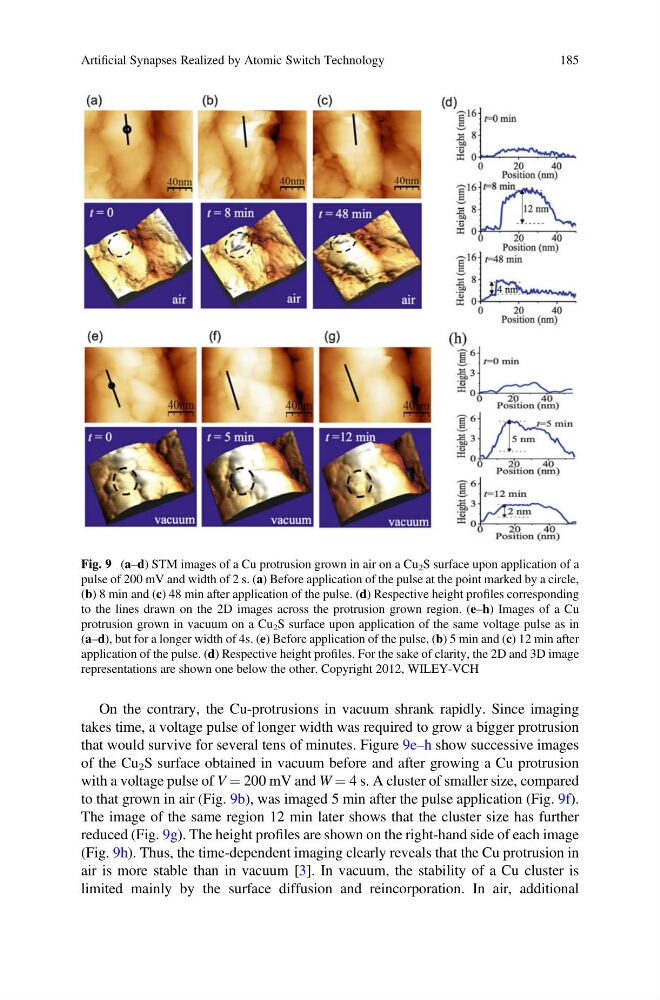
On the contrary, the Cu-protrusions in vacuum shrank rapidly. Since imaging
takes time, a voltage pulse of longer width was required to grow a bigger protrusion
that would survive for several tens of minutes. Figure 9e–h show successive images
of the Cu 2 S surface obtained in vacuum before and after growing a Cu protrusion
with a voltage pulse of V ¼ 200 mV and W ¼ 4 s. A cluster of smaller size, compared
to that grown in air (Fig. 9b), was imaged 5 min after the pulse application (Fig. 9f).
The image of the same region 12 min later shows that the cluster size has further
reduced (Fig. 9g). The height profiles are shown on the right-hand side of each image
(Fig. 9h). Thus, the time-dependent imaging clearly reveals that the Cu protrusion in
air is more stable than in vacuum [3]. In vacuum, the stability of a Cu cluster is
limited mainly by the surface diffusion and reincorporation. In air, additional
Fig. 9 (a–d) STM images of a Cu protrusion grown in air on a Cu 2 S surface upon application of a
pulse of 200 mV and width of 2 s. (a) Before application of the pulse at the point marked by a circle,
(b) 8 min and (c) 48 min after application of the pulse. (d) Respective height profiles corresponding
to the lines drawn on the 2D images across the protrusion grown region. (e–h) Images of a Cu
protrusion grown in vacuum on a Cu 2 S surface upon application of the same voltage pulse as in
(a–d), but for a longer width of 4s. (e) Before application of the pulse, (b) 5 min and (c) 12 min after
application of the pulse. (d) Respective height profiles. For the sake of clarity, the 2D and 3D image
representations are shown one below the other. Copyright 2012, WILEY-VCH
Artificial Synapses Realized by Atomic Switch Technology
185
takes time, a voltage pulse of longer width was required to grow a bigger protrusion
that would survive for several tens of minutes. Figure 9e–h show successive images
of the Cu 2 S surface obtained in vacuum before and after growing a Cu protrusion
with a voltage pulse of V ¼ 200 mV and W ¼ 4 s. A cluster of smaller size, compared
to that grown in air (Fig. 9b), was imaged 5 min after the pulse application (Fig. 9f).
The image of the same region 12 min later shows that the cluster size has further
reduced (Fig. 9g). The height profiles are shown on the right-hand side of each image
(Fig. 9h). Thus, the time-dependent imaging clearly reveals that the Cu protrusion in
air is more stable than in vacuum [3]. In vacuum, the stability of a Cu cluster is
limited mainly by the surface diffusion and reincorporation. In air, additional
Fig. 9 (a–d) STM images of a Cu protrusion grown in air on a Cu 2 S surface upon application of a
pulse of 200 mV and width of 2 s. (a) Before application of the pulse at the point marked by a circle,
(b) 8 min and (c) 48 min after application of the pulse. (d) Respective height profiles corresponding
to the lines drawn on the 2D images across the protrusion grown region. (e–h) Images of a Cu
protrusion grown in vacuum on a Cu 2 S surface upon application of the same voltage pulse as in
(a–d), but for a longer width of 4s. (e) Before application of the pulse, (b) 5 min and (c) 12 min after
application of the pulse. (d) Respective height profiles. For the sake of clarity, the 2D and 3D image
representations are shown one below the other. Copyright 2012, WILEY-VCH
Artificial Synapses Realized by Atomic Switch Technology
185