

atmosphere-dependent factors such as the chemisorption of oxygen [14] and water
[15] can form energetically stable clusters of copper oxides and hydroxides [16].
Moreover, the temperature dependence of the Cu 2 S synapse indicated a better
retention property of the synaptic strength at elevated temperatures. Thus, the LTM
state could be obtained with fewer input pulses compared to that at room temperature
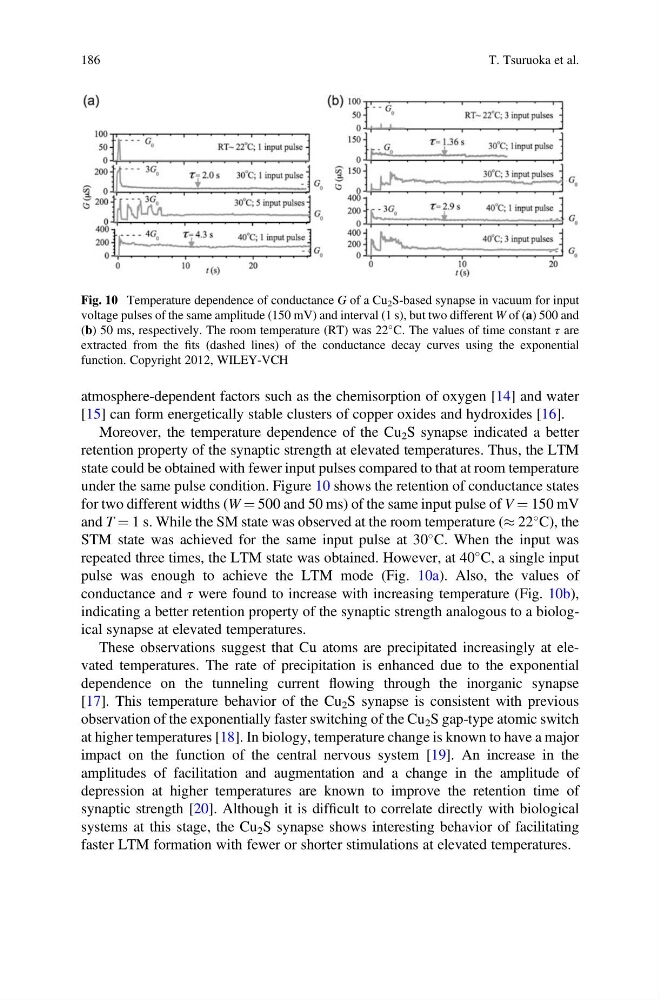
under the same pulse condition. Figure 10 shows the retention of conductance states
for two different widths (W ¼ 500 and 50 ms) of the same input pulse of V ¼ 150 mV
and T ¼ 1 s. While the SM state was observed at the room temperature (% 22
C), the
STM state was achieved for the same input pulse at 30
C. When the input was
repeated three times, the LTM state was obtained. However, at 40
C, a single input
pulse was enough to achieve the LTM mode (Fig. 10a). Also, the values of
conductance and τ were found to increase with increasing temperature (Fig. 10b),
indicating a better retention property of the synaptic strength analogous to a biological synapse at elevated temperatures.
These observations suggest that Cu atoms are precipitated increasingly at elevated temperatures. The rate of precipitation is enhanced due to the exponential
dependence on the tunneling current flowing through the inorganic synapse
[17]. This temperature behavior of the Cu 2 S synapse is consistent with previous
observation of the exponentially faster switching of the Cu 2 S gap-type atomic switch
at higher temperatures [18]. In biology, temperature change is known to have a major
impact on the function of the central nervous system [19]. An increase in the
amplitudes of facilitation and augmentation and a change in the amplitude of
depression at higher temperatures are known to improve the retention time of
synaptic strength [20]. Although it is difficult to correlate directly with biological
systems at this stage, the Cu 2 S synapse shows interesting behavior of facilitating
faster LTM formation with fewer or shorter stimulations at elevated temperatures.
Fig. 10 Temperature dependence of conductance G of a Cu 2 S-based synapse in vacuum for input
voltage pulses of the same amplitude (150 mV) and interval (1 s), but two different W of (a) 500 and
(b) 50 ms, respectively. The room temperature (RT) was 22
C. The values of time constant τ are
extracted from the fits (dashed lines) of the conductance decay curves using the exponential
function. Copyright 2012, WILEY-VCH
186
T. Tsuruoka et al.
[15] can form energetically stable clusters of copper oxides and hydroxides [16].
Moreover, the temperature dependence of the Cu 2 S synapse indicated a better
retention property of the synaptic strength at elevated temperatures. Thus, the LTM
state could be obtained with fewer input pulses compared to that at room temperature
under the same pulse condition. Figure 10 shows the retention of conductance states
for two different widths (W ¼ 500 and 50 ms) of the same input pulse of V ¼ 150 mV
and T ¼ 1 s. While the SM state was observed at the room temperature (% 22
C), the
STM state was achieved for the same input pulse at 30
C. When the input was
repeated three times, the LTM state was obtained. However, at 40
C, a single input
pulse was enough to achieve the LTM mode (Fig. 10a). Also, the values of
conductance and τ were found to increase with increasing temperature (Fig. 10b),
indicating a better retention property of the synaptic strength analogous to a biological synapse at elevated temperatures.
These observations suggest that Cu atoms are precipitated increasingly at elevated temperatures. The rate of precipitation is enhanced due to the exponential
dependence on the tunneling current flowing through the inorganic synapse
[17]. This temperature behavior of the Cu 2 S synapse is consistent with previous
observation of the exponentially faster switching of the Cu 2 S gap-type atomic switch
at higher temperatures [18]. In biology, temperature change is known to have a major
impact on the function of the central nervous system [19]. An increase in the
amplitudes of facilitation and augmentation and a change in the amplitude of
depression at higher temperatures are known to improve the retention time of
synaptic strength [20]. Although it is difficult to correlate directly with biological
systems at this stage, the Cu 2 S synapse shows interesting behavior of facilitating
faster LTM formation with fewer or shorter stimulations at elevated temperatures.
Fig. 10 Temperature dependence of conductance G of a Cu 2 S-based synapse in vacuum for input
voltage pulses of the same amplitude (150 mV) and interval (1 s), but two different W of (a) 500 and
(b) 50 ms, respectively. The room temperature (RT) was 22
C. The values of time constant τ are
extracted from the fits (dashed lines) of the conductance decay curves using the exponential
function. Copyright 2012, WILEY-VCH
186
T. Tsuruoka et al.