

because power consumption for ion insertion/desertion is very small. Nanoionicsbased manipulation of magnetic property is an exciting subject for exploring novel
and useful functions of the solid/solid interface.
4 Modulation of Superconducting Critical Temperature by
All-Solid-State EDLT
Room-temperature superconductivity has long been a dream as it can solve serious
energy and environmental problems. While synthesis of novel bulk materials and
chemical doping have been performed to search for room-temperature superconductor, none of them were successful so far. One promising means is electrostatic carrier
doping to potential superconductor, which cannot be superconductor due to lack of
sufficient electronic carrier density, because of the freedom from structural disorder
inherent in chemical doping.
Drozdov et al. reported that H 2 S solid showed superconducting transition at
200 K [52]. It strongly suggested that the possibility of high temperature superconductivity through electrostatic carrier doping in high Debye temperature solid, which
is indicated to be potential high-temperature superconductor on the basis of
Matthias’ law for the BCS type superconductor [53],
T c ¼ 1:14
hω D
k B
exp À
1
D 0
ð ÞV
,
ð3Þ
where D(0) and V are the density of states (DOS) near the Fermi level and the
electron-phonon interaction, respectively [53]. Electrostatic carrier doping using
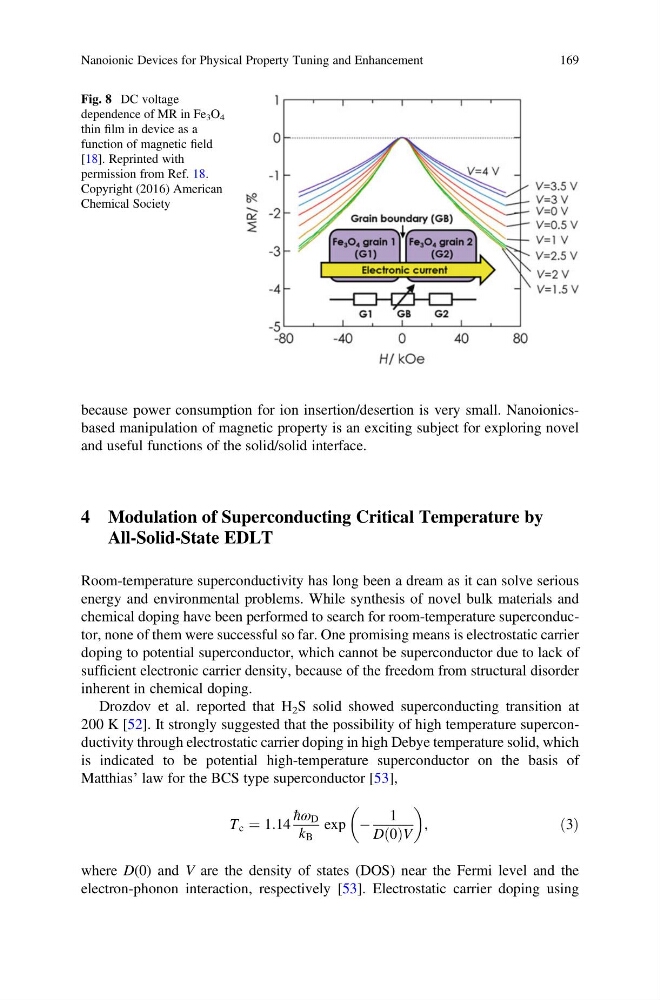
Fig. 8 DC voltage
dependence of MR in Fe 3 O 4
thin film in device as a
function of magnetic field
[18]. Reprinted with
permission from Ref. 18.
Copyright (2016) American
Chemical Society
Nanoionic Devices for Physical Property Tuning and Enhancement
169
and useful functions of the solid/solid interface.
4 Modulation of Superconducting Critical Temperature by
All-Solid-State EDLT
Room-temperature superconductivity has long been a dream as it can solve serious
energy and environmental problems. While synthesis of novel bulk materials and
chemical doping have been performed to search for room-temperature superconductor, none of them were successful so far. One promising means is electrostatic carrier
doping to potential superconductor, which cannot be superconductor due to lack of
sufficient electronic carrier density, because of the freedom from structural disorder
inherent in chemical doping.
Drozdov et al. reported that H 2 S solid showed superconducting transition at
200 K [52]. It strongly suggested that the possibility of high temperature superconductivity through electrostatic carrier doping in high Debye temperature solid, which
is indicated to be potential high-temperature superconductor on the basis of
Matthias’ law for the BCS type superconductor [53],
T c ¼ 1:14
hω D
k B
exp À
1
D 0
ð ÞV
,
ð3Þ
where D(0) and V are the density of states (DOS) near the Fermi level and the
electron-phonon interaction, respectively [53]. Electrostatic carrier doping using
Fig. 8 DC voltage
dependence of MR in Fe 3 O 4
thin film in device as a
function of magnetic field
[18]. Reprinted with
permission from Ref. 18.
Copyright (2016) American
Chemical Society
Nanoionic Devices for Physical Property Tuning and Enhancement
169