

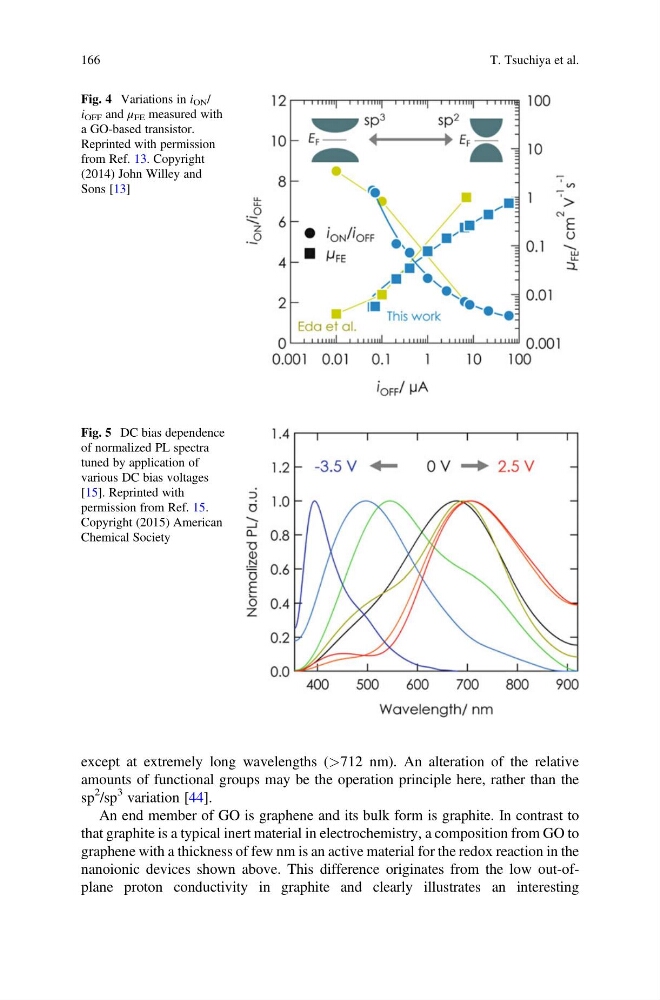
except at extremely long wavelengths (>712 nm). An alteration of the relative
amounts of functional groups may be the operation principle here, rather than the
sp
2 /sp
3 variation [44].
An end member of GO is graphene and its bulk form is graphite. In contrast to
that graphite is a typical inert material in electrochemistry, a composition from GO to
graphene with a thickness of few nm is an active material for the redox reaction in the
nanoionic devices shown above. This difference originates from the low out-ofplane proton conductivity in graphite and clearly illustrates an interesting
Fig. 4 Variations in i ON /
i OFF and μ FE measured with
a GO-based transistor.
Reprinted with permission
from Ref. 13. Copyright
(2014) John Willey and
Sons [13]
Fig. 5 DC bias dependence
of normalized PL spectra
tuned by application of
various DC bias voltages
[15]. Reprinted with
permission from Ref. 15.
Copyright (2015) American
Chemical Society
166
T. Tsuchiya et al.
amounts of functional groups may be the operation principle here, rather than the
sp
2 /sp
3 variation [44].
An end member of GO is graphene and its bulk form is graphite. In contrast to
that graphite is a typical inert material in electrochemistry, a composition from GO to
graphene with a thickness of few nm is an active material for the redox reaction in the
nanoionic devices shown above. This difference originates from the low out-ofplane proton conductivity in graphite and clearly illustrates an interesting
Fig. 4 Variations in i ON /
i OFF and μ FE measured with
a GO-based transistor.
Reprinted with permission
from Ref. 13. Copyright
(2014) John Willey and
Sons [13]
Fig. 5 DC bias dependence
of normalized PL spectra
tuned by application of
various DC bias voltages
[15]. Reprinted with
permission from Ref. 15.
Copyright (2015) American
Chemical Society
166
T. Tsuchiya et al.