

proton transport is accompanied by the redox reaction of GO in the vicinity of
GO/YSZ interface.
C x O y H z þ 2H
þ
þ 2e
0
$ C x O yÀ1 H z þ H 2 O,
ð1Þ
where C x O y H z , C x O yÀ1 H z , and H 2 O are GO, reduced GO, and water molecules,
respectively. The water molecules are known to adsorb on the surface of YSZ nanograins, in which sufficient proton conduction is enabled even at room temperature
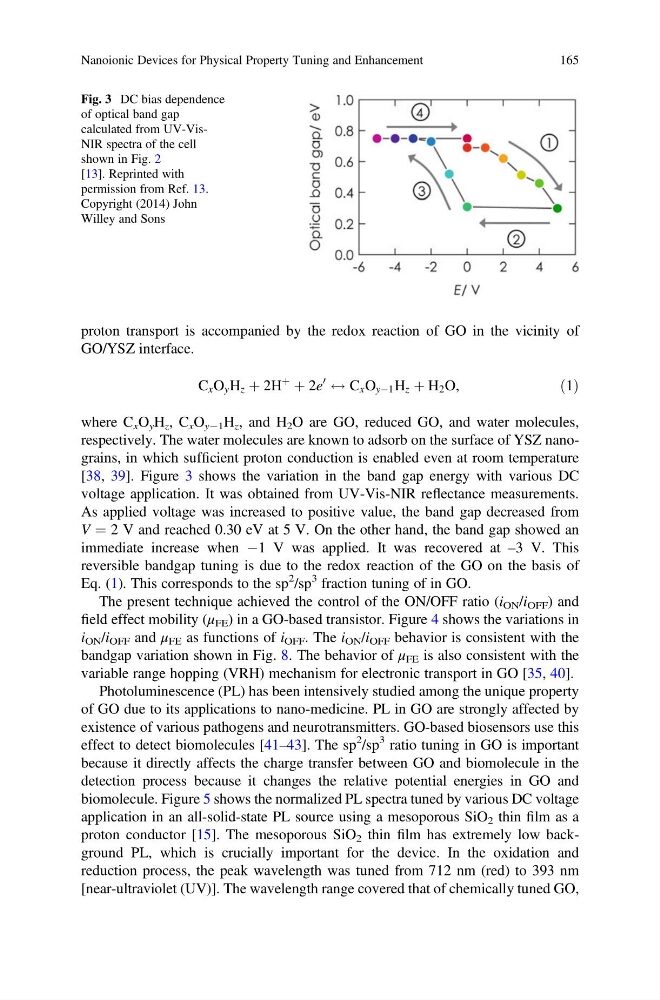
[38, 39]. Figure 3 shows the variation in the band gap energy with various DC
voltage application. It was obtained from UV-Vis-NIR reflectance measurements.
As applied voltage was increased to positive value, the band gap decreased from
V ¼ 2 V and reached 0.30 eV at 5 V. On the other hand, the band gap showed an
immediate increase when À1 V was applied. It was recovered at –3 V. This
reversible bandgap tuning is due to the redox reaction of the GO on the basis of
Eq. (1). This corresponds to the sp
2 /sp
3 fraction tuning of in GO.
The present technique achieved the control of the ON/OFF ratio (i ON /i OFF ) and
field effect mobility (μ FE ) in a GO-based transistor. Figure 4 shows the variations in
i ON /i OFF and μ FE as functions of i OFF . The i ON /i OFF behavior is consistent with the
bandgap variation shown in Fig. 8. The behavior of μ FE is also consistent with the
variable range hopping (VRH) mechanism for electronic transport in GO [35, 40].
Photoluminescence (PL) has been intensively studied among the unique property
of GO due to its applications to nano-medicine. PL in GO are strongly affected by
existence of various pathogens and neurotransmitters. GO-based biosensors use this
effect to detect biomolecules [41–43]. The sp
2 /sp
3 ratio tuning in GO is important
because it directly affects the charge transfer between GO and biomolecule in the
detection process because it changes the relative potential energies in GO and
biomolecule. Figure 5 shows the normalized PL spectra tuned by various DC voltage
application in an all-solid-state PL source using a mesoporous SiO 2 thin film as a
proton conductor [15]. The mesoporous SiO 2 thin film has extremely low background PL, which is crucially important for the device. In the oxidation and
reduction process, the peak wavelength was tuned from 712 nm (red) to 393 nm
[near-ultraviolet (UV)]. The wavelength range covered that of chemically tuned GO,
Fig. 3 DC bias dependence
of optical band gap
calculated from UV-VisNIR spectra of the cell
shown in Fig. 2
[13]. Reprinted with
permission from Ref. 13.
Copyright (2014) John
Willey and Sons
Nanoionic Devices for Physical Property Tuning and Enhancement
165
GO/YSZ interface.
C x O y H z þ 2H
þ
þ 2e
0
$ C x O yÀ1 H z þ H 2 O,
ð1Þ
where C x O y H z , C x O yÀ1 H z , and H 2 O are GO, reduced GO, and water molecules,
respectively. The water molecules are known to adsorb on the surface of YSZ nanograins, in which sufficient proton conduction is enabled even at room temperature
[38, 39]. Figure 3 shows the variation in the band gap energy with various DC
voltage application. It was obtained from UV-Vis-NIR reflectance measurements.
As applied voltage was increased to positive value, the band gap decreased from
V ¼ 2 V and reached 0.30 eV at 5 V. On the other hand, the band gap showed an
immediate increase when À1 V was applied. It was recovered at –3 V. This
reversible bandgap tuning is due to the redox reaction of the GO on the basis of
Eq. (1). This corresponds to the sp
2 /sp
3 fraction tuning of in GO.
The present technique achieved the control of the ON/OFF ratio (i ON /i OFF ) and
field effect mobility (μ FE ) in a GO-based transistor. Figure 4 shows the variations in
i ON /i OFF and μ FE as functions of i OFF . The i ON /i OFF behavior is consistent with the
bandgap variation shown in Fig. 8. The behavior of μ FE is also consistent with the
variable range hopping (VRH) mechanism for electronic transport in GO [35, 40].
Photoluminescence (PL) has been intensively studied among the unique property
of GO due to its applications to nano-medicine. PL in GO are strongly affected by
existence of various pathogens and neurotransmitters. GO-based biosensors use this
effect to detect biomolecules [41–43]. The sp
2 /sp
3 ratio tuning in GO is important
because it directly affects the charge transfer between GO and biomolecule in the
detection process because it changes the relative potential energies in GO and
biomolecule. Figure 5 shows the normalized PL spectra tuned by various DC voltage
application in an all-solid-state PL source using a mesoporous SiO 2 thin film as a
proton conductor [15]. The mesoporous SiO 2 thin film has extremely low background PL, which is crucially important for the device. In the oxidation and
reduction process, the peak wavelength was tuned from 712 nm (red) to 393 nm
[near-ultraviolet (UV)]. The wavelength range covered that of chemically tuned GO,
Fig. 3 DC bias dependence
of optical band gap
calculated from UV-VisNIR spectra of the cell
shown in Fig. 2
[13]. Reprinted with
permission from Ref. 13.
Copyright (2014) John
Willey and Sons
Nanoionic Devices for Physical Property Tuning and Enhancement
165