

Crystallization of Amorphous Pharmaceuticals at Ambient and Elevated …
83
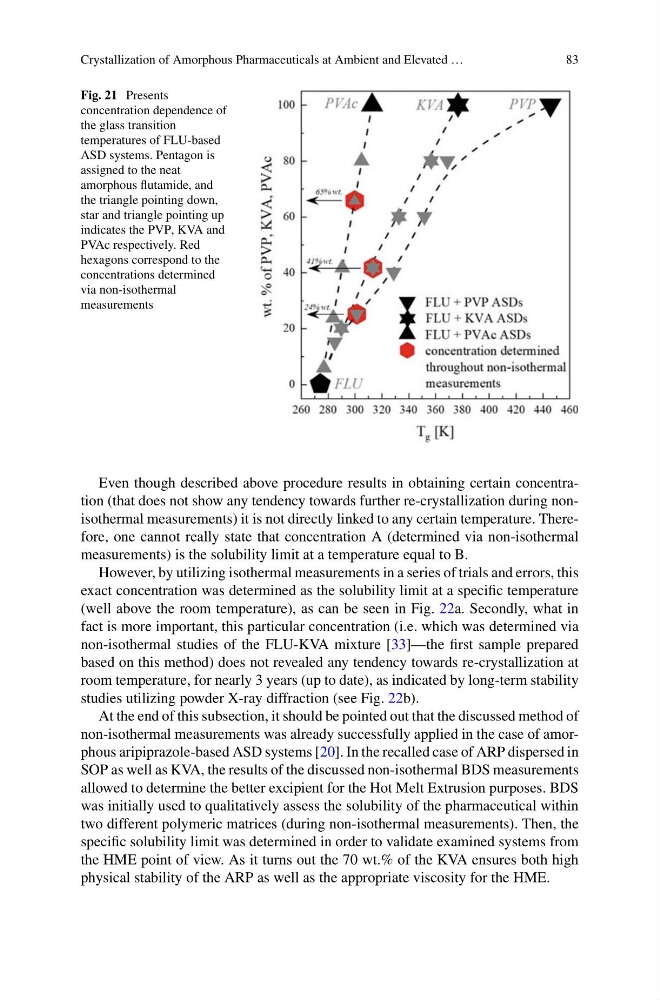
Fig. 21 Presents
concentration dependence of
the glass transition
temperatures of FLU-based
ASD systems. Pentagon is
assigned to the neat
amorphous flutamide, and
the triangle pointing down,
star and triangle pointing up
indicates the PVP, KVA and
PVAc respectively. Red
hexagons correspond to the
concentrations determined
via non-isothermal
measurements
Even though described above procedure results in obtaining certain concentration (that does not show any tendency towards further re-crystallization during nonisothermal measurements) it is not directly linked to any certain temperature. Therefore, one cannot really state that concentration A (determined via non-isothermal
measurements) is the solubility limit at a temperature equal to B.
However, by utilizing isothermal measurements in a series of trials and errors, this
exact concentration was determined as the solubility limit at a specific temperature
(well above the room temperature), as can be seen in Fig. 22a. Secondly, what in
fact is more important, this particular concentration (i.e. which was determined via
non-isothermal studies of the FLU-KVA mixture [33]—the first sample prepared
based on this method) does not revealed any tendency towards re-crystallization at
room temperature, for nearly 3 years (up to date), as indicated by long-term stability
studies utilizing powder X-ray diffraction (see Fig. 22b).
At the end of this subsection, it should be pointed out that the discussed method of
non-isothermal measurements was already successfully applied in the case of amorphous aripiprazole-based ASD systems [20]. In the recalled case of ARP dispersed in
SOP as well as KVA, the results of the discussed non-isothermal BDS measurements
allowed to determine the better excipient for the Hot Melt Extrusion purposes. BDS
was initially used to qualitatively assess the solubility of the pharmaceutical within
two different polymeric matrices (during non-isothermal measurements). Then, the
specific solubility limit was determined in order to validate examined systems from
the HME point of view. As it turns out the 70 wt.% of the KVA ensures both high
physical stability of the ARP as well as the appropriate viscosity for the HME.
83
Fig. 21 Presents
concentration dependence of
the glass transition
temperatures of FLU-based
ASD systems. Pentagon is
assigned to the neat
amorphous flutamide, and
the triangle pointing down,
star and triangle pointing up
indicates the PVP, KVA and
PVAc respectively. Red
hexagons correspond to the
concentrations determined
via non-isothermal
measurements
Even though described above procedure results in obtaining certain concentration (that does not show any tendency towards further re-crystallization during nonisothermal measurements) it is not directly linked to any certain temperature. Therefore, one cannot really state that concentration A (determined via non-isothermal
measurements) is the solubility limit at a temperature equal to B.
However, by utilizing isothermal measurements in a series of trials and errors, this
exact concentration was determined as the solubility limit at a specific temperature
(well above the room temperature), as can be seen in Fig. 22a. Secondly, what in
fact is more important, this particular concentration (i.e. which was determined via
non-isothermal studies of the FLU-KVA mixture [33]—the first sample prepared
based on this method) does not revealed any tendency towards re-crystallization at
room temperature, for nearly 3 years (up to date), as indicated by long-term stability
studies utilizing powder X-ray diffraction (see Fig. 22b).
At the end of this subsection, it should be pointed out that the discussed method of
non-isothermal measurements was already successfully applied in the case of amorphous aripiprazole-based ASD systems [20]. In the recalled case of ARP dispersed in
SOP as well as KVA, the results of the discussed non-isothermal BDS measurements
allowed to determine the better excipient for the Hot Melt Extrusion purposes. BDS
was initially used to qualitatively assess the solubility of the pharmaceutical within
two different polymeric matrices (during non-isothermal measurements). Then, the
specific solubility limit was determined in order to validate examined systems from
the HME point of view. As it turns out the 70 wt.% of the KVA ensures both high
physical stability of the ARP as well as the appropriate viscosity for the HME.