

80
J. Knapik-Kowalczuk et al.
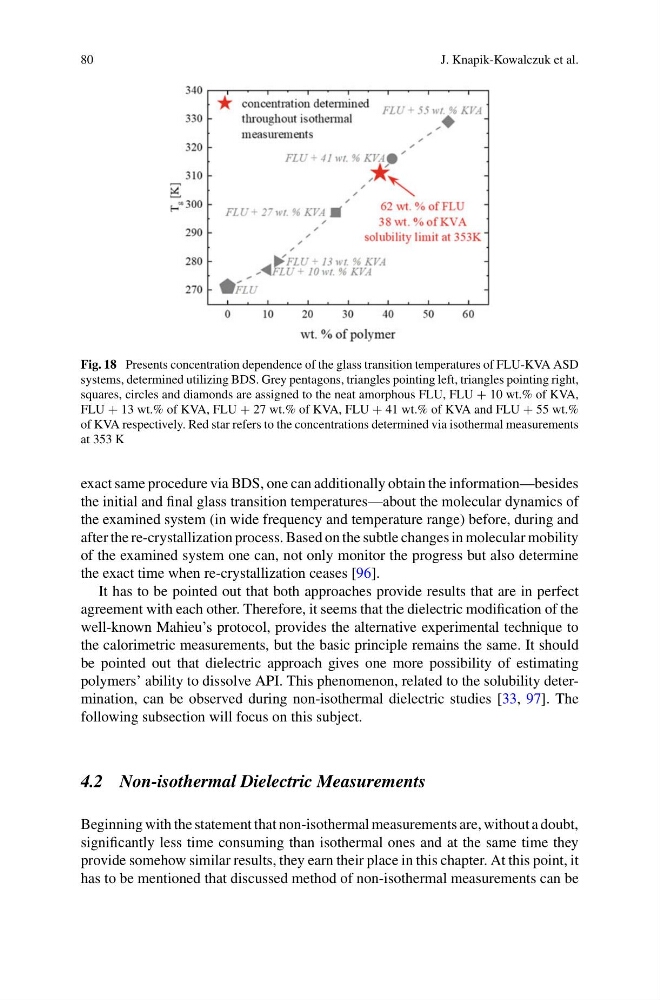
Fig. 18 Presents concentration dependence of the glass transition temperatures of FLU-KVA ASD
systems, determined utilizing BDS. Grey pentagons, triangles pointing left, triangles pointing right,
squares, circles and diamonds are assigned to the neat amorphous FLU, FLU + 10 wt.% of KVA,
FLU + 13 wt.% of KVA, FLU + 27 wt.% of KVA, FLU + 41 wt.% of KVA and FLU + 55 wt.%
of KVA respectively. Red star refers to the concentrations determined via isothermal measurements
at 353 K
exact same procedure via BDS, one can additionally obtain the information—besides
the initial and final glass transition temperatures—about the molecular dynamics of
the examined system (in wide frequency and temperature range) before, during and
after the re-crystallization process. Based on the subtle changes in molecular mobility
of the examined system one can, not only monitor the progress but also determine
the exact time when re-crystallization ceases [96].
It has to be pointed out that both approaches provide results that are in perfect
agreement with each other. Therefore, it seems that the dielectric modification of the
well-known Mahieu’s protocol, provides the alternative experimental technique to
the calorimetric measurements, but the basic principle remains the same. It should
be pointed out that dielectric approach gives one more possibility of estimating
polymers’ ability to dissolve API. This phenomenon, related to the solubility determination, can be observed during non-isothermal dielectric studies [33, 97]. The
following subsection will focus on this subject.
4.2 Non-isothermal Dielectric Measurements
Beginning with the statement that non-isothermal measurements are, without a doubt,
significantly less time consuming than isothermal ones and at the same time they
provide somehow similar results, they earn their place in this chapter. At this point, it
has to be mentioned that discussed method of non-isothermal measurements can be
J. Knapik-Kowalczuk et al.
Fig. 18 Presents concentration dependence of the glass transition temperatures of FLU-KVA ASD
systems, determined utilizing BDS. Grey pentagons, triangles pointing left, triangles pointing right,
squares, circles and diamonds are assigned to the neat amorphous FLU, FLU + 10 wt.% of KVA,
FLU + 13 wt.% of KVA, FLU + 27 wt.% of KVA, FLU + 41 wt.% of KVA and FLU + 55 wt.%
of KVA respectively. Red star refers to the concentrations determined via isothermal measurements
at 353 K
exact same procedure via BDS, one can additionally obtain the information—besides
the initial and final glass transition temperatures—about the molecular dynamics of
the examined system (in wide frequency and temperature range) before, during and
after the re-crystallization process. Based on the subtle changes in molecular mobility
of the examined system one can, not only monitor the progress but also determine
the exact time when re-crystallization ceases [96].
It has to be pointed out that both approaches provide results that are in perfect
agreement with each other. Therefore, it seems that the dielectric modification of the
well-known Mahieu’s protocol, provides the alternative experimental technique to
the calorimetric measurements, but the basic principle remains the same. It should
be pointed out that dielectric approach gives one more possibility of estimating
polymers’ ability to dissolve API. This phenomenon, related to the solubility determination, can be observed during non-isothermal dielectric studies [33, 97]. The
following subsection will focus on this subject.
4.2 Non-isothermal Dielectric Measurements
Beginning with the statement that non-isothermal measurements are, without a doubt,
significantly less time consuming than isothermal ones and at the same time they
provide somehow similar results, they earn their place in this chapter. At this point, it
has to be mentioned that discussed method of non-isothermal measurements can be