

76
J. Knapik-Kowalczuk et al.
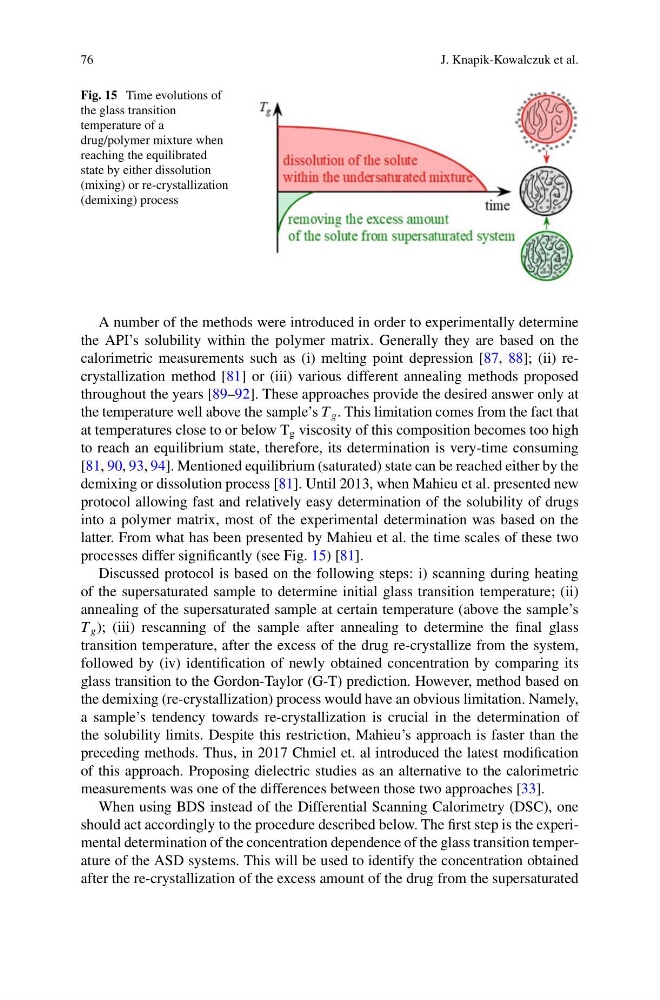
Fig. 15 Time evolutions of
the glass transition
temperature of a
drug/polymer mixture when
reaching the equilibrated
state by either dissolution
(mixing) or re-crystallization
(demixing) process
A number of the methods were introduced in order to experimentally determine
the API’s solubility within the polymer matrix. Generally they are based on the
calorimetric measurements such as (i) melting point depression [87, 88]; (ii) recrystallization method [81] or (iii) various different annealing methods proposed
throughout the years [89–92]. These approaches provide the desired answer only at
the temperature well above the sample’s T g . This limitation comes from the fact that
at temperatures close to or below T g viscosity of this composition becomes too high
to reach an equilibrium state, therefore, its determination is very-time consuming
[81, 90, 93, 94]. Mentioned equilibrium (saturated) state can be reached either by the
demixing or dissolution process [81]. Until 2013, when Mahieu et al. presented new
protocol allowing fast and relatively easy determination of the solubility of drugs
into a polymer matrix, most of the experimental determination was based on the
latter. From what has been presented by Mahieu et al. the time scales of these two
processes differ significantly (see Fig. 15) [81].
Discussed protocol is based on the following steps: i) scanning during heating
of the supersaturated sample to determine initial glass transition temperature; (ii)
annealing of the supersaturated sample at certain temperature (above the sample’s
T g ); (iii) rescanning of the sample after annealing to determine the final glass
transition temperature, after the excess of the drug re-crystallize from the system,
followed by (iv) identification of newly obtained concentration by comparing its
glass transition to the Gordon-Taylor (G-T) prediction. However, method based on
the demixing (re-crystallization) process would have an obvious limitation. Namely,
a sample’s tendency towards re-crystallization is crucial in the determination of
the solubility limits. Despite this restriction, Mahieu’s approach is faster than the
preceding methods. Thus, in 2017 Chmiel et. al introduced the latest modification
of this approach. Proposing dielectric studies as an alternative to the calorimetric
measurements was one of the differences between those two approaches [33].
When using BDS instead of the Differential Scanning Calorimetry (DSC), one
should act accordingly to the procedure described below. The first step is the experimental determination of the concentration dependence of the glass transition temperature of the ASD systems. This will be used to identify the concentration obtained
after the re-crystallization of the excess amount of the drug from the supersaturated
J. Knapik-Kowalczuk et al.
Fig. 15 Time evolutions of
the glass transition
temperature of a
drug/polymer mixture when
reaching the equilibrated
state by either dissolution
(mixing) or re-crystallization
(demixing) process
A number of the methods were introduced in order to experimentally determine
the API’s solubility within the polymer matrix. Generally they are based on the
calorimetric measurements such as (i) melting point depression [87, 88]; (ii) recrystallization method [81] or (iii) various different annealing methods proposed
throughout the years [89–92]. These approaches provide the desired answer only at
the temperature well above the sample’s T g . This limitation comes from the fact that
at temperatures close to or below T g viscosity of this composition becomes too high
to reach an equilibrium state, therefore, its determination is very-time consuming
[81, 90, 93, 94]. Mentioned equilibrium (saturated) state can be reached either by the
demixing or dissolution process [81]. Until 2013, when Mahieu et al. presented new
protocol allowing fast and relatively easy determination of the solubility of drugs
into a polymer matrix, most of the experimental determination was based on the
latter. From what has been presented by Mahieu et al. the time scales of these two
processes differ significantly (see Fig. 15) [81].
Discussed protocol is based on the following steps: i) scanning during heating
of the supersaturated sample to determine initial glass transition temperature; (ii)
annealing of the supersaturated sample at certain temperature (above the sample’s
T g ); (iii) rescanning of the sample after annealing to determine the final glass
transition temperature, after the excess of the drug re-crystallize from the system,
followed by (iv) identification of newly obtained concentration by comparing its
glass transition to the Gordon-Taylor (G-T) prediction. However, method based on
the demixing (re-crystallization) process would have an obvious limitation. Namely,
a sample’s tendency towards re-crystallization is crucial in the determination of
the solubility limits. Despite this restriction, Mahieu’s approach is faster than the
preceding methods. Thus, in 2017 Chmiel et. al introduced the latest modification
of this approach. Proposing dielectric studies as an alternative to the calorimetric
measurements was one of the differences between those two approaches [33].
When using BDS instead of the Differential Scanning Calorimetry (DSC), one
should act accordingly to the procedure described below. The first step is the experimental determination of the concentration dependence of the glass transition temperature of the ASD systems. This will be used to identify the concentration obtained
after the re-crystallization of the excess amount of the drug from the supersaturated