

Crystallization of Amorphous Pharmaceuticals at Ambient and Elevated …
75
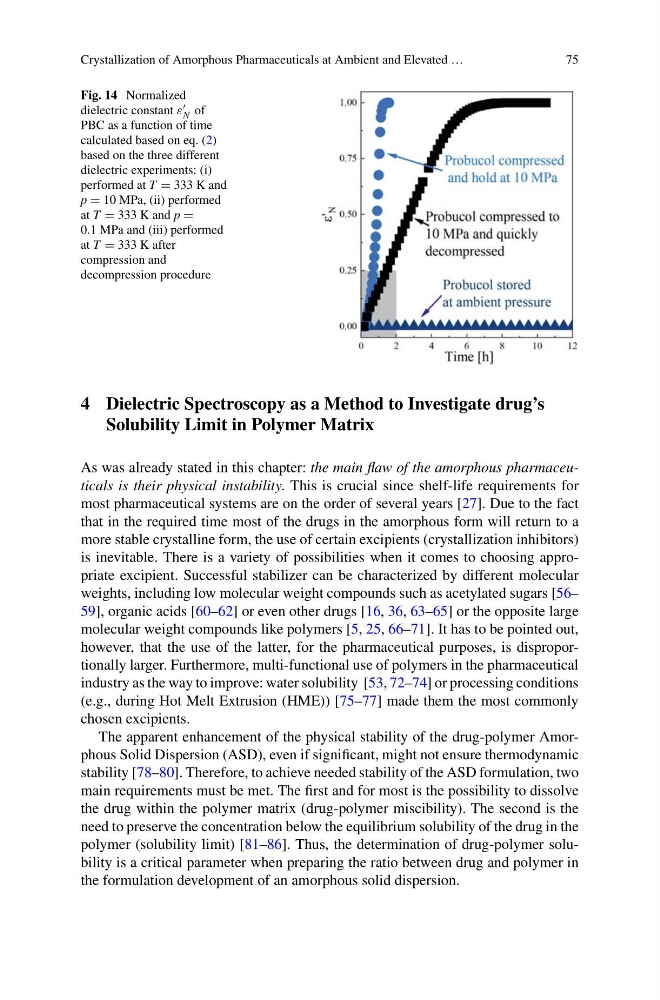
Fig. 14 Normalized
dielectric constant ε
N of
PBC as a function of time
calculated based on eq. (2)
based on the three different
dielectric experiments: (i)
performed at T = 333 K and
p = 10 MPa, (ii) performed
at T = 333 K and p =
0.1 MPa and (iii) performed
at T = 333 K after
compression and
decompression procedure
4 Dielectric Spectroscopy as a Method to Investigate drug’s
Solubility Limit in Polymer Matrix
As was already stated in this chapter: the main flaw of the amorphous pharmaceuticals is their physical instability. This is crucial since shelf-life requirements for
most pharmaceutical systems are on the order of several years [27]. Due to the fact
that in the required time most of the drugs in the amorphous form will return to a
more stable crystalline form, the use of certain excipients (crystallization inhibitors)
is inevitable. There is a variety of possibilities when it comes to choosing appropriate excipient. Successful stabilizer can be characterized by different molecular
weights, including low molecular weight compounds such as acetylated sugars [56–
59], organic acids [60–62] or even other drugs [16, 36, 63–65] or the opposite large
molecular weight compounds like polymers [5, 25, 66–71]. It has to be pointed out,
however, that the use of the latter, for the pharmaceutical purposes, is disproportionally larger. Furthermore, multi-functional use of polymers in the pharmaceutical
industry as the way to improve: water solubility [53, 72–74] or processing conditions
(e.g., during Hot Melt Extrusion (HME)) [75–77] made them the most commonly
chosen excipients.
The apparent enhancement of the physical stability of the drug-polymer Amorphous Solid Dispersion (ASD), even if significant, might not ensure thermodynamic
stability [78–80]. Therefore, to achieve needed stability of the ASD formulation, two
main requirements must be met. The first and for most is the possibility to dissolve
the drug within the polymer matrix (drug-polymer miscibility). The second is the
need to preserve the concentration below the equilibrium solubility of the drug in the
polymer (solubility limit) [81–86]. Thus, the determination of drug-polymer solubility is a critical parameter when preparing the ratio between drug and polymer in
the formulation development of an amorphous solid dispersion.
75
Fig. 14 Normalized
dielectric constant ε
N of
PBC as a function of time
calculated based on eq. (2)
based on the three different
dielectric experiments: (i)
performed at T = 333 K and
p = 10 MPa, (ii) performed
at T = 333 K and p =
0.1 MPa and (iii) performed
at T = 333 K after
compression and
decompression procedure
4 Dielectric Spectroscopy as a Method to Investigate drug’s
Solubility Limit in Polymer Matrix
As was already stated in this chapter: the main flaw of the amorphous pharmaceuticals is their physical instability. This is crucial since shelf-life requirements for
most pharmaceutical systems are on the order of several years [27]. Due to the fact
that in the required time most of the drugs in the amorphous form will return to a
more stable crystalline form, the use of certain excipients (crystallization inhibitors)
is inevitable. There is a variety of possibilities when it comes to choosing appropriate excipient. Successful stabilizer can be characterized by different molecular
weights, including low molecular weight compounds such as acetylated sugars [56–
59], organic acids [60–62] or even other drugs [16, 36, 63–65] or the opposite large
molecular weight compounds like polymers [5, 25, 66–71]. It has to be pointed out,
however, that the use of the latter, for the pharmaceutical purposes, is disproportionally larger. Furthermore, multi-functional use of polymers in the pharmaceutical
industry as the way to improve: water solubility [53, 72–74] or processing conditions
(e.g., during Hot Melt Extrusion (HME)) [75–77] made them the most commonly
chosen excipients.
The apparent enhancement of the physical stability of the drug-polymer Amorphous Solid Dispersion (ASD), even if significant, might not ensure thermodynamic
stability [78–80]. Therefore, to achieve needed stability of the ASD formulation, two
main requirements must be met. The first and for most is the possibility to dissolve
the drug within the polymer matrix (drug-polymer miscibility). The second is the
need to preserve the concentration below the equilibrium solubility of the drug in the
polymer (solubility limit) [81–86]. Thus, the determination of drug-polymer solubility is a critical parameter when preparing the ratio between drug and polymer in
the formulation development of an amorphous solid dispersion.