

Crystallization of Amorphous Pharmaceuticals at Ambient and Elevated …
69
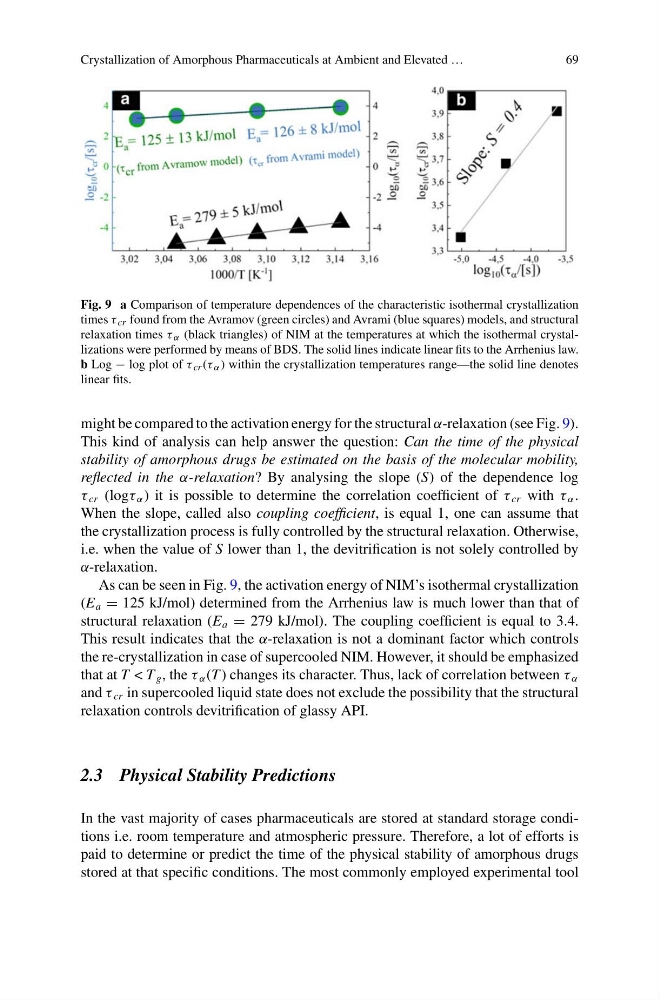
Fig. 9 a Comparison of temperature dependences of the characteristic isothermal crystallization
times τ cr found from the Avramov (green circles) and Avrami (blue squares) models, and structural
relaxation times τ α (black triangles) of NIM at the temperatures at which the isothermal crystallizations were performed by means of BDS. The solid lines indicate linear fits to the Arrhenius law.
b Log − log plot of τ cr (τ α ) within the crystallization temperatures range—the solid line denotes
linear fits.
might be compared to the activation energy for the structural α-relaxation (see Fig. 9).
This kind of analysis can help answer the question: Can the time of the physical
stability of amorphous drugs be estimated on the basis of the molecular mobility,
reflected in the α-relaxation? By analysing the slope (S) of the dependence log
τ cr (logτ α ) it is possible to determine the correlation coefficient of τ cr with τ α .
When the slope, called also coupling coefficient, is equal 1, one can assume that
the crystallization process is fully controlled by the structural relaxation. Otherwise,
i.e. when the value of S lower than 1, the devitrification is not solely controlled by
α-relaxation.
As can be seen in Fig. 9, the activation energy of NIM’s isothermal crystallization
(E a = 125 kJ/mol) determined from the Arrhenius law is much lower than that of
structural relaxation (E a = 279 kJ/mol). The coupling coefficient is equal to 3.4.
This result indicates that the α-relaxation is not a dominant factor which controls
the re-crystallization in case of supercooled NIM. However, it should be emphasized
that at T < T g , the τ α (T ) changes its character. Thus, lack of correlation between τ α
and τ cr in supercooled liquid state does not exclude the possibility that the structural
relaxation controls devitrification of glassy API.
2.3 Physical Stability Predictions
In the vast majority of cases pharmaceuticals are stored at standard storage conditions i.e. room temperature and atmospheric pressure. Therefore, a lot of efforts is
paid to determine or predict the time of the physical stability of amorphous drugs
stored at that specific conditions. The most commonly employed experimental tool
69
Fig. 9 a Comparison of temperature dependences of the characteristic isothermal crystallization
times τ cr found from the Avramov (green circles) and Avrami (blue squares) models, and structural
relaxation times τ α (black triangles) of NIM at the temperatures at which the isothermal crystallizations were performed by means of BDS. The solid lines indicate linear fits to the Arrhenius law.
b Log − log plot of τ cr (τ α ) within the crystallization temperatures range—the solid line denotes
linear fits.
might be compared to the activation energy for the structural α-relaxation (see Fig. 9).
This kind of analysis can help answer the question: Can the time of the physical
stability of amorphous drugs be estimated on the basis of the molecular mobility,
reflected in the α-relaxation? By analysing the slope (S) of the dependence log
τ cr (logτ α ) it is possible to determine the correlation coefficient of τ cr with τ α .
When the slope, called also coupling coefficient, is equal 1, one can assume that
the crystallization process is fully controlled by the structural relaxation. Otherwise,
i.e. when the value of S lower than 1, the devitrification is not solely controlled by
α-relaxation.
As can be seen in Fig. 9, the activation energy of NIM’s isothermal crystallization
(E a = 125 kJ/mol) determined from the Arrhenius law is much lower than that of
structural relaxation (E a = 279 kJ/mol). The coupling coefficient is equal to 3.4.
This result indicates that the α-relaxation is not a dominant factor which controls
the re-crystallization in case of supercooled NIM. However, it should be emphasized
that at T < T g , the τ α (T ) changes its character. Thus, lack of correlation between τ α
and τ cr in supercooled liquid state does not exclude the possibility that the structural
relaxation controls devitrification of glassy API.
2.3 Physical Stability Predictions
In the vast majority of cases pharmaceuticals are stored at standard storage conditions i.e. room temperature and atmospheric pressure. Therefore, a lot of efforts is
paid to determine or predict the time of the physical stability of amorphous drugs
stored at that specific conditions. The most commonly employed experimental tool