

70
J. Knapik-Kowalczuk et al.
for investigating long-term physical stability of amorphous APIs is X-ray diffraction
(XRD). However, it has to be pointed out that the long-term isothermal XRD studies
performed at room temperature are very time consuming. Such experiments can take
even several years prior the first sign of the sample re-crystallization will be registered. Therefore, scientists constantly try to find method that enables the prediction
of the minimal time of amorphous APIs physical stability.
As it has been mentioned, in the above section, the re-crystallization of amorphous
APIs can be controlled by the structural relaxation. Thus, by determining the time of
the α-relaxation of these pharmaceuticals stored at room temperature, it is possible
to estimate the time of their physical stability. Unfortunately, below T g the structural
α-relaxation becomes too slow to be experimentally observed. To overcome this
problem, one can use a few methods, which were originally developed for estimation
of the structural relaxation times of glasses. Application of these methods is based
on the measurements of τ α (T ) in the supercooled liquid region. In this section two
of these methods will be thoroughly describe.
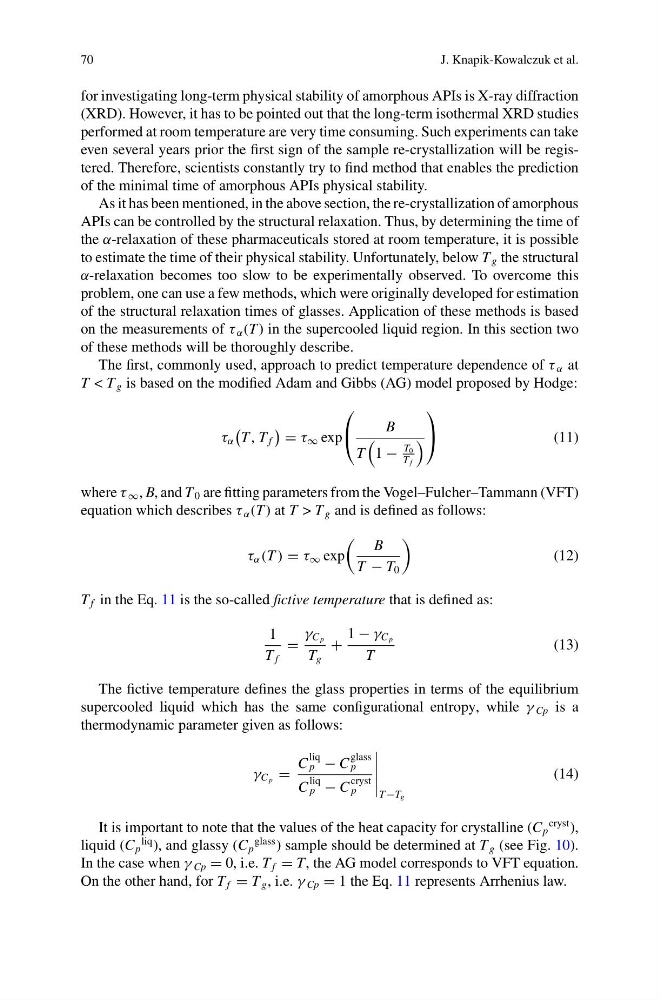
The first, commonly used, approach to predict temperature dependence of τ α at
T < T g is based on the modified Adam and Gibbs (AG) model proposed by Hodge:
τ α
T, T f
= τ ∞ exp
⎛
⎝
B
T
1 −
T 0
T f
⎞
⎠
(11)
where τ ∞ , B, and T 0 are fitting parameters from the Vogel–Fulcher–Tammann (VFT)
equation which describes τ α (T ) at T > T g and is defined as follows:
τ α (T ) = τ ∞ exp
B
T − T 0
(12)
T f in the Eq. 11 is the so-called fictive temperature that is defined as:
1
T f
=
γ C p
T g
+
1 − γ C p
T
(13)
The fictive temperature defines the glass properties in terms of the equilibrium
supercooled liquid which has the same configurational entropy, while γ Cp is a
thermodynamic parameter given as follows:
γ C p =
C
liq
p − C
glass
p
C
liq
p − C
cryst
p
T −T g
(14)
It is important to note that the values of the heat capacity for crystalline (C p
cryst ),
liquid (C p
liq ), and glassy (C p
glass ) sample should be determined at T g (see Fig. 10).
In the case when γ Cp = 0, i.e. T f = T, the AG model corresponds to VFT equation.
On the other hand, for T f = T g , i.e. γ Cp = 1 the Eq. 11 represents Arrhenius law.
J. Knapik-Kowalczuk et al.
for investigating long-term physical stability of amorphous APIs is X-ray diffraction
(XRD). However, it has to be pointed out that the long-term isothermal XRD studies
performed at room temperature are very time consuming. Such experiments can take
even several years prior the first sign of the sample re-crystallization will be registered. Therefore, scientists constantly try to find method that enables the prediction
of the minimal time of amorphous APIs physical stability.
As it has been mentioned, in the above section, the re-crystallization of amorphous
APIs can be controlled by the structural relaxation. Thus, by determining the time of
the α-relaxation of these pharmaceuticals stored at room temperature, it is possible
to estimate the time of their physical stability. Unfortunately, below T g the structural
α-relaxation becomes too slow to be experimentally observed. To overcome this
problem, one can use a few methods, which were originally developed for estimation
of the structural relaxation times of glasses. Application of these methods is based
on the measurements of τ α (T ) in the supercooled liquid region. In this section two
of these methods will be thoroughly describe.
The first, commonly used, approach to predict temperature dependence of τ α at
T < T g is based on the modified Adam and Gibbs (AG) model proposed by Hodge:
τ α
T, T f
= τ ∞ exp
⎛
⎝
B
T
1 −
T 0
T f
⎞
⎠
(11)
where τ ∞ , B, and T 0 are fitting parameters from the Vogel–Fulcher–Tammann (VFT)
equation which describes τ α (T ) at T > T g and is defined as follows:
τ α (T ) = τ ∞ exp
B
T − T 0
(12)
T f in the Eq. 11 is the so-called fictive temperature that is defined as:
1
T f
=
γ C p
T g
+
1 − γ C p
T
(13)
The fictive temperature defines the glass properties in terms of the equilibrium
supercooled liquid which has the same configurational entropy, while γ Cp is a
thermodynamic parameter given as follows:
γ C p =
C
liq
p − C
glass
p
C
liq
p − C
cryst
p
T −T g
(14)
It is important to note that the values of the heat capacity for crystalline (C p
cryst ),
liquid (C p
liq ), and glassy (C p
glass ) sample should be determined at T g (see Fig. 10).
In the case when γ Cp = 0, i.e. T f = T, the AG model corresponds to VFT equation.
On the other hand, for T f = T g , i.e. γ Cp = 1 the Eq. 11 represents Arrhenius law.