

276
M. Tress et al.
3.4 Spatial Distribution of Regions with Different Dynamics
Following the picture that the RAF is not only dynamically distinct but also spatially
separated, namely in a layer surrounding each crystallite, we assume that also the
segments belonging to the CAF are concentrated in a particular region. Hence, CAF
does not only refer to a certain proportion of the segments but also to particular
spatial regions. The architecture of the chains then allows more detailed conjectures
about the distribution of these regions.
It is known that in the presence of POSS molecules the crystallization of polymer
chains is suppressed [27–30]. Since in the studied star-polymer the arms are relatively short, the chains are likely to resemble soft spherical shapes with only limited
interpenetration of arms of adjacent chains. Consequently, the POSS which connects
the arms of each molecule will be located roughly in the centers of these sphere-like
molecules and their arrangement may be approximated by some spherical packing.
For reasons of simplicity we will assume close packing of spheres to estimate the
average center-to-center distance of adjacent molecules of volume V which is then
given by:
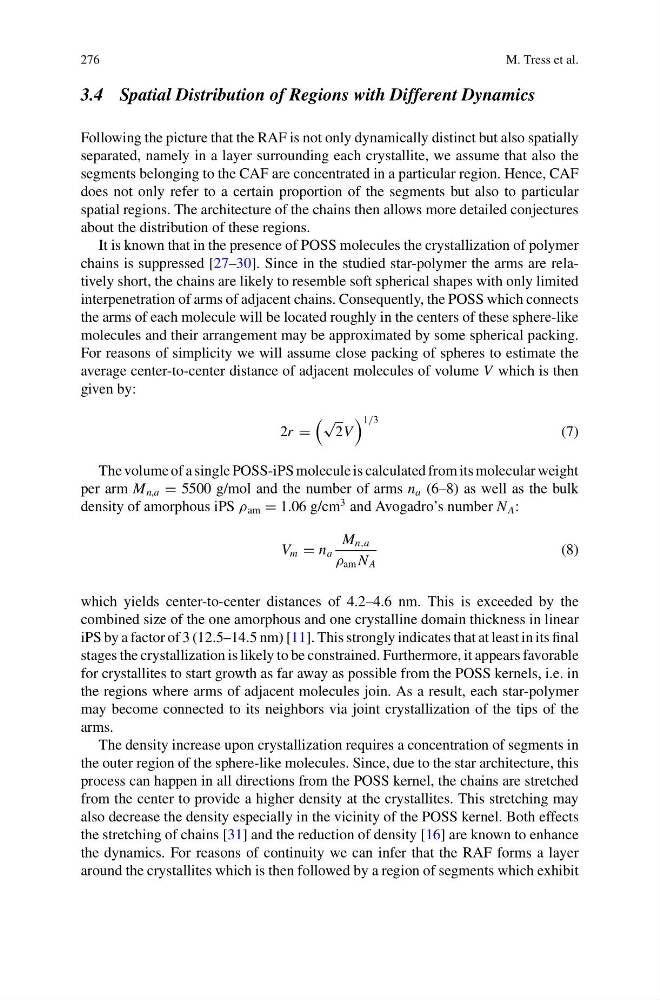
2r =
√
2V
1/3
(7)
The volume of a single POSS-iPS molecule is calculated from its molecular weight
per arm M n,a = 5500 g/mol and the number of arms n a (6–8) as well as the bulk
density of amorphous iPS ρ am = 1.06 g/cm
3 and Avogadro’s number N A :
V m = n a
M n,a
ρ am N A
(8)
which yields center-to-center distances of 4.2–4.6 nm. This is exceeded by the
combined size of the one amorphous and one crystalline domain thickness in linear
iPS by a factor of 3 (12.5–14.5 nm) [11]. This strongly indicates that at least in its final
stages the crystallization is likely to be constrained. Furthermore, it appears favorable
for crystallites to start growth as far away as possible from the POSS kernels, i.e. in
the regions where arms of adjacent molecules join. As a result, each star-polymer
may become connected to its neighbors via joint crystallization of the tips of the
arms.
The density increase upon crystallization requires a concentration of segments in
the outer region of the sphere-like molecules. Since, due to the star architecture, this
process can happen in all directions from the POSS kernel, the chains are stretched
from the center to provide a higher density at the crystallites. This stretching may
also decrease the density especially in the vicinity of the POSS kernel. Both effects
the stretching of chains [31] and the reduction of density [16] are known to enhance
the dynamics. For reasons of continuity we can infer that the RAF forms a layer
around the crystallites which is then followed by a region of segments which exhibit
M. Tress et al.
3.4 Spatial Distribution of Regions with Different Dynamics
Following the picture that the RAF is not only dynamically distinct but also spatially
separated, namely in a layer surrounding each crystallite, we assume that also the
segments belonging to the CAF are concentrated in a particular region. Hence, CAF
does not only refer to a certain proportion of the segments but also to particular
spatial regions. The architecture of the chains then allows more detailed conjectures
about the distribution of these regions.
It is known that in the presence of POSS molecules the crystallization of polymer
chains is suppressed [27–30]. Since in the studied star-polymer the arms are relatively short, the chains are likely to resemble soft spherical shapes with only limited
interpenetration of arms of adjacent chains. Consequently, the POSS which connects
the arms of each molecule will be located roughly in the centers of these sphere-like
molecules and their arrangement may be approximated by some spherical packing.
For reasons of simplicity we will assume close packing of spheres to estimate the
average center-to-center distance of adjacent molecules of volume V which is then
given by:
2r =
√
2V
1/3
(7)
The volume of a single POSS-iPS molecule is calculated from its molecular weight
per arm M n,a = 5500 g/mol and the number of arms n a (6–8) as well as the bulk
density of amorphous iPS ρ am = 1.06 g/cm
3 and Avogadro’s number N A :
V m = n a
M n,a
ρ am N A
(8)
which yields center-to-center distances of 4.2–4.6 nm. This is exceeded by the
combined size of the one amorphous and one crystalline domain thickness in linear
iPS by a factor of 3 (12.5–14.5 nm) [11]. This strongly indicates that at least in its final
stages the crystallization is likely to be constrained. Furthermore, it appears favorable
for crystallites to start growth as far away as possible from the POSS kernels, i.e. in
the regions where arms of adjacent molecules join. As a result, each star-polymer
may become connected to its neighbors via joint crystallization of the tips of the
arms.
The density increase upon crystallization requires a concentration of segments in
the outer region of the sphere-like molecules. Since, due to the star architecture, this
process can happen in all directions from the POSS kernel, the chains are stretched
from the center to provide a higher density at the crystallites. This stretching may
also decrease the density especially in the vicinity of the POSS kernel. Both effects
the stretching of chains [31] and the reduction of density [16] are known to enhance
the dynamics. For reasons of continuity we can infer that the RAF forms a layer
around the crystallites which is then followed by a region of segments which exhibit