

Confined Glassy Dynamics in a Star-Shaped Polymer …
275
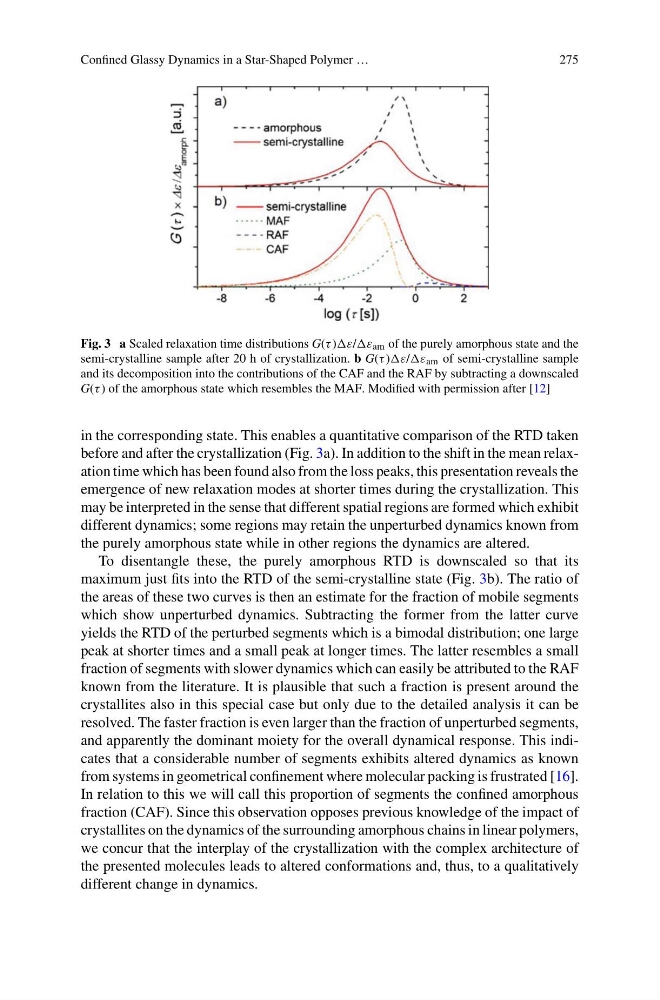
Fig. 3 a Scaled relaxation time distributions G(τ )ε/ε am of the purely amorphous state and the
semi-crystalline sample after 20 h of crystallization. b G(τ )ε/ε am of semi-crystalline sample
and its decomposition into the contributions of the CAF and the RAF by subtracting a downscaled
G(τ ) of the amorphous state which resembles the MAF. Modified with permission after [12]
in the corresponding state. This enables a quantitative comparison of the RTD taken
before and after the crystallization (Fig. 3a). In addition to the shift in the mean relaxation time which has been found also from the loss peaks, this presentation reveals the
emergence of new relaxation modes at shorter times during the crystallization. This
may be interpreted in the sense that different spatial regions are formed which exhibit
different dynamics; some regions may retain the unperturbed dynamics known from
the purely amorphous state while in other regions the dynamics are altered.
To disentangle these, the purely amorphous RTD is downscaled so that its
maximum just fits into the RTD of the semi-crystalline state (Fig. 3b). The ratio of
the areas of these two curves is then an estimate for the fraction of mobile segments
which show unperturbed dynamics. Subtracting the former from the latter curve
yields the RTD of the perturbed segments which is a bimodal distribution; one large
peak at shorter times and a small peak at longer times. The latter resembles a small
fraction of segments with slower dynamics which can easily be attributed to the RAF
known from the literature. It is plausible that such a fraction is present around the
crystallites also in this special case but only due to the detailed analysis it can be
resolved. The faster fraction is even larger than the fraction of unperturbed segments,
and apparently the dominant moiety for the overall dynamical response. This indicates that a considerable number of segments exhibits altered dynamics as known
from systems in geometrical confinement where molecular packing is frustrated [16].
In relation to this we will call this proportion of segments the confined amorphous
fraction (CAF). Since this observation opposes previous knowledge of the impact of
crystallites on the dynamics of the surrounding amorphous chains in linear polymers,
we concur that the interplay of the crystallization with the complex architecture of
the presented molecules leads to altered conformations and, thus, to a qualitatively
different change in dynamics.
275
Fig. 3 a Scaled relaxation time distributions G(τ )ε/ε am of the purely amorphous state and the
semi-crystalline sample after 20 h of crystallization. b G(τ )ε/ε am of semi-crystalline sample
and its decomposition into the contributions of the CAF and the RAF by subtracting a downscaled
G(τ ) of the amorphous state which resembles the MAF. Modified with permission after [12]
in the corresponding state. This enables a quantitative comparison of the RTD taken
before and after the crystallization (Fig. 3a). In addition to the shift in the mean relaxation time which has been found also from the loss peaks, this presentation reveals the
emergence of new relaxation modes at shorter times during the crystallization. This
may be interpreted in the sense that different spatial regions are formed which exhibit
different dynamics; some regions may retain the unperturbed dynamics known from
the purely amorphous state while in other regions the dynamics are altered.
To disentangle these, the purely amorphous RTD is downscaled so that its
maximum just fits into the RTD of the semi-crystalline state (Fig. 3b). The ratio of
the areas of these two curves is then an estimate for the fraction of mobile segments
which show unperturbed dynamics. Subtracting the former from the latter curve
yields the RTD of the perturbed segments which is a bimodal distribution; one large
peak at shorter times and a small peak at longer times. The latter resembles a small
fraction of segments with slower dynamics which can easily be attributed to the RAF
known from the literature. It is plausible that such a fraction is present around the
crystallites also in this special case but only due to the detailed analysis it can be
resolved. The faster fraction is even larger than the fraction of unperturbed segments,
and apparently the dominant moiety for the overall dynamical response. This indicates that a considerable number of segments exhibits altered dynamics as known
from systems in geometrical confinement where molecular packing is frustrated [16].
In relation to this we will call this proportion of segments the confined amorphous
fraction (CAF). Since this observation opposes previous knowledge of the impact of
crystallites on the dynamics of the surrounding amorphous chains in linear polymers,
we concur that the interplay of the crystallization with the complex architecture of
the presented molecules leads to altered conformations and, thus, to a qualitatively
different change in dynamics.