

Confined Glassy Dynamics in a Star-Shaped Polymer …
277
the same dynamics as in the purely amorphous state, the so-called mobile amorphous
fraction (MAF), before the fastest dynamics is present most likely around the POSS
(CAF).
If we understand the different dynamical fractions to reflect a spatial heterogeneity,
the areas of the scaled RTD also resemble the relative size of the corresponding
regions. To introduce an absolute length scale, we may infer that crystallites typically
grow in lamellar structures which in the present case must fit in-between the planes
defined by the arrangement of the POSS kernels of the star-shaped polymer chains.
Consequently, the separation between these planes defines a maximum distance.
We assume that the POSS kernels are in the center of the CAF which means that
the distance h = (2/3)
1/2 2r = 3.6 (±0.2) nm (considering a close packing pattern)
between two adjacent planes of POSS kernels contains two times half the thickness
of the CAF 2d CAF /2, two times the thickness of each the MAF d MAF and the RAF
d RAF (we consider d MAF /2 to reflect the thickness of a single MAF layer; the same
applies to d RAF /2), and the thickness of the crystalline lamella d c :
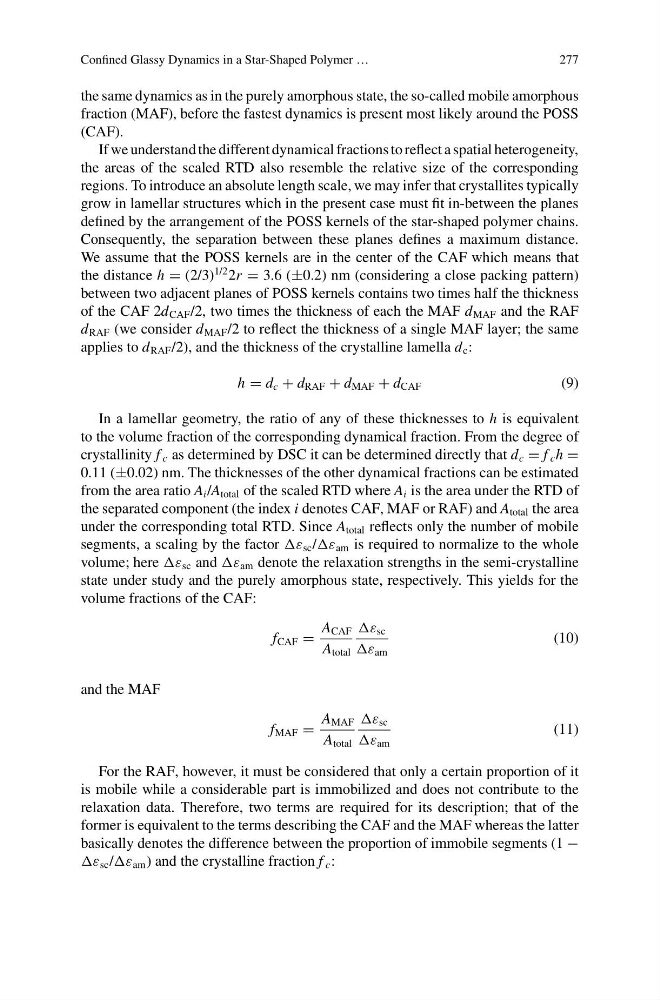
h = d c + d RAF + d MAF + d CAF
(9)
In a lamellar geometry, the ratio of any of these thicknesses to h is equivalent
to the volume fraction of the corresponding dynamical fraction. From the degree of
crystallinity f c as determined by DSC it can be determined directly that d c = f c h =
0.11 (±0.02) nm. The thicknesses of the other dynamical fractions can be estimated
from the area ratio A i /A total of the scaled RTD where A i is the area under the RTD of
the separated component (the index i denotes CAF, MAF or RAF) and A total the area
under the corresponding total RTD. Since A total reflects only the number of mobile
segments, a scaling by the factor ε sc /ε am is required to normalize to the whole
volume; here ε sc and ε am denote the relaxation strengths in the semi-crystalline
state under study and the purely amorphous state, respectively. This yields for the
volume fractions of the CAF:
f CAF =
A CAF
A total
ε sc
ε am
(10)
and the MAF
f MAF =
A MAF
A total
ε sc
ε am
(11)
For the RAF, however, it must be considered that only a certain proportion of it
is mobile while a considerable part is immobilized and does not contribute to the
relaxation data. Therefore, two terms are required for its description; that of the
former is equivalent to the terms describing the CAF and the MAF whereas the latter
basically denotes the difference between the proportion of immobile segments (1 −
ε sc /ε am ) and the crystalline fraction f c :
277
the same dynamics as in the purely amorphous state, the so-called mobile amorphous
fraction (MAF), before the fastest dynamics is present most likely around the POSS
(CAF).
If we understand the different dynamical fractions to reflect a spatial heterogeneity,
the areas of the scaled RTD also resemble the relative size of the corresponding
regions. To introduce an absolute length scale, we may infer that crystallites typically
grow in lamellar structures which in the present case must fit in-between the planes
defined by the arrangement of the POSS kernels of the star-shaped polymer chains.
Consequently, the separation between these planes defines a maximum distance.
We assume that the POSS kernels are in the center of the CAF which means that
the distance h = (2/3)
1/2 2r = 3.6 (±0.2) nm (considering a close packing pattern)
between two adjacent planes of POSS kernels contains two times half the thickness
of the CAF 2d CAF /2, two times the thickness of each the MAF d MAF and the RAF
d RAF (we consider d MAF /2 to reflect the thickness of a single MAF layer; the same
applies to d RAF /2), and the thickness of the crystalline lamella d c :
h = d c + d RAF + d MAF + d CAF
(9)
In a lamellar geometry, the ratio of any of these thicknesses to h is equivalent
to the volume fraction of the corresponding dynamical fraction. From the degree of
crystallinity f c as determined by DSC it can be determined directly that d c = f c h =
0.11 (±0.02) nm. The thicknesses of the other dynamical fractions can be estimated
from the area ratio A i /A total of the scaled RTD where A i is the area under the RTD of
the separated component (the index i denotes CAF, MAF or RAF) and A total the area
under the corresponding total RTD. Since A total reflects only the number of mobile
segments, a scaling by the factor ε sc /ε am is required to normalize to the whole
volume; here ε sc and ε am denote the relaxation strengths in the semi-crystalline
state under study and the purely amorphous state, respectively. This yields for the
volume fractions of the CAF:
f CAF =
A CAF
A total
ε sc
ε am
(10)
and the MAF
f MAF =
A MAF
A total
ε sc
ε am
(11)
For the RAF, however, it must be considered that only a certain proportion of it
is mobile while a considerable part is immobilized and does not contribute to the
relaxation data. Therefore, two terms are required for its description; that of the
former is equivalent to the terms describing the CAF and the MAF whereas the latter
basically denotes the difference between the proportion of immobile segments (1 −
ε sc /ε am ) and the crystalline fraction f c :