

262
S. X. Drakopoulos et al.
Table 2 Dielectric properties of metal-isotactic polypropylene nano-composites having different
volume fractions of Al nanoparticles in the polymer matrix [75]. Adapted from Fredin
et al. Substantial recoverable energy storage in percolative metallic aluminum-polypropylene
nanocomposites. Advanced Functional Materials 2013, 23, 3560–3569
Al particle vol% Permittivity Interparticle distance
(nm)
Dielectric breakdown
strength (MV/m)
Al particle vol%
0.7
2.4 ± 0.4
321.3
123.7
0.7
2.0
2.8 ± 0.9
196.9
–
2.0
2.9
3.0 ± 0.4
162.3
85.2
2.9
10.4
10.5 ± 0.3
71.4
119.3
10.4
12.4
15.4 ± 0.1
61.6
75.8
12.4
25.4
conductive
27.3
–
25.4
38.2
conductive
11.1
–
38.2
40.8
conductive
8.7
–
40.8
adhesion/compatibility. The latter effect can enhance the mechanical properties, such
as the case when stearic acid is used as a functionalization agent [73]. Another range
of ceramic nanoparticles that improve the dielectric behavior of polypropylene are
those of very high dielectric constants, like barium titanate (BaTiO3, ε r ~ 2,000).
It has been proven that the addition of the BaTiO 3 nanoparticles combined with
uniaxial orientation can indeed result in high energy densities [74].
Besides ceramic nanofillers, metallic nano-inclusions can be added to enhance the
interfacial polarization and hence the dielectric constant of the resulting composite.
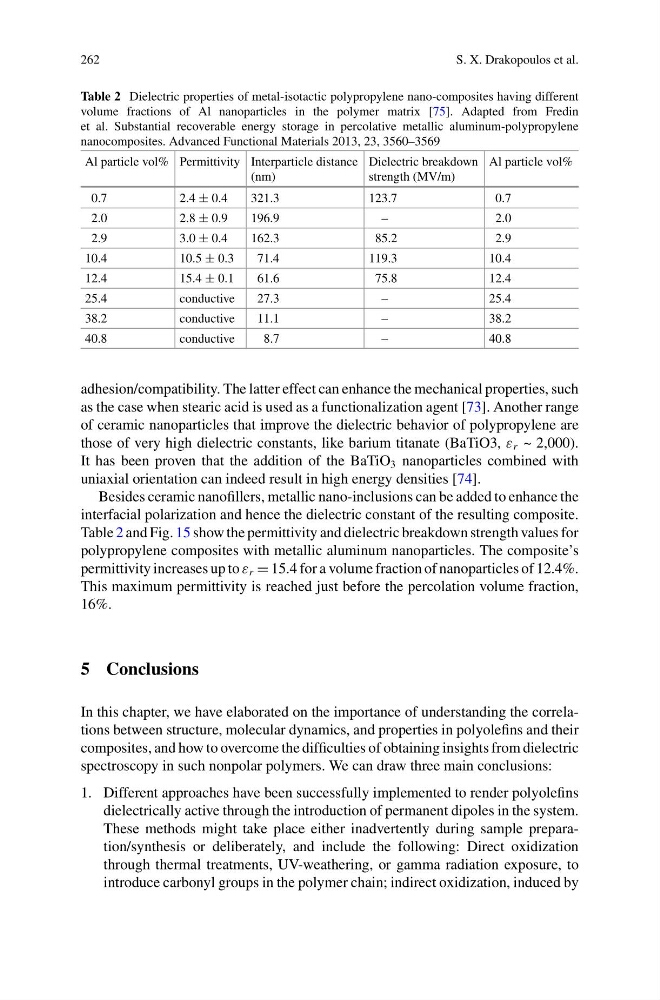
Table 2 and Fig. 15 show the permittivity and dielectric breakdown strength values for
polypropylene composites with metallic aluminum nanoparticles. The composite’s
permittivity increases up to ε r = 15.4 for a volume fraction of nanoparticles of 12.4%.
This maximum permittivity is reached just before the percolation volume fraction,
16%.
5 Conclusions
In this chapter, we have elaborated on the importance of understanding the correlations between structure, molecular dynamics, and properties in polyolefins and their
composites, and how to overcome the difficulties of obtaining insights from dielectric
spectroscopy in such nonpolar polymers. We can draw three main conclusions:
1. Different approaches have been successfully implemented to render polyolefins
dielectrically active through the introduction of permanent dipoles in the system.
These methods might take place either inadvertently during sample preparation/synthesis or deliberately, and include the following: Direct oxidization
through thermal treatments, UV-weathering, or gamma radiation exposure, to
introduce carbonyl groups in the polymer chain; indirect oxidization, induced by
S. X. Drakopoulos et al.
Table 2 Dielectric properties of metal-isotactic polypropylene nano-composites having different
volume fractions of Al nanoparticles in the polymer matrix [75]. Adapted from Fredin
et al. Substantial recoverable energy storage in percolative metallic aluminum-polypropylene
nanocomposites. Advanced Functional Materials 2013, 23, 3560–3569
Al particle vol% Permittivity Interparticle distance
(nm)
Dielectric breakdown
strength (MV/m)
Al particle vol%
0.7
2.4 ± 0.4
321.3
123.7
0.7
2.0
2.8 ± 0.9
196.9
–
2.0
2.9
3.0 ± 0.4
162.3
85.2
2.9
10.4
10.5 ± 0.3
71.4
119.3
10.4
12.4
15.4 ± 0.1
61.6
75.8
12.4
25.4
conductive
27.3
–
25.4
38.2
conductive
11.1
–
38.2
40.8
conductive
8.7
–
40.8
adhesion/compatibility. The latter effect can enhance the mechanical properties, such
as the case when stearic acid is used as a functionalization agent [73]. Another range
of ceramic nanoparticles that improve the dielectric behavior of polypropylene are
those of very high dielectric constants, like barium titanate (BaTiO3, ε r ~ 2,000).
It has been proven that the addition of the BaTiO 3 nanoparticles combined with
uniaxial orientation can indeed result in high energy densities [74].
Besides ceramic nanofillers, metallic nano-inclusions can be added to enhance the
interfacial polarization and hence the dielectric constant of the resulting composite.
Table 2 and Fig. 15 show the permittivity and dielectric breakdown strength values for
polypropylene composites with metallic aluminum nanoparticles. The composite’s
permittivity increases up to ε r = 15.4 for a volume fraction of nanoparticles of 12.4%.
This maximum permittivity is reached just before the percolation volume fraction,
16%.
5 Conclusions
In this chapter, we have elaborated on the importance of understanding the correlations between structure, molecular dynamics, and properties in polyolefins and their
composites, and how to overcome the difficulties of obtaining insights from dielectric
spectroscopy in such nonpolar polymers. We can draw three main conclusions:
1. Different approaches have been successfully implemented to render polyolefins
dielectrically active through the introduction of permanent dipoles in the system.
These methods might take place either inadvertently during sample preparation/synthesis or deliberately, and include the following: Direct oxidization
through thermal treatments, UV-weathering, or gamma radiation exposure, to
introduce carbonyl groups in the polymer chain; indirect oxidization, induced by