

Dielectric Behavior of Nonpolar Polymers and Their Composites …
263
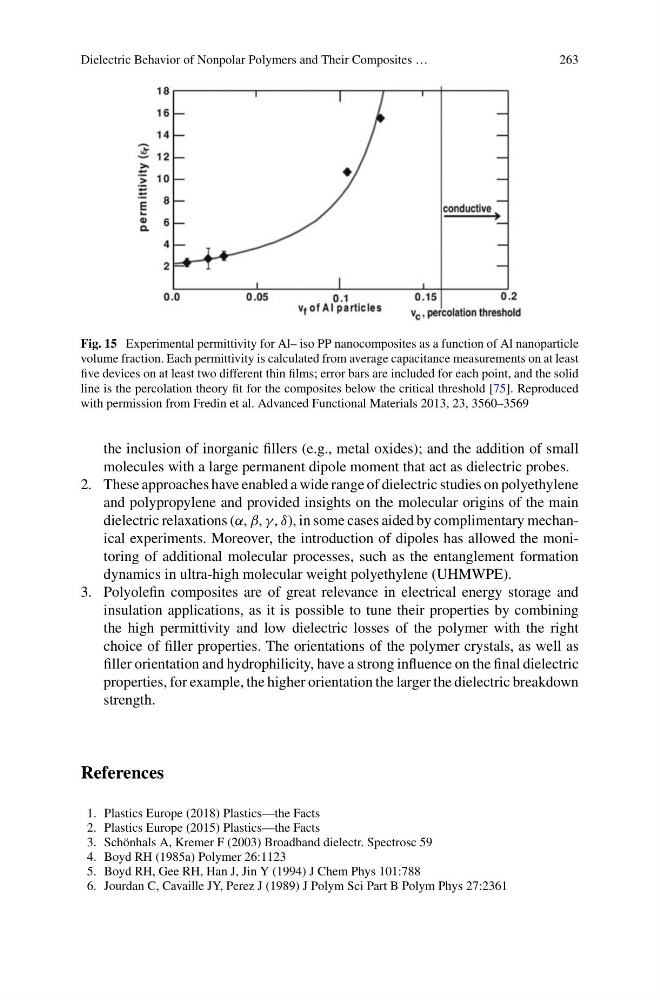
Fig. 15 Experimental permittivity for Al– iso PP nanocomposites as a function of Al nanoparticle
volume fraction. Each permittivity is calculated from average capacitance measurements on at least
five devices on at least two different thin films; error bars are included for each point, and the solid
line is the percolation theory fit for the composites below the critical threshold [75]. Reproduced
with permission from Fredin et al. Advanced Functional Materials 2013, 23, 3560–3569
the inclusion of inorganic fillers (e.g., metal oxides); and the addition of small
molecules with a large permanent dipole moment that act as dielectric probes.
2. These approaches have enabled a wide range of dielectric studies on polyethylene
and polypropylene and provided insights on the molecular origins of the main
dielectric relaxations (α, β, γ , δ), in some cases aided by complimentary mechanical experiments. Moreover, the introduction of dipoles has allowed the monitoring of additional molecular processes, such as the entanglement formation
dynamics in ultra-high molecular weight polyethylene (UHMWPE).
3. Polyolefin composites are of great relevance in electrical energy storage and
insulation applications, as it is possible to tune their properties by combining
the high permittivity and low dielectric losses of the polymer with the right
choice of filler properties. The orientations of the polymer crystals, as well as
filler orientation and hydrophilicity, have a strong influence on the final dielectric
properties, for example, the higher orientation the larger the dielectric breakdown
strength.
References
1. Plastics Europe (2018) Plastics—the Facts
2. Plastics Europe (2015) Plastics—the Facts
3. Schönhals A, Kremer F (2003) Broadband dielectr. Spectrosc 59
4. Boyd RH (1985a) Polymer 26:1123
5. Boyd RH, Gee RH, Han J, Jin Y (1994) J Chem Phys 101:788
6. Jourdan C, Cavaille JY, Perez J (1989) J Polym Sci Part B Polym Phys 27:2361
263
Fig. 15 Experimental permittivity for Al– iso PP nanocomposites as a function of Al nanoparticle
volume fraction. Each permittivity is calculated from average capacitance measurements on at least
five devices on at least two different thin films; error bars are included for each point, and the solid
line is the percolation theory fit for the composites below the critical threshold [75]. Reproduced
with permission from Fredin et al. Advanced Functional Materials 2013, 23, 3560–3569
the inclusion of inorganic fillers (e.g., metal oxides); and the addition of small
molecules with a large permanent dipole moment that act as dielectric probes.
2. These approaches have enabled a wide range of dielectric studies on polyethylene
and polypropylene and provided insights on the molecular origins of the main
dielectric relaxations (α, β, γ , δ), in some cases aided by complimentary mechanical experiments. Moreover, the introduction of dipoles has allowed the monitoring of additional molecular processes, such as the entanglement formation
dynamics in ultra-high molecular weight polyethylene (UHMWPE).
3. Polyolefin composites are of great relevance in electrical energy storage and
insulation applications, as it is possible to tune their properties by combining
the high permittivity and low dielectric losses of the polymer with the right
choice of filler properties. The orientations of the polymer crystals, as well as
filler orientation and hydrophilicity, have a strong influence on the final dielectric
properties, for example, the higher orientation the larger the dielectric breakdown
strength.
References
1. Plastics Europe (2018) Plastics—the Facts
2. Plastics Europe (2015) Plastics—the Facts
3. Schönhals A, Kremer F (2003) Broadband dielectr. Spectrosc 59
4. Boyd RH (1985a) Polymer 26:1123
5. Boyd RH, Gee RH, Han J, Jin Y (1994) J Chem Phys 101:788
6. Jourdan C, Cavaille JY, Perez J (1989) J Polym Sci Part B Polym Phys 27:2361