

Dielectric Behavior of Nonpolar Polymers and Their Composites …
261
strength due to orientation can be attributed to the crystallites acting as a barrier
against treeing [66].
Two more parameters have been found to play a significant role on the dielectric
properties of biaxially oriented polypropylene. The first factor is that with orientation, the porosity decreases enhancing thus the dielectric breakdown strength.
This is explained on the basis that the density of the material increases through the
alignment of the amorphous segments and crystallites [53]. Therefore, orientation
reduces the topological electric field enhancement generated around microcavities
that induces dielectric failure and breakdown. The second factor relies on the crystal
transformation of polypropylene from the β to the α crystal phase that takes place
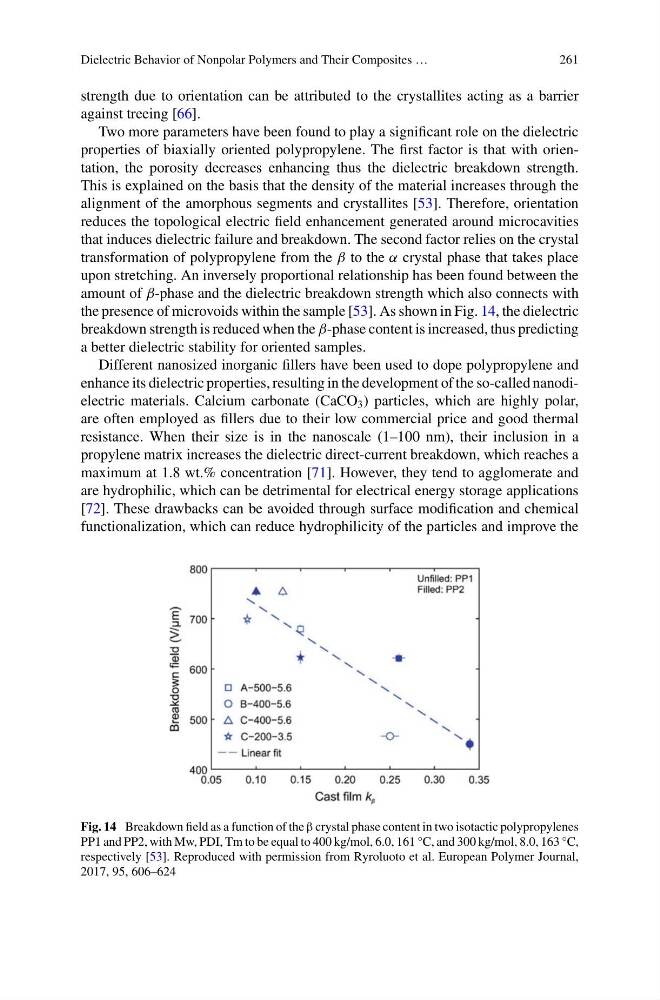
upon stretching. An inversely proportional relationship has been found between the
amount of β-phase and the dielectric breakdown strength which also connects with
the presence of microvoids within the sample [53]. As shown in Fig. 14, the dielectric
breakdown strength is reduced when the β-phase content is increased, thus predicting
a better dielectric stability for oriented samples.
Different nanosized inorganic fillers have been used to dope polypropylene and
enhance its dielectric properties, resulting in the development of the so-called nanodielectric materials. Calcium carbonate (CaCO 3 ) particles, which are highly polar,
are often employed as fillers due to their low commercial price and good thermal
resistance. When their size is in the nanoscale (1–100 nm), their inclusion in a
propylene matrix increases the dielectric direct-current breakdown, which reaches a
maximum at 1.8 wt.% concentration [71]. However, they tend to agglomerate and
are hydrophilic, which can be detrimental for electrical energy storage applications
[72]. These drawbacks can be avoided through surface modification and chemical
functionalization, which can reduce hydrophilicity of the particles and improve the
Fig. 14 Breakdown field as a function of the β crystal phase content in two isotactic polypropylenes
PP1 and PP2, with Mw, PDI, Tm to be equal to 400 kg/mol, 6.0, 161 °C, and 300 kg/mol, 8.0, 163 °C,
respectively [53]. Reproduced with permission from Ryroluoto et al. European Polymer Journal,
2017, 95, 606–624
261
strength due to orientation can be attributed to the crystallites acting as a barrier
against treeing [66].
Two more parameters have been found to play a significant role on the dielectric
properties of biaxially oriented polypropylene. The first factor is that with orientation, the porosity decreases enhancing thus the dielectric breakdown strength.
This is explained on the basis that the density of the material increases through the
alignment of the amorphous segments and crystallites [53]. Therefore, orientation
reduces the topological electric field enhancement generated around microcavities
that induces dielectric failure and breakdown. The second factor relies on the crystal
transformation of polypropylene from the β to the α crystal phase that takes place
upon stretching. An inversely proportional relationship has been found between the
amount of β-phase and the dielectric breakdown strength which also connects with
the presence of microvoids within the sample [53]. As shown in Fig. 14, the dielectric
breakdown strength is reduced when the β-phase content is increased, thus predicting
a better dielectric stability for oriented samples.
Different nanosized inorganic fillers have been used to dope polypropylene and
enhance its dielectric properties, resulting in the development of the so-called nanodielectric materials. Calcium carbonate (CaCO 3 ) particles, which are highly polar,
are often employed as fillers due to their low commercial price and good thermal
resistance. When their size is in the nanoscale (1–100 nm), their inclusion in a
propylene matrix increases the dielectric direct-current breakdown, which reaches a
maximum at 1.8 wt.% concentration [71]. However, they tend to agglomerate and
are hydrophilic, which can be detrimental for electrical energy storage applications
[72]. These drawbacks can be avoided through surface modification and chemical
functionalization, which can reduce hydrophilicity of the particles and improve the
Fig. 14 Breakdown field as a function of the β crystal phase content in two isotactic polypropylenes
PP1 and PP2, with Mw, PDI, Tm to be equal to 400 kg/mol, 6.0, 161 °C, and 300 kg/mol, 8.0, 163 °C,
respectively [53]. Reproduced with permission from Ryroluoto et al. European Polymer Journal,
2017, 95, 606–624