

252
S. X. Drakopoulos et al.
0
1x10
4
2x10
4
3x10
4
4x10
4
5x10
4
0.316
0.318
0.320
0.322
0.324
0.326
0.328
0
1x10 5 2x10 5 3x10 5 4x10 5
0.4
0.6
0.8
1.0
1.2
1.4
1 Hz
10 Hz
G' (MPa)
t (s)
100 Hz
10 Hz
M'
t (s)
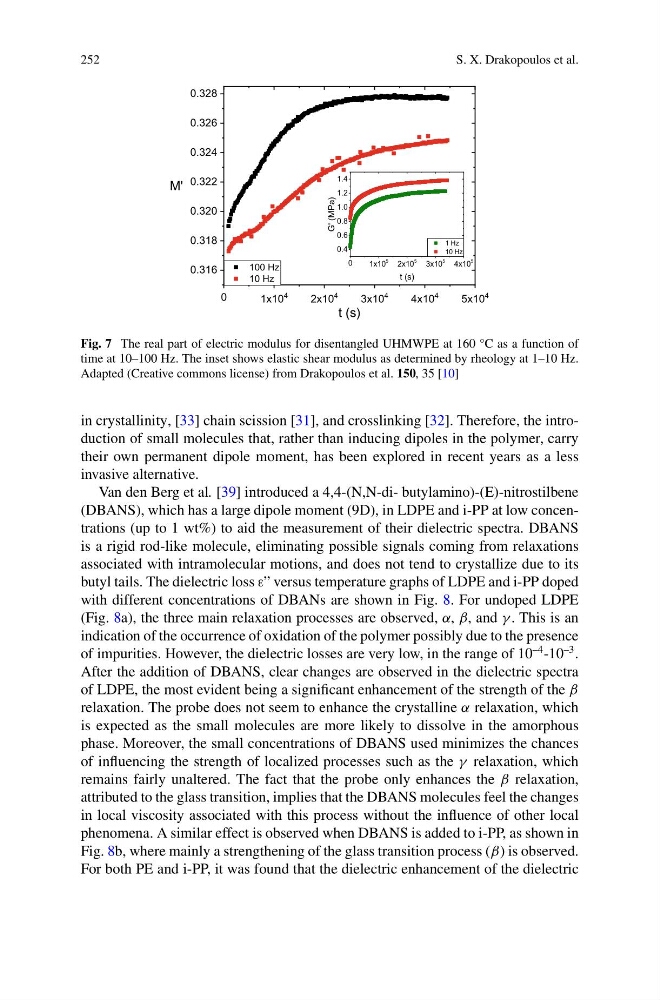
Fig. 7 The real part of electric modulus for disentangled UHMWPE at 160 °C as a function of
time at 10–100 Hz. The inset shows elastic shear modulus as determined by rheology at 1–10 Hz.
Adapted (Creative commons license) from Drakopoulos et al. 150, 35 [10]
in crystallinity, [33] chain scission [31], and crosslinking [32]. Therefore, the introduction of small molecules that, rather than inducing dipoles in the polymer, carry
their own permanent dipole moment, has been explored in recent years as a less
invasive alternative.
Van den Berg et al. [39] introduced a 4,4-(N,N-di- butylamino)-(E)-nitrostilbene
(DBANS), which has a large dipole moment (9D), in LDPE and i-PP at low concentrations (up to 1 wt%) to aid the measurement of their dielectric spectra. DBANS
is a rigid rod-like molecule, eliminating possible signals coming from relaxations
associated with intramolecular motions, and does not tend to crystallize due to its
butyl tails. The dielectric loss ε” versus temperature graphs of LDPE and i-PP doped
with different concentrations of DBANs are shown in Fig. 8. For undoped LDPE
(Fig. 8a), the three main relaxation processes are observed, α, β, and γ . This is an
indication of the occurrence of oxidation of the polymer possibly due to the presence
of impurities. However, the dielectric losses are very low, in the range of 10
–4 -10
–3 .
After the addition of DBANS, clear changes are observed in the dielectric spectra
of LDPE, the most evident being a significant enhancement of the strength of the β
relaxation. The probe does not seem to enhance the crystalline α relaxation, which
is expected as the small molecules are more likely to dissolve in the amorphous
phase. Moreover, the small concentrations of DBANS used minimizes the chances
of influencing the strength of localized processes such as the γ relaxation, which
remains fairly unaltered. The fact that the probe only enhances the β relaxation,
attributed to the glass transition, implies that the DBANS molecules feel the changes
in local viscosity associated with this process without the influence of other local
phenomena. A similar effect is observed when DBANS is added to i-PP, as shown in
Fig. 8b, where mainly a strengthening of the glass transition process (β) is observed.
For both PE and i-PP, it was found that the dielectric enhancement of the dielectric
S. X. Drakopoulos et al.
0
1x10
4
2x10
4
3x10
4
4x10
4
5x10
4
0.316
0.318
0.320
0.322
0.324
0.326
0.328
0
1x10 5 2x10 5 3x10 5 4x10 5
0.4
0.6
0.8
1.0
1.2
1.4
1 Hz
10 Hz
G' (MPa)
t (s)
100 Hz
10 Hz
M'
t (s)
Fig. 7 The real part of electric modulus for disentangled UHMWPE at 160 °C as a function of
time at 10–100 Hz. The inset shows elastic shear modulus as determined by rheology at 1–10 Hz.
Adapted (Creative commons license) from Drakopoulos et al. 150, 35 [10]
in crystallinity, [33] chain scission [31], and crosslinking [32]. Therefore, the introduction of small molecules that, rather than inducing dipoles in the polymer, carry
their own permanent dipole moment, has been explored in recent years as a less
invasive alternative.
Van den Berg et al. [39] introduced a 4,4-(N,N-di- butylamino)-(E)-nitrostilbene
(DBANS), which has a large dipole moment (9D), in LDPE and i-PP at low concentrations (up to 1 wt%) to aid the measurement of their dielectric spectra. DBANS
is a rigid rod-like molecule, eliminating possible signals coming from relaxations
associated with intramolecular motions, and does not tend to crystallize due to its
butyl tails. The dielectric loss ε” versus temperature graphs of LDPE and i-PP doped
with different concentrations of DBANs are shown in Fig. 8. For undoped LDPE
(Fig. 8a), the three main relaxation processes are observed, α, β, and γ . This is an
indication of the occurrence of oxidation of the polymer possibly due to the presence
of impurities. However, the dielectric losses are very low, in the range of 10
–4 -10
–3 .
After the addition of DBANS, clear changes are observed in the dielectric spectra
of LDPE, the most evident being a significant enhancement of the strength of the β
relaxation. The probe does not seem to enhance the crystalline α relaxation, which
is expected as the small molecules are more likely to dissolve in the amorphous
phase. Moreover, the small concentrations of DBANS used minimizes the chances
of influencing the strength of localized processes such as the γ relaxation, which
remains fairly unaltered. The fact that the probe only enhances the β relaxation,
attributed to the glass transition, implies that the DBANS molecules feel the changes
in local viscosity associated with this process without the influence of other local
phenomena. A similar effect is observed when DBANS is added to i-PP, as shown in
Fig. 8b, where mainly a strengthening of the glass transition process (β) is observed.
For both PE and i-PP, it was found that the dielectric enhancement of the dielectric