

250
S. X. Drakopoulos et al.
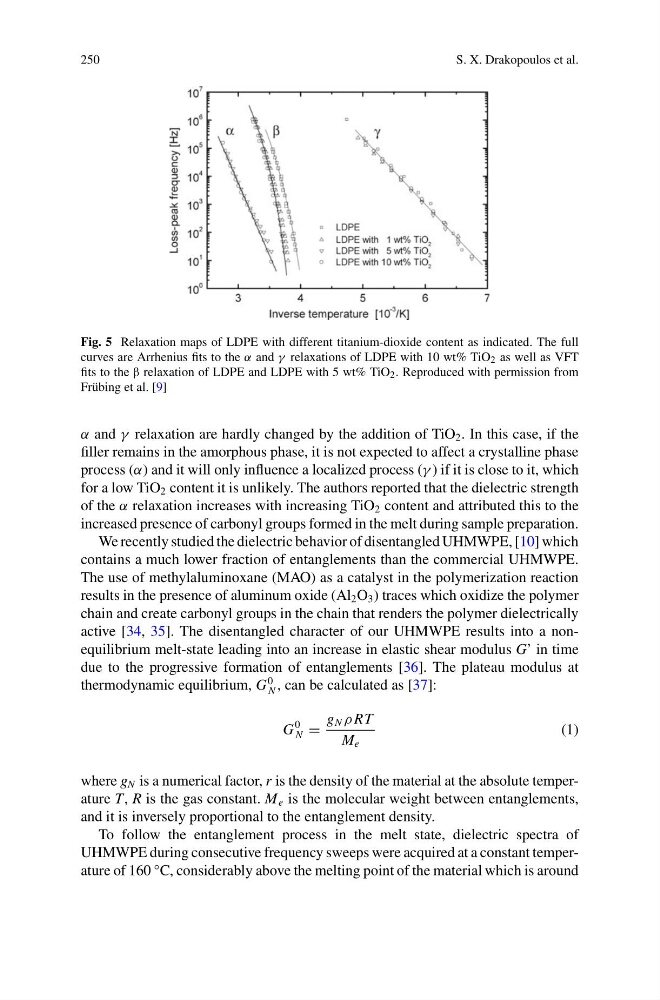
Fig. 5 Relaxation maps of LDPE with different titanium-dioxide content as indicated. The full
curves are Arrhenius fits to the α and γ relaxations of LDPE with 10 wt% TiO 2 as well as VFT
fits to the β relaxation of LDPE and LDPE with 5 wt% TiO 2 . Reproduced with permission from
Frübing et al. [9]
α and γ relaxation are hardly changed by the addition of TiO 2 . In this case, if the
filler remains in the amorphous phase, it is not expected to affect a crystalline phase
process (α) and it will only influence a localized process (γ ) if it is close to it, which
for a low TiO 2 content it is unlikely. The authors reported that the dielectric strength
of the α relaxation increases with increasing TiO 2 content and attributed this to the
increased presence of carbonyl groups formed in the melt during sample preparation.
We recently studied the dielectric behavior of disentangled UHMWPE, [10] which
contains a much lower fraction of entanglements than the commercial UHMWPE.
The use of methylaluminoxane (MAO) as a catalyst in the polymerization reaction
results in the presence of aluminum oxide (Al 2 O 3 ) traces which oxidize the polymer
chain and create carbonyl groups in the chain that renders the polymer dielectrically
active [34, 35]. The disentangled character of our UHMWPE results into a nonequilibrium melt-state leading into an increase in elastic shear modulus G’ in time
due to the progressive formation of entanglements [36]. The plateau modulus at
thermodynamic equilibrium, G
0
N , can be calculated as [37]:
G
0
N =
g N ρ RT
M e
(1)
where g N is a numerical factor, r is the density of the material at the absolute temperature T, R is the gas constant. M e is the molecular weight between entanglements,
and it is inversely proportional to the entanglement density.
To follow the entanglement process in the melt state, dielectric spectra of
UHMWPE during consecutive frequency sweeps were acquired at a constant temperature of 160 °C, considerably above the melting point of the material which is around
S. X. Drakopoulos et al.
Fig. 5 Relaxation maps of LDPE with different titanium-dioxide content as indicated. The full
curves are Arrhenius fits to the α and γ relaxations of LDPE with 10 wt% TiO 2 as well as VFT
fits to the β relaxation of LDPE and LDPE with 5 wt% TiO 2 . Reproduced with permission from
Frübing et al. [9]
α and γ relaxation are hardly changed by the addition of TiO 2 . In this case, if the
filler remains in the amorphous phase, it is not expected to affect a crystalline phase
process (α) and it will only influence a localized process (γ ) if it is close to it, which
for a low TiO 2 content it is unlikely. The authors reported that the dielectric strength
of the α relaxation increases with increasing TiO 2 content and attributed this to the
increased presence of carbonyl groups formed in the melt during sample preparation.
We recently studied the dielectric behavior of disentangled UHMWPE, [10] which
contains a much lower fraction of entanglements than the commercial UHMWPE.
The use of methylaluminoxane (MAO) as a catalyst in the polymerization reaction
results in the presence of aluminum oxide (Al 2 O 3 ) traces which oxidize the polymer
chain and create carbonyl groups in the chain that renders the polymer dielectrically
active [34, 35]. The disentangled character of our UHMWPE results into a nonequilibrium melt-state leading into an increase in elastic shear modulus G’ in time
due to the progressive formation of entanglements [36]. The plateau modulus at
thermodynamic equilibrium, G
0
N , can be calculated as [37]:
G
0
N =
g N ρ RT
M e
(1)
where g N is a numerical factor, r is the density of the material at the absolute temperature T, R is the gas constant. M e is the molecular weight between entanglements,
and it is inversely proportional to the entanglement density.
To follow the entanglement process in the melt state, dielectric spectra of
UHMWPE during consecutive frequency sweeps were acquired at a constant temperature of 160 °C, considerably above the melting point of the material which is around