

Dielectric Behavior of Nonpolar Polymers and Their Composites …
249
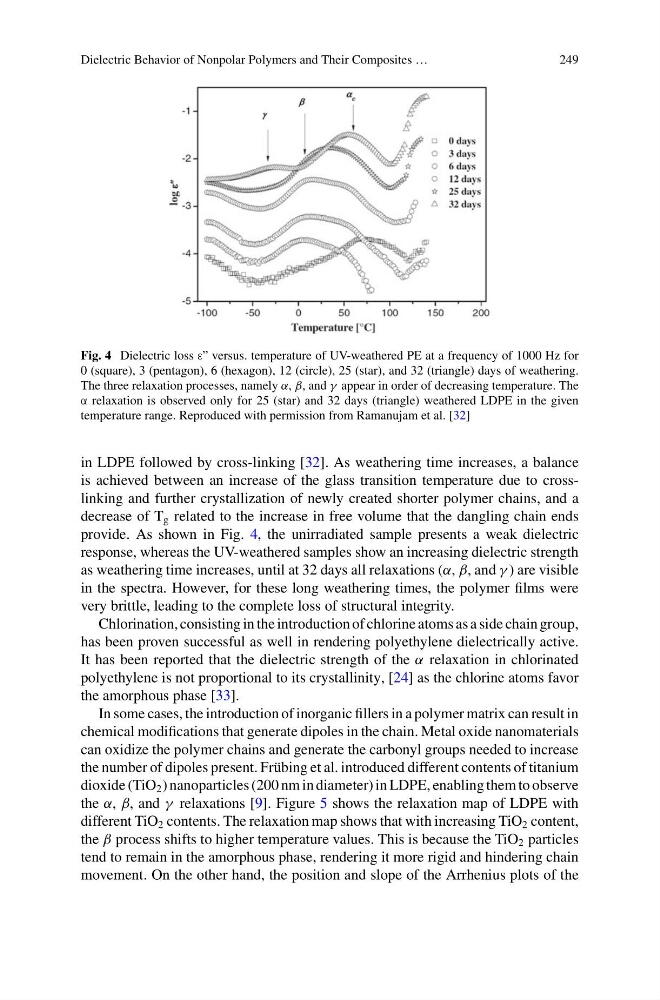
Fig. 4 Dielectric loss ε” versus. temperature of UV-weathered PE at a frequency of 1000 Hz for
0 (square), 3 (pentagon), 6 (hexagon), 12 (circle), 25 (star), and 32 (triangle) days of weathering.
The three relaxation processes, namely α, β, and γ appear in order of decreasing temperature. The
α relaxation is observed only for 25 (star) and 32 days (triangle) weathered LDPE in the given
temperature range. Reproduced with permission from Ramanujam et al. [32]
in LDPE followed by cross-linking [32]. As weathering time increases, a balance
is achieved between an increase of the glass transition temperature due to crosslinking and further crystallization of newly created shorter polymer chains, and a
decrease of T g related to the increase in free volume that the dangling chain ends
provide. As shown in Fig. 4, the unirradiated sample presents a weak dielectric
response, whereas the UV-weathered samples show an increasing dielectric strength
as weathering time increases, until at 32 days all relaxations (α, β, and γ ) are visible
in the spectra. However, for these long weathering times, the polymer films were
very brittle, leading to the complete loss of structural integrity.
Chlorination, consisting in the introduction of chlorine atoms as a side chain group,
has been proven successful as well in rendering polyethylene dielectrically active.
It has been reported that the dielectric strength of the α relaxation in chlorinated
polyethylene is not proportional to its crystallinity, [24] as the chlorine atoms favor
the amorphous phase [33].
In some cases, the introduction of inorganic fillers in a polymer matrix can result in
chemical modifications that generate dipoles in the chain. Metal oxide nanomaterials
can oxidize the polymer chains and generate the carbonyl groups needed to increase
the number of dipoles present. Frübing et al. introduced different contents of titanium
dioxide (TiO 2 ) nanoparticles (200 nm in diameter) in LDPE, enabling them to observe
the α, β, and γ relaxations [9]. Figure 5 shows the relaxation map of LDPE with
different TiO 2 contents. The relaxation map shows that with increasing TiO 2 content,
the β process shifts to higher temperature values. This is because the TiO 2 particles
tend to remain in the amorphous phase, rendering it more rigid and hindering chain
movement. On the other hand, the position and slope of the Arrhenius plots of the
249
Fig. 4 Dielectric loss ε” versus. temperature of UV-weathered PE at a frequency of 1000 Hz for
0 (square), 3 (pentagon), 6 (hexagon), 12 (circle), 25 (star), and 32 (triangle) days of weathering.
The three relaxation processes, namely α, β, and γ appear in order of decreasing temperature. The
α relaxation is observed only for 25 (star) and 32 days (triangle) weathered LDPE in the given
temperature range. Reproduced with permission from Ramanujam et al. [32]
in LDPE followed by cross-linking [32]. As weathering time increases, a balance
is achieved between an increase of the glass transition temperature due to crosslinking and further crystallization of newly created shorter polymer chains, and a
decrease of T g related to the increase in free volume that the dangling chain ends
provide. As shown in Fig. 4, the unirradiated sample presents a weak dielectric
response, whereas the UV-weathered samples show an increasing dielectric strength
as weathering time increases, until at 32 days all relaxations (α, β, and γ ) are visible
in the spectra. However, for these long weathering times, the polymer films were
very brittle, leading to the complete loss of structural integrity.
Chlorination, consisting in the introduction of chlorine atoms as a side chain group,
has been proven successful as well in rendering polyethylene dielectrically active.
It has been reported that the dielectric strength of the α relaxation in chlorinated
polyethylene is not proportional to its crystallinity, [24] as the chlorine atoms favor
the amorphous phase [33].
In some cases, the introduction of inorganic fillers in a polymer matrix can result in
chemical modifications that generate dipoles in the chain. Metal oxide nanomaterials
can oxidize the polymer chains and generate the carbonyl groups needed to increase
the number of dipoles present. Frübing et al. introduced different contents of titanium
dioxide (TiO 2 ) nanoparticles (200 nm in diameter) in LDPE, enabling them to observe
the α, β, and γ relaxations [9]. Figure 5 shows the relaxation map of LDPE with
different TiO 2 contents. The relaxation map shows that with increasing TiO 2 content,
the β process shifts to higher temperature values. This is because the TiO 2 particles
tend to remain in the amorphous phase, rendering it more rigid and hindering chain
movement. On the other hand, the position and slope of the Arrhenius plots of the