

228
S. Napolitano
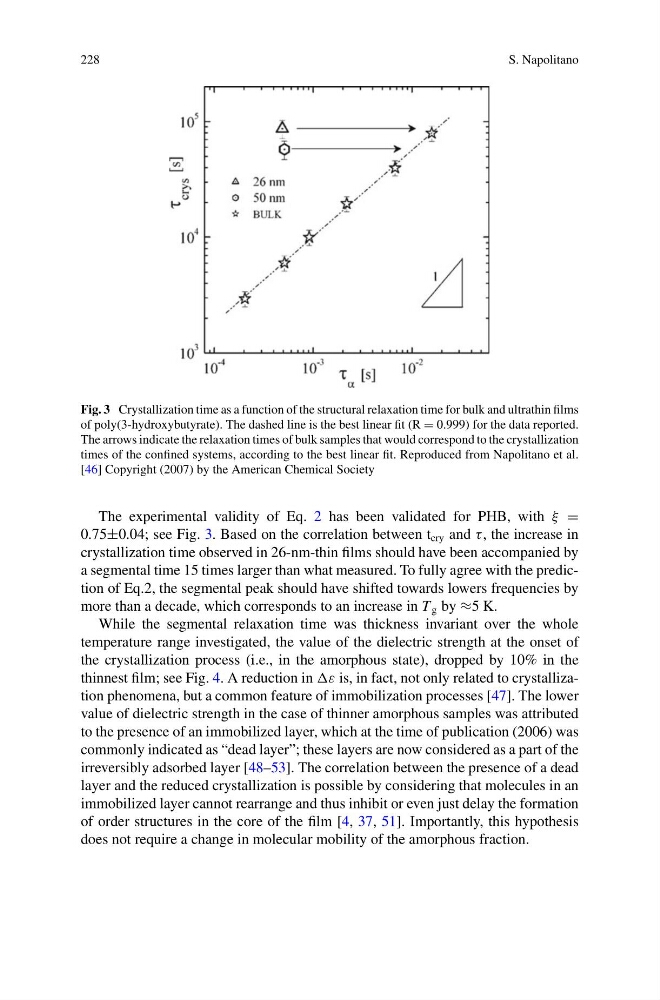
Fig. 3 Crystallization time as a function of the structural relaxation time for bulk and ultrathin films
of poly(3-hydroxybutyrate). The dashed line is the best linear fit (R = 0.999) for the data reported.
The arrows indicate the relaxation times of bulk samples that would correspond to the crystallization
times of the confined systems, according to the best linear fit. Reproduced from Napolitano et al.
[46] Copyright (2007) by the American Chemical Society
The experimental validity of Eq. 2 has been validated for PHB, with ξ =
0.75±0.04; see Fig. 3. Based on the correlation between t cry and τ, the increase in
crystallization time observed in 26-nm-thin films should have been accompanied by
a segmental time 15 times larger than what measured. To fully agree with the prediction of Eq.2, the segmental peak should have shifted towards lowers frequencies by
more than a decade, which corresponds to an increase in T g by ≈5 K.
While the segmental relaxation time was thickness invariant over the whole
temperature range investigated, the value of the dielectric strength at the onset of
the crystallization process (i.e., in the amorphous state), dropped by 10% in the
thinnest film; see Fig. 4. A reduction in ε is, in fact, not only related to crystallization phenomena, but a common feature of immobilization processes [47]. The lower
value of dielectric strength in the case of thinner amorphous samples was attributed
to the presence of an immobilized layer, which at the time of publication (2006) was
commonly indicated as “dead layer”; these layers are now considered as a part of the
irreversibly adsorbed layer [48–53]. The correlation between the presence of a dead
layer and the reduced crystallization is possible by considering that molecules in an
immobilized layer cannot rearrange and thus inhibit or even just delay the formation
of order structures in the core of the film [4, 37, 51]. Importantly, this hypothesis
does not require a change in molecular mobility of the amorphous fraction.
S. Napolitano
Fig. 3 Crystallization time as a function of the structural relaxation time for bulk and ultrathin films
of poly(3-hydroxybutyrate). The dashed line is the best linear fit (R = 0.999) for the data reported.
The arrows indicate the relaxation times of bulk samples that would correspond to the crystallization
times of the confined systems, according to the best linear fit. Reproduced from Napolitano et al.
[46] Copyright (2007) by the American Chemical Society
The experimental validity of Eq. 2 has been validated for PHB, with ξ =
0.75±0.04; see Fig. 3. Based on the correlation between t cry and τ, the increase in
crystallization time observed in 26-nm-thin films should have been accompanied by
a segmental time 15 times larger than what measured. To fully agree with the prediction of Eq.2, the segmental peak should have shifted towards lowers frequencies by
more than a decade, which corresponds to an increase in T g by ≈5 K.
While the segmental relaxation time was thickness invariant over the whole
temperature range investigated, the value of the dielectric strength at the onset of
the crystallization process (i.e., in the amorphous state), dropped by 10% in the
thinnest film; see Fig. 4. A reduction in ε is, in fact, not only related to crystallization phenomena, but a common feature of immobilization processes [47]. The lower
value of dielectric strength in the case of thinner amorphous samples was attributed
to the presence of an immobilized layer, which at the time of publication (2006) was
commonly indicated as “dead layer”; these layers are now considered as a part of the
irreversibly adsorbed layer [48–53]. The correlation between the presence of a dead
layer and the reduced crystallization is possible by considering that molecules in an
immobilized layer cannot rearrange and thus inhibit or even just delay the formation
of order structures in the core of the film [4, 37, 51]. Importantly, this hypothesis
does not require a change in molecular mobility of the amorphous fraction.