

Crystallization of Polymers Under 1D Confinement
229
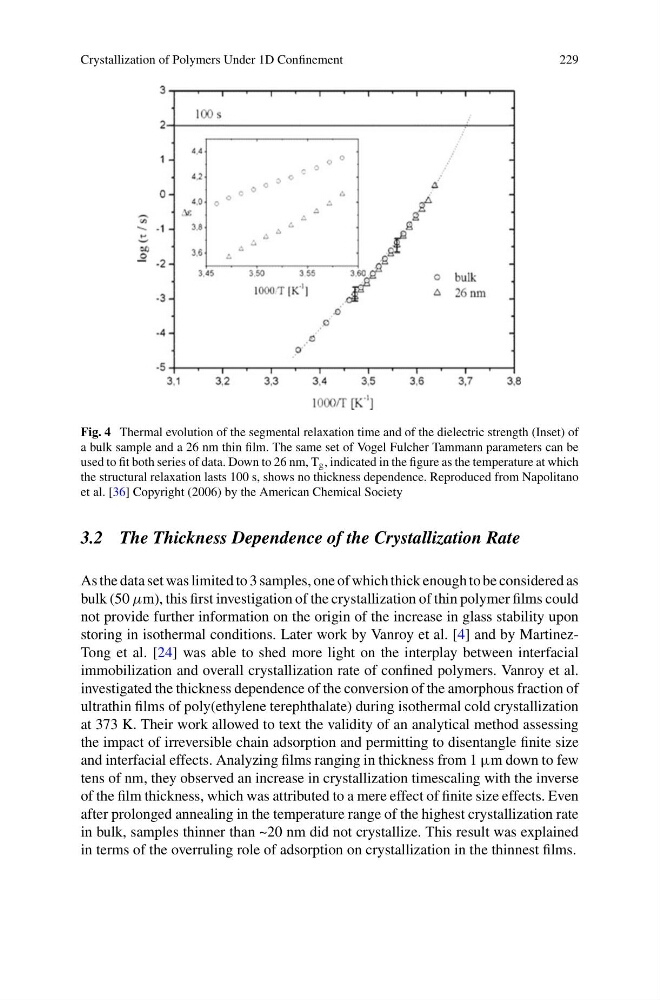
Fig. 4 Thermal evolution of the segmental relaxation time and of the dielectric strength (Inset) of
a bulk sample and a 26 nm thin film. The same set of Vogel Fulcher Tammann parameters can be
used to fit both series of data. Down to 26 nm, T g , indicated in the figure as the temperature at which
the structural relaxation lasts 100 s, shows no thickness dependence. Reproduced from Napolitano
et al. [36] Copyright (2006) by the American Chemical Society
3.2 The Thickness Dependence of the Crystallization Rate
As the data set was limited to 3 samples, one of which thick enough to be considered as
bulk (50 μm), this first investigation of the crystallization of thin polymer films could
not provide further information on the origin of the increase in glass stability upon
storing in isothermal conditions. Later work by Vanroy et al. [4] and by MartinezTong et al. [24] was able to shed more light on the interplay between interfacial
immobilization and overall crystallization rate of confined polymers. Vanroy et al.
investigated the thickness dependence of the conversion of the amorphous fraction of
ultrathin films of poly(ethylene terephthalate) during isothermal cold crystallization
at 373 K. Their work allowed to text the validity of an analytical method assessing
the impact of irreversible chain adsorption and permitting to disentangle finite size
and interfacial effects. Analyzing films ranging in thickness from 1 μm down to few
tens of nm, they observed an increase in crystallization timescaling with the inverse
of the film thickness, which was attributed to a mere effect of finite size effects. Even
after prolonged annealing in the temperature range of the highest crystallization rate
in bulk, samples thinner than ~20 nm did not crystallize. This result was explained
in terms of the overruling role of adsorption on crystallization in the thinnest films.
229
Fig. 4 Thermal evolution of the segmental relaxation time and of the dielectric strength (Inset) of
a bulk sample and a 26 nm thin film. The same set of Vogel Fulcher Tammann parameters can be
used to fit both series of data. Down to 26 nm, T g , indicated in the figure as the temperature at which
the structural relaxation lasts 100 s, shows no thickness dependence. Reproduced from Napolitano
et al. [36] Copyright (2006) by the American Chemical Society
3.2 The Thickness Dependence of the Crystallization Rate
As the data set was limited to 3 samples, one of which thick enough to be considered as
bulk (50 μm), this first investigation of the crystallization of thin polymer films could
not provide further information on the origin of the increase in glass stability upon
storing in isothermal conditions. Later work by Vanroy et al. [4] and by MartinezTong et al. [24] was able to shed more light on the interplay between interfacial
immobilization and overall crystallization rate of confined polymers. Vanroy et al.
investigated the thickness dependence of the conversion of the amorphous fraction of
ultrathin films of poly(ethylene terephthalate) during isothermal cold crystallization
at 373 K. Their work allowed to text the validity of an analytical method assessing
the impact of irreversible chain adsorption and permitting to disentangle finite size
and interfacial effects. Analyzing films ranging in thickness from 1 μm down to few
tens of nm, they observed an increase in crystallization timescaling with the inverse
of the film thickness, which was attributed to a mere effect of finite size effects. Even
after prolonged annealing in the temperature range of the highest crystallization rate
in bulk, samples thinner than ~20 nm did not crystallize. This result was explained
in terms of the overruling role of adsorption on crystallization in the thinnest films.