

Crystallization of Polymers Under 1D Confinement
227
above for bulk samples. Successful amorphizations resulted in samples showing an
α-relaxation peaked in the same frequency range and with a similar intensity as
observed for bulk samples. Defining a general criterion to ensure reproducibility is,
however, not straightforward. For the thinnest films analyzed, the dielectric strength
was reduced by 10% compared to the bulk value, as discussed below. A priori it is not
possible to know whether the starting value of ε for a given thickness is correct,
or if further material processing is necessary; we noticed that repeated essays of
amorphization of the same sample resulted in degradation—easily detectable via a
severe change in dielectric constant in the limit of high frequencies.
With respect to other more rigid polymers as poly(ethylene terephthalate), PET,
poly(ethylene 2,6-naphthalate), PEN, and polyether ether ketone, PEEK, PHB has a
serious advantage. Its structural relaxation time is not affected by the degree of crystallinity, which allows a more reliable determination of the absolute determination
of the molecular mobility. Experiments were performed at 291 K, a temperature at
which the intense peak attributed to the structural relaxation is present in the middle
of the frequency window investigated, around 300 Hz. In bulk, the intensity of the
segmental peak decreases upon annealing and in isothermal conditions within 3 h
ε drops to zero, indicating that crystallization is taking place.
For thin films, the same scenario is qualitative observed. No shift in segmental
relaxation time is measured in a 26-nm-thin sample, and ε decreases upon
annealing. But, differently than in bulk, within 3 h no significant reduction in dielectric strength is detected. Based on further analysis of the results, the crystallization
of the thin film appeared more than an order of magnitude slower than in bulk.
Remarkably, the segmental mobility was invariant with confinement, which strongly
confuted the original conjecture.
A more quantitative picture can be obtained considering the relation between
crystallization and segmental times in bulk [46]. In its simplest formulation, the
classical crystallization rate, G(T ) ~ t
−1
cry (T ), can be written as the product of two
exponential terms n(T ) and D(T ), respectively related to the nucleation/growth free
energy term and molecular diffusion.
The latter component is related to the shear viscosity and to the main relaxation
time via fractional Stokes–Einstein and Debye–Stokes–Einstein relations through a
temperature-dependent parameter ξ ≤ 1:
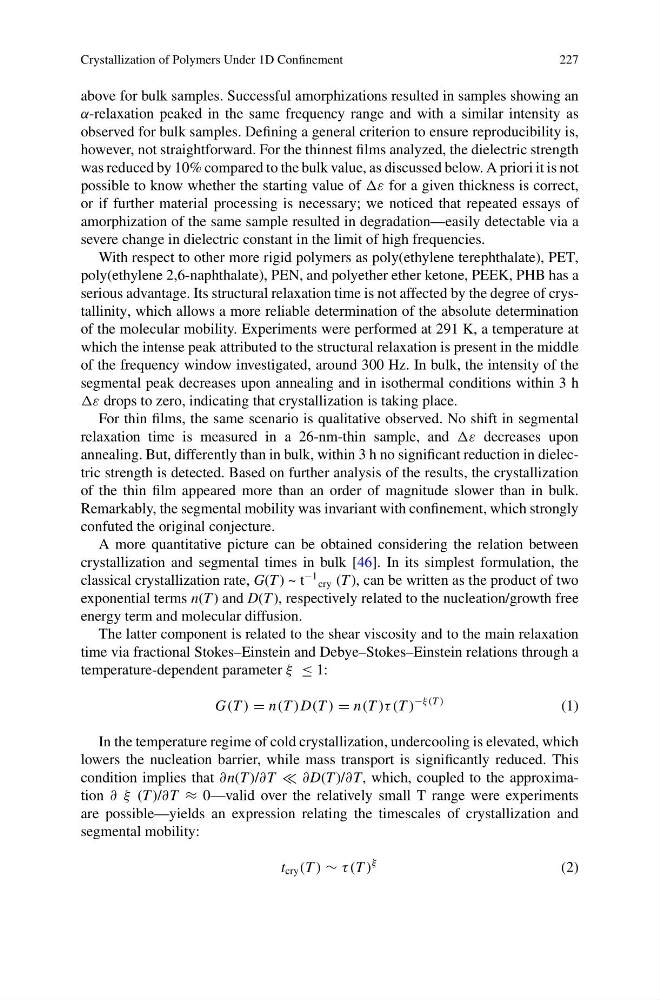
G(T ) = n(T )D(T ) = n(T )τ (T )
−ξ (T )
(1)
In the temperature regime of cold crystallization, undercooling is elevated, which
lowers the nucleation barrier, while mass transport is significantly reduced. This
condition implies that ∂n(T )/∂T ∂D(T )/∂T, which, coupled to the approximation ∂ ξ (T )/∂T ≈ 0—valid over the relatively small T range were experiments
are possible—yields an expression relating the timescales of crystallization and
segmental mobility:
t cry (T ) ∼ τ (T )
ξ
(2)
227
above for bulk samples. Successful amorphizations resulted in samples showing an
α-relaxation peaked in the same frequency range and with a similar intensity as
observed for bulk samples. Defining a general criterion to ensure reproducibility is,
however, not straightforward. For the thinnest films analyzed, the dielectric strength
was reduced by 10% compared to the bulk value, as discussed below. A priori it is not
possible to know whether the starting value of ε for a given thickness is correct,
or if further material processing is necessary; we noticed that repeated essays of
amorphization of the same sample resulted in degradation—easily detectable via a
severe change in dielectric constant in the limit of high frequencies.
With respect to other more rigid polymers as poly(ethylene terephthalate), PET,
poly(ethylene 2,6-naphthalate), PEN, and polyether ether ketone, PEEK, PHB has a
serious advantage. Its structural relaxation time is not affected by the degree of crystallinity, which allows a more reliable determination of the absolute determination
of the molecular mobility. Experiments were performed at 291 K, a temperature at
which the intense peak attributed to the structural relaxation is present in the middle
of the frequency window investigated, around 300 Hz. In bulk, the intensity of the
segmental peak decreases upon annealing and in isothermal conditions within 3 h
ε drops to zero, indicating that crystallization is taking place.
For thin films, the same scenario is qualitative observed. No shift in segmental
relaxation time is measured in a 26-nm-thin sample, and ε decreases upon
annealing. But, differently than in bulk, within 3 h no significant reduction in dielectric strength is detected. Based on further analysis of the results, the crystallization
of the thin film appeared more than an order of magnitude slower than in bulk.
Remarkably, the segmental mobility was invariant with confinement, which strongly
confuted the original conjecture.
A more quantitative picture can be obtained considering the relation between
crystallization and segmental times in bulk [46]. In its simplest formulation, the
classical crystallization rate, G(T ) ~ t
−1
cry (T ), can be written as the product of two
exponential terms n(T ) and D(T ), respectively related to the nucleation/growth free
energy term and molecular diffusion.
The latter component is related to the shear viscosity and to the main relaxation
time via fractional Stokes–Einstein and Debye–Stokes–Einstein relations through a
temperature-dependent parameter ξ ≤ 1:
G(T ) = n(T )D(T ) = n(T )τ (T )
−ξ (T )
(1)
In the temperature regime of cold crystallization, undercooling is elevated, which
lowers the nucleation barrier, while mass transport is significantly reduced. This
condition implies that ∂n(T )/∂T ∂D(T )/∂T, which, coupled to the approximation ∂ ξ (T )/∂T ≈ 0—valid over the relatively small T range were experiments
are possible—yields an expression relating the timescales of crystallization and
segmental mobility:
t cry (T ) ∼ τ (T )
ξ
(2)