

216
A. Nogales et al.
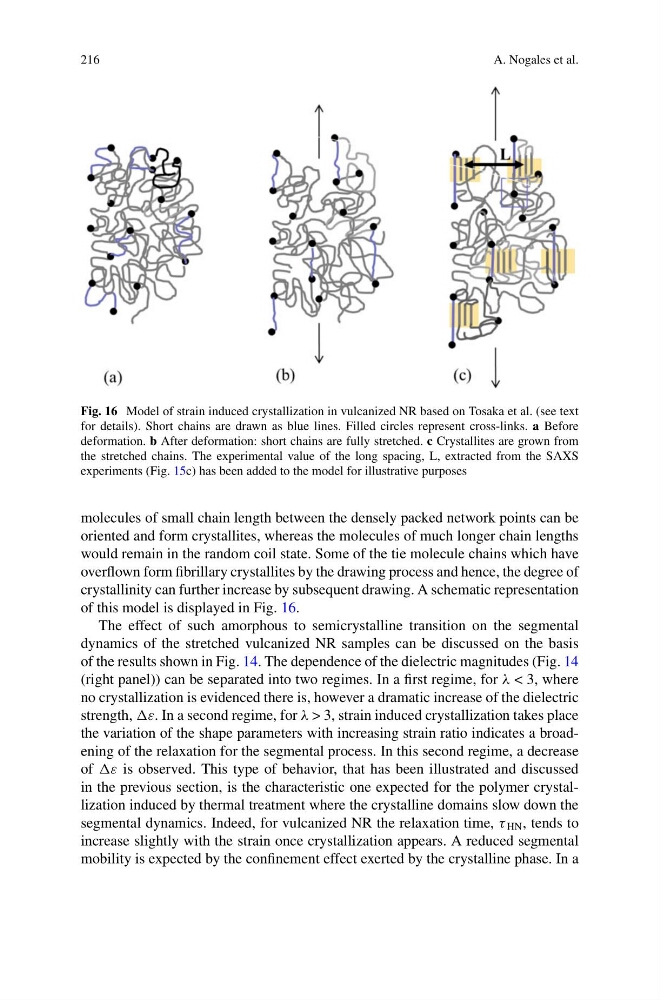
Fig. 16 Model of strain induced crystallization in vulcanized NR based on Tosaka et al. (see text
for details). Short chains are drawn as blue lines. Filled circles represent cross-links. a Before
deformation. b After deformation: short chains are fully stretched. c Crystallites are grown from
the stretched chains. The experimental value of the long spacing, L, extracted from the SAXS
experiments (Fig. 15c) has been added to the model for illustrative purposes
molecules of small chain length between the densely packed network points can be
oriented and form crystallites, whereas the molecules of much longer chain lengths
would remain in the random coil state. Some of the tie molecule chains which have
overflown form fibrillary crystallites by the drawing process and hence, the degree of
crystallinity can further increase by subsequent drawing. A schematic representation
of this model is displayed in Fig. 16.
The effect of such amorphous to semicrystalline transition on the segmental
dynamics of the stretched vulcanized NR samples can be discussed on the basis
of the results shown in Fig. 14. The dependence of the dielectric magnitudes (Fig. 14
(right panel)) can be separated into two regimes. In a first regime, for λ < 3, where
no crystallization is evidenced there is, however a dramatic increase of the dielectric
strength, ε. In a second regime, for λ > 3, strain induced crystallization takes place
the variation of the shape parameters with increasing strain ratio indicates a broadening of the relaxation for the segmental process. In this second regime, a decrease
of ε is observed. This type of behavior, that has been illustrated and discussed
in the previous section, is the characteristic one expected for the polymer crystallization induced by thermal treatment where the crystalline domains slow down the
segmental dynamics. Indeed, for vulcanized NR the relaxation time, τ HN , tends to
increase slightly with the strain once crystallization appears. A reduced segmental
mobility is expected by the confinement effect exerted by the crystalline phase. In a
A. Nogales et al.
Fig. 16 Model of strain induced crystallization in vulcanized NR based on Tosaka et al. (see text
for details). Short chains are drawn as blue lines. Filled circles represent cross-links. a Before
deformation. b After deformation: short chains are fully stretched. c Crystallites are grown from
the stretched chains. The experimental value of the long spacing, L, extracted from the SAXS
experiments (Fig. 15c) has been added to the model for illustrative purposes
molecules of small chain length between the densely packed network points can be
oriented and form crystallites, whereas the molecules of much longer chain lengths
would remain in the random coil state. Some of the tie molecule chains which have
overflown form fibrillary crystallites by the drawing process and hence, the degree of
crystallinity can further increase by subsequent drawing. A schematic representation
of this model is displayed in Fig. 16.
The effect of such amorphous to semicrystalline transition on the segmental
dynamics of the stretched vulcanized NR samples can be discussed on the basis
of the results shown in Fig. 14. The dependence of the dielectric magnitudes (Fig. 14
(right panel)) can be separated into two regimes. In a first regime, for λ < 3, where
no crystallization is evidenced there is, however a dramatic increase of the dielectric
strength, ε. In a second regime, for λ > 3, strain induced crystallization takes place
the variation of the shape parameters with increasing strain ratio indicates a broadening of the relaxation for the segmental process. In this second regime, a decrease
of ε is observed. This type of behavior, that has been illustrated and discussed
in the previous section, is the characteristic one expected for the polymer crystallization induced by thermal treatment where the crystalline domains slow down the
segmental dynamics. Indeed, for vulcanized NR the relaxation time, τ HN , tends to
increase slightly with the strain once crystallization appears. A reduced segmental
mobility is expected by the confinement effect exerted by the crystalline phase. In a