

Order and Dielectric Relaxation During Polymer Crystallization
215
(b)
WAXS
(a)
SAXS
(c)
8
I(arb.
units)
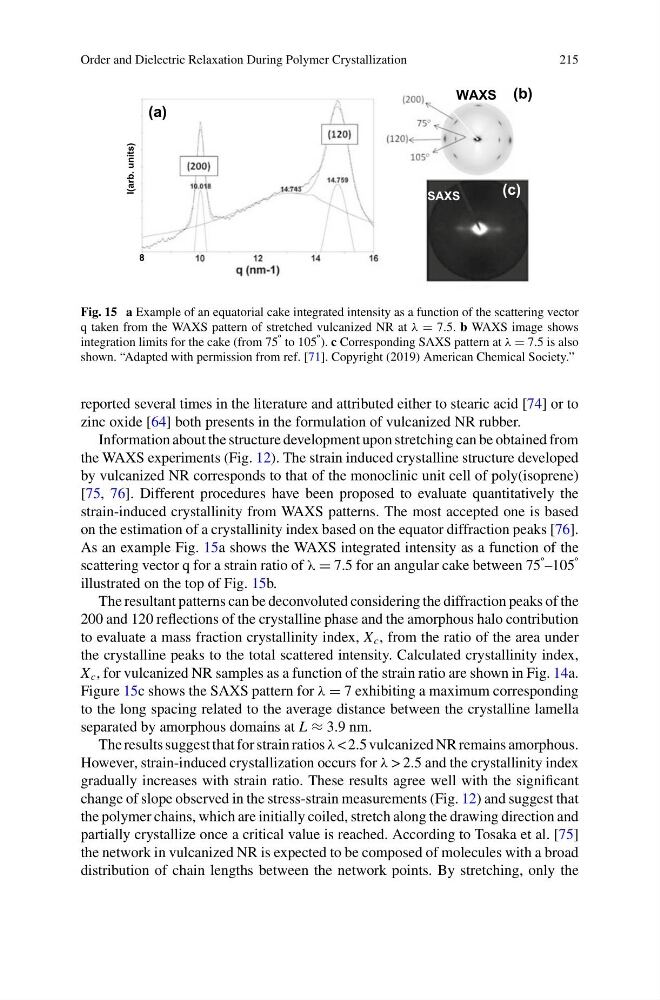
Fig. 15 a Example of an equatorial cake integrated intensity as a function of the scattering vector
q taken from the WAXS pattern of stretched vulcanized NR at λ = 7.5. b WAXS image shows
integration limits for the cake (from 75 º to 105 º ). c Corresponding SAXS pattern at λ = 7.5 is also
shown. “Adapted with permission from ref. [71]. Copyright (2019) American Chemical Society.”
reported several times in the literature and attributed either to stearic acid [74] or to
zinc oxide [64] both presents in the formulation of vulcanized NR rubber.
Information about the structure development upon stretching can be obtained from
the WAXS experiments (Fig. 12). The strain induced crystalline structure developed
by vulcanized NR corresponds to that of the monoclinic unit cell of poly(isoprene)
[75, 76]. Different procedures have been proposed to evaluate quantitatively the
strain-induced crystallinity from WAXS patterns. The most accepted one is based
on the estimation of a crystallinity index based on the equator diffraction peaks [76].
As an example Fig. 15a shows the WAXS integrated intensity as a function of the
scattering vector q for a strain ratio of λ = 7.5 for an angular cake between 75
º –105
º
illustrated on the top of Fig. 15b.
The resultant patterns can be deconvoluted considering the diffraction peaks of the
200 and 120 reflections of the crystalline phase and the amorphous halo contribution
to evaluate a mass fraction crystallinity index, X c , from the ratio of the area under
the crystalline peaks to the total scattered intensity. Calculated crystallinity index,
X c , for vulcanized NR samples as a function of the strain ratio are shown in Fig. 14a.
Figure 15c shows the SAXS pattern for λ = 7 exhibiting a maximum corresponding
to the long spacing related to the average distance between the crystalline lamella
separated by amorphous domains at L ≈ 3.9 nm.
The results suggest that for strain ratios λ < 2.5 vulcanized NR remains amorphous.
However, strain-induced crystallization occurs for λ > 2.5 and the crystallinity index
gradually increases with strain ratio. These results agree well with the significant
change of slope observed in the stress-strain measurements (Fig. 12) and suggest that
the polymer chains, which are initially coiled, stretch along the drawing direction and
partially crystallize once a critical value is reached. According to Tosaka et al. [75]
the network in vulcanized NR is expected to be composed of molecules with a broad
distribution of chain lengths between the network points. By stretching, only the
215
(b)
WAXS
(a)
SAXS
(c)
8
I(arb.
units)
Fig. 15 a Example of an equatorial cake integrated intensity as a function of the scattering vector
q taken from the WAXS pattern of stretched vulcanized NR at λ = 7.5. b WAXS image shows
integration limits for the cake (from 75 º to 105 º ). c Corresponding SAXS pattern at λ = 7.5 is also
shown. “Adapted with permission from ref. [71]. Copyright (2019) American Chemical Society.”
reported several times in the literature and attributed either to stearic acid [74] or to
zinc oxide [64] both presents in the formulation of vulcanized NR rubber.
Information about the structure development upon stretching can be obtained from
the WAXS experiments (Fig. 12). The strain induced crystalline structure developed
by vulcanized NR corresponds to that of the monoclinic unit cell of poly(isoprene)
[75, 76]. Different procedures have been proposed to evaluate quantitatively the
strain-induced crystallinity from WAXS patterns. The most accepted one is based
on the estimation of a crystallinity index based on the equator diffraction peaks [76].
As an example Fig. 15a shows the WAXS integrated intensity as a function of the
scattering vector q for a strain ratio of λ = 7.5 for an angular cake between 75
º –105
º
illustrated on the top of Fig. 15b.
The resultant patterns can be deconvoluted considering the diffraction peaks of the
200 and 120 reflections of the crystalline phase and the amorphous halo contribution
to evaluate a mass fraction crystallinity index, X c , from the ratio of the area under
the crystalline peaks to the total scattered intensity. Calculated crystallinity index,
X c , for vulcanized NR samples as a function of the strain ratio are shown in Fig. 14a.
Figure 15c shows the SAXS pattern for λ = 7 exhibiting a maximum corresponding
to the long spacing related to the average distance between the crystalline lamella
separated by amorphous domains at L ≈ 3.9 nm.
The results suggest that for strain ratios λ < 2.5 vulcanized NR remains amorphous.
However, strain-induced crystallization occurs for λ > 2.5 and the crystallinity index
gradually increases with strain ratio. These results agree well with the significant
change of slope observed in the stress-strain measurements (Fig. 12) and suggest that
the polymer chains, which are initially coiled, stretch along the drawing direction and
partially crystallize once a critical value is reached. According to Tosaka et al. [75]
the network in vulcanized NR is expected to be composed of molecules with a broad
distribution of chain lengths between the network points. By stretching, only the