

Order and Dielectric Relaxation During Polymer Crystallization
217
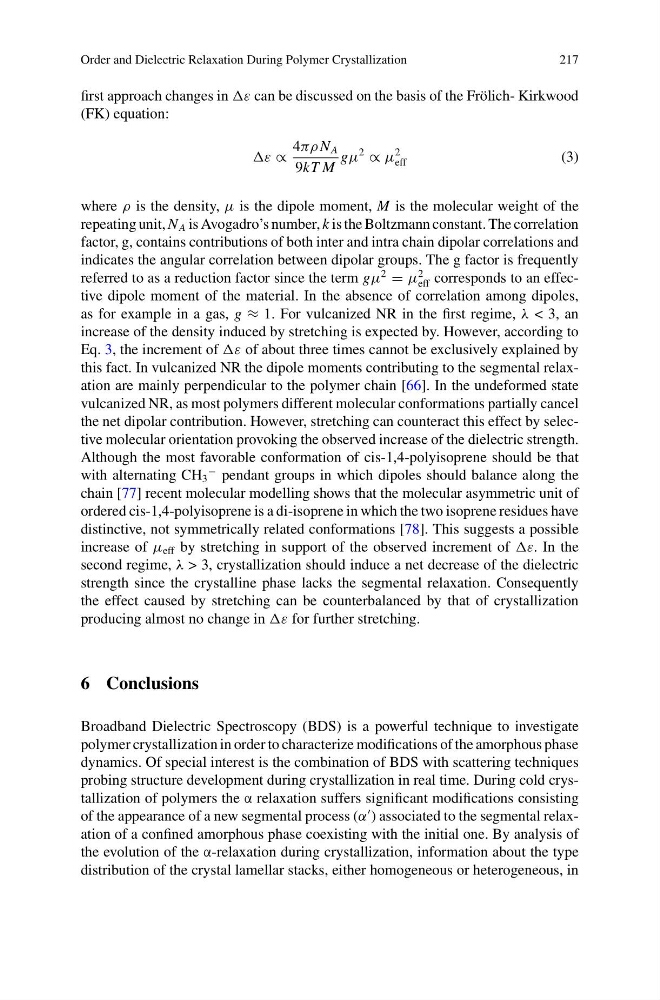
first approach changes in ε can be discussed on the basis of the Frölich- Kirkwood
(FK) equation:
ε ∝
4πρ N A
9kT M
gμ
2
∝ μ
2
eff
(3)
where ρ is the density, μ is the dipole moment, M is the molecular weight of the
repeating unit, N A is Avogadro’s number, k is the Boltzmann constant. The correlation
factor, g, contains contributions of both inter and intra chain dipolar correlations and
indicates the angular correlation between dipolar groups. The g factor is frequently
referred to as a reduction factor since the term gμ
2
= μ
2
eff corresponds to an effective dipole moment of the material. In the absence of correlation among dipoles,
as for example in a gas, g ≈ 1. For vulcanized NR in the first regime, λ < 3, an
increase of the density induced by stretching is expected by. However, according to
Eq. 3, the increment of ε of about three times cannot be exclusively explained by
this fact. In vulcanized NR the dipole moments contributing to the segmental relaxation are mainly perpendicular to the polymer chain [66]. In the undeformed state
vulcanized NR, as most polymers different molecular conformations partially cancel
the net dipolar contribution. However, stretching can counteract this effect by selective molecular orientation provoking the observed increase of the dielectric strength.
Although the most favorable conformation of cis-1,4-polyisoprene should be that
with alternating CH 3
− pendant groups in which dipoles should balance along the
chain [77] recent molecular modelling shows that the molecular asymmetric unit of
ordered cis-1,4-polyisoprene is a di-isoprene in which the two isoprene residues have
distinctive, not symmetrically related conformations [78]. This suggests a possible
increase of μ eff by stretching in support of the observed increment of ε. In the
second regime, λ > 3, crystallization should induce a net decrease of the dielectric
strength since the crystalline phase lacks the segmental relaxation. Consequently
the effect caused by stretching can be counterbalanced by that of crystallization
producing almost no change in ε for further stretching.
6 Conclusions
Broadband Dielectric Spectroscopy (BDS) is a powerful technique to investigate
polymer crystallization in order to characterize modifications of the amorphous phase
dynamics. Of special interest is the combination of BDS with scattering techniques
probing structure development during crystallization in real time. During cold crystallization of polymers the α relaxation suffers significant modifications consisting
of the appearance of a new segmental process (α
) associated to the segmental relaxation of a confined amorphous phase coexisting with the initial one. By analysis of
the evolution of the α-relaxation during crystallization, information about the type
distribution of the crystal lamellar stacks, either homogeneous or heterogeneous, in
217
first approach changes in ε can be discussed on the basis of the Frölich- Kirkwood
(FK) equation:
ε ∝
4πρ N A
9kT M
gμ
2
∝ μ
2
eff
(3)
where ρ is the density, μ is the dipole moment, M is the molecular weight of the
repeating unit, N A is Avogadro’s number, k is the Boltzmann constant. The correlation
factor, g, contains contributions of both inter and intra chain dipolar correlations and
indicates the angular correlation between dipolar groups. The g factor is frequently
referred to as a reduction factor since the term gμ
2
= μ
2
eff corresponds to an effective dipole moment of the material. In the absence of correlation among dipoles,
as for example in a gas, g ≈ 1. For vulcanized NR in the first regime, λ < 3, an
increase of the density induced by stretching is expected by. However, according to
Eq. 3, the increment of ε of about three times cannot be exclusively explained by
this fact. In vulcanized NR the dipole moments contributing to the segmental relaxation are mainly perpendicular to the polymer chain [66]. In the undeformed state
vulcanized NR, as most polymers different molecular conformations partially cancel
the net dipolar contribution. However, stretching can counteract this effect by selective molecular orientation provoking the observed increase of the dielectric strength.
Although the most favorable conformation of cis-1,4-polyisoprene should be that
with alternating CH 3
− pendant groups in which dipoles should balance along the
chain [77] recent molecular modelling shows that the molecular asymmetric unit of
ordered cis-1,4-polyisoprene is a di-isoprene in which the two isoprene residues have
distinctive, not symmetrically related conformations [78]. This suggests a possible
increase of μ eff by stretching in support of the observed increment of ε. In the
second regime, λ > 3, crystallization should induce a net decrease of the dielectric
strength since the crystalline phase lacks the segmental relaxation. Consequently
the effect caused by stretching can be counterbalanced by that of crystallization
producing almost no change in ε for further stretching.
6 Conclusions
Broadband Dielectric Spectroscopy (BDS) is a powerful technique to investigate
polymer crystallization in order to characterize modifications of the amorphous phase
dynamics. Of special interest is the combination of BDS with scattering techniques
probing structure development during crystallization in real time. During cold crystallization of polymers the α relaxation suffers significant modifications consisting
of the appearance of a new segmental process (α
) associated to the segmental relaxation of a confined amorphous phase coexisting with the initial one. By analysis of
the evolution of the α-relaxation during crystallization, information about the type
distribution of the crystal lamellar stacks, either homogeneous or heterogeneous, in