

Order and Dielectric Relaxation During Polymer Crystallization
211
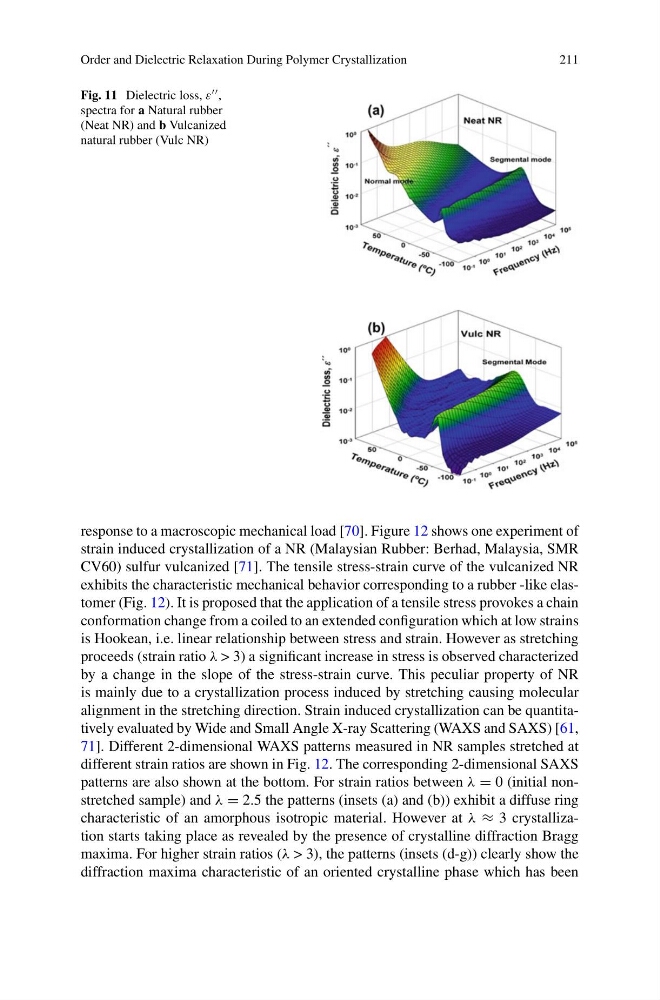
Fig. 11 Dielectric loss, ε ,
spectra for a Natural rubber
(Neat NR) and b Vulcanized
natural rubber (Vulc NR)
response to a macroscopic mechanical load [70]. Figure 12 shows one experiment of
strain induced crystallization of a NR (Malaysian Rubber: Berhad, Malaysia, SMR
CV60) sulfur vulcanized [71]. The tensile stress-strain curve of the vulcanized NR
exhibits the characteristic mechanical behavior corresponding to a rubber -like elastomer (Fig. 12). It is proposed that the application of a tensile stress provokes a chain
conformation change from a coiled to an extended configuration which at low strains
is Hookean, i.e. linear relationship between stress and strain. However as stretching
proceeds (strain ratio λ > 3) a significant increase in stress is observed characterized
by a change in the slope of the stress-strain curve. This peculiar property of NR
is mainly due to a crystallization process induced by stretching causing molecular
alignment in the stretching direction. Strain induced crystallization can be quantitatively evaluated by Wide and Small Angle X-ray Scattering (WAXS and SAXS) [61,
71]. Different 2-dimensional WAXS patterns measured in NR samples stretched at
different strain ratios are shown in Fig. 12. The corresponding 2-dimensional SAXS
patterns are also shown at the bottom. For strain ratios between λ = 0 (initial nonstretched sample) and λ = 2.5 the patterns (insets (a) and (b)) exhibit a diffuse ring
characteristic of an amorphous isotropic material. However at λ ≈ 3 crystallization starts taking place as revealed by the presence of crystalline diffraction Bragg
maxima. For higher strain ratios (λ > 3), the patterns (insets (d-g)) clearly show the
diffraction maxima characteristic of an oriented crystalline phase which has been
211
Fig. 11 Dielectric loss, ε ,
spectra for a Natural rubber
(Neat NR) and b Vulcanized
natural rubber (Vulc NR)
response to a macroscopic mechanical load [70]. Figure 12 shows one experiment of
strain induced crystallization of a NR (Malaysian Rubber: Berhad, Malaysia, SMR
CV60) sulfur vulcanized [71]. The tensile stress-strain curve of the vulcanized NR
exhibits the characteristic mechanical behavior corresponding to a rubber -like elastomer (Fig. 12). It is proposed that the application of a tensile stress provokes a chain
conformation change from a coiled to an extended configuration which at low strains
is Hookean, i.e. linear relationship between stress and strain. However as stretching
proceeds (strain ratio λ > 3) a significant increase in stress is observed characterized
by a change in the slope of the stress-strain curve. This peculiar property of NR
is mainly due to a crystallization process induced by stretching causing molecular
alignment in the stretching direction. Strain induced crystallization can be quantitatively evaluated by Wide and Small Angle X-ray Scattering (WAXS and SAXS) [61,
71]. Different 2-dimensional WAXS patterns measured in NR samples stretched at
different strain ratios are shown in Fig. 12. The corresponding 2-dimensional SAXS
patterns are also shown at the bottom. For strain ratios between λ = 0 (initial nonstretched sample) and λ = 2.5 the patterns (insets (a) and (b)) exhibit a diffuse ring
characteristic of an amorphous isotropic material. However at λ ≈ 3 crystallization starts taking place as revealed by the presence of crystalline diffraction Bragg
maxima. For higher strain ratios (λ > 3), the patterns (insets (d-g)) clearly show the
diffraction maxima characteristic of an oriented crystalline phase which has been