

188
S. Cerveny and J. Swenson
10
3
10
4
10
5
10
6
10
7
4
8
12
16
20
10
0
10
1
10
2
10
3
10
4
10
5
1
10
T = 215K
T = 180K
tc = 0 min
tc = 30 min
tc = 60 min
tc = 90 min
tc = 150 min
tc = 210 min
tc = 390 min
tc = 570 min
c w = 55wt%
f [Hz]
(b)
(a)
f [Hz]
ε´´
ε´´
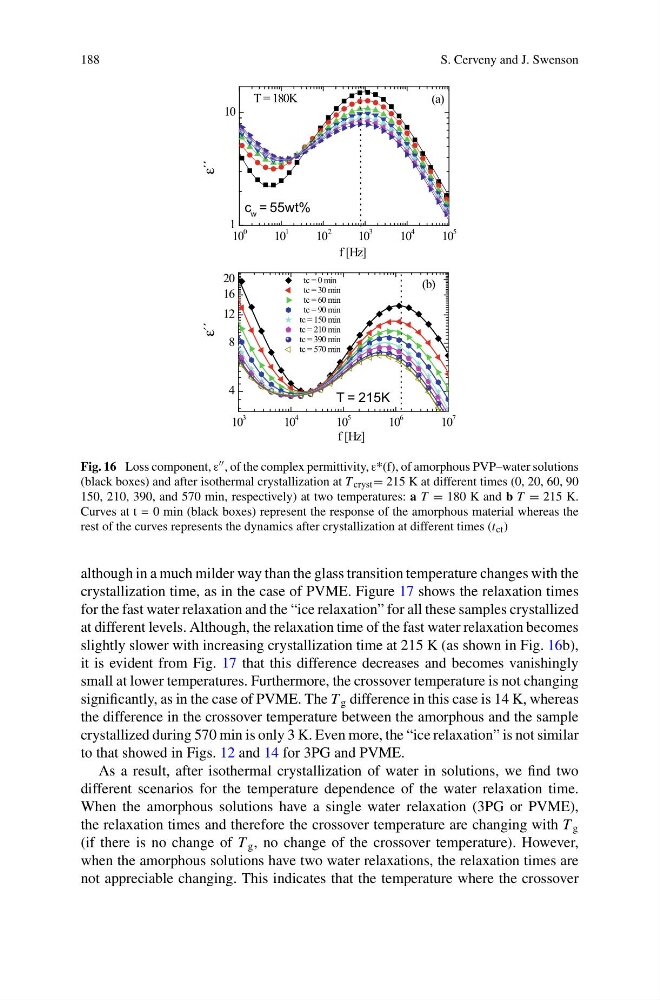
Fig. 16 Loss component, ε , of the complex permittivity, ε*(f), of amorphous PVP–water solutions
(black boxes) and after isothermal crystallization at T cryst = 215 K at different times (0, 20, 60, 90
150, 210, 390, and 570 min, respectively) at two temperatures: a T = 180 K and b T = 215 K.
Curves at t = 0 min (black boxes) represent the response of the amorphous material whereas the
rest of the curves represents the dynamics after crystallization at different times (t ct )
although in a much milder way than the glass transition temperature changes with the
crystallization time, as in the case of PVME. Figure 17 shows the relaxation times
for the fast water relaxation and the “ice relaxation” for all these samples crystallized
at different levels. Although, the relaxation time of the fast water relaxation becomes
slightly slower with increasing crystallization time at 215 K (as shown in Fig. 16b),
it is evident from Fig. 17 that this difference decreases and becomes vanishingly
small at lower temperatures. Furthermore, the crossover temperature is not changing
significantly, as in the case of PVME. The T g difference in this case is 14 K, whereas
the difference in the crossover temperature between the amorphous and the sample
crystallized during 570 min is only 3 K. Even more, the “ice relaxation” is not similar
to that showed in Figs. 12 and 14 for 3PG and PVME.
As a result, after isothermal crystallization of water in solutions, we find two
different scenarios for the temperature dependence of the water relaxation time.
When the amorphous solutions have a single water relaxation (3PG or PVME),
the relaxation times and therefore the crossover temperature are changing with T g
(if there is no change of T g , no change of the crossover temperature). However,
when the amorphous solutions have two water relaxations, the relaxation times are
not appreciable changing. This indicates that the temperature where the crossover
S. Cerveny and J. Swenson
10
3
10
4
10
5
10
6
10
7
4
8
12
16
20
10
0
10
1
10
2
10
3
10
4
10
5
1
10
T = 215K
T = 180K
tc = 0 min
tc = 30 min
tc = 60 min
tc = 90 min
tc = 150 min
tc = 210 min
tc = 390 min
tc = 570 min
c w = 55wt%
f [Hz]
(b)
(a)
f [Hz]
ε´´
ε´´
Fig. 16 Loss component, ε , of the complex permittivity, ε*(f), of amorphous PVP–water solutions
(black boxes) and after isothermal crystallization at T cryst = 215 K at different times (0, 20, 60, 90
150, 210, 390, and 570 min, respectively) at two temperatures: a T = 180 K and b T = 215 K.
Curves at t = 0 min (black boxes) represent the response of the amorphous material whereas the
rest of the curves represents the dynamics after crystallization at different times (t ct )
although in a much milder way than the glass transition temperature changes with the
crystallization time, as in the case of PVME. Figure 17 shows the relaxation times
for the fast water relaxation and the “ice relaxation” for all these samples crystallized
at different levels. Although, the relaxation time of the fast water relaxation becomes
slightly slower with increasing crystallization time at 215 K (as shown in Fig. 16b),
it is evident from Fig. 17 that this difference decreases and becomes vanishingly
small at lower temperatures. Furthermore, the crossover temperature is not changing
significantly, as in the case of PVME. The T g difference in this case is 14 K, whereas
the difference in the crossover temperature between the amorphous and the sample
crystallized during 570 min is only 3 K. Even more, the “ice relaxation” is not similar
to that showed in Figs. 12 and 14 for 3PG and PVME.
As a result, after isothermal crystallization of water in solutions, we find two
different scenarios for the temperature dependence of the water relaxation time.
When the amorphous solutions have a single water relaxation (3PG or PVME),
the relaxation times and therefore the crossover temperature are changing with T g
(if there is no change of T g , no change of the crossover temperature). However,
when the amorphous solutions have two water relaxations, the relaxation times are
not appreciable changing. This indicates that the temperature where the crossover